Tijdens mijn Belgische Zakkenreis in september 2023 was ik welkom voor een studiebezoek aan het War Heritage Institute in Brussel, waarbij ik meelzakken kon bekijken en bestuderen.[1] Enkele jaren geleden was een groot aantal meelzakken aangetroffen in een kist in het museumdepot; de zakken waren in slechte staat. Ik was benieuwd naar de voortgang daarmee.
Conservator Ilse Bogaerts informeerde me tevoren dat de inventarisatie van de gevonden zakken nog niet veel verder stond, maar dit sloot niet uit dat het museum de meelzakken zou tonen.
Vier dozen vol zakken Vier dozen vol zakken stonden gereed voor onderzoek. Ik schrok bij de eerste aanblik van de stapels bloemzakken.
Ze zijn kapot, rafelig, afgescheurd, of verrot, hebben waterschade vlekken, sommige zakken zijn wel in betere conditie. Meerdere maalderijmerken zijn verbleekt en onleesbaar; inscripties zijn verdwenen door het vergaan van het katoen.
Alle zakken zijn onbewerkt, het zijn originele katoenen zakken met Amerikaanse en Canadese bedrukkingen; er is geen enkele Belgische versiering van borduurwerk, kant of beschildering.
Doos met bloemzakken, 1914. Coll. WHI, Doos 2. Foto: auteur
De dozen zijn genummerd 2, 10 en 11, plus een ongenummerde doos met etiket ’70 bloemzakken totaal verrot’. Het etiket op doos 2 zegt:
BLOEMZAKKEN
23 ex verrot
16 ex idem 15 ex idem
54
Ik besluit doos 2 en de ongenummerde doos te laten voor wat het is en concentreer me op dozen 10 en 11.
Annelien van Kempen en Evelyn McMillan doen onderzoek naar de bloemzakken in het War Heritage Institute, Brussel, september 2023. Foto: auteur
Honderdvijfenzeventig zakken in vier uur Bekijken en bestuderen van katoenen zakken in dermate slechte staat is deprimerend. Gelukkig was Evelyn McMillan met mij meegekomen en samen konden we flink doorwerken om alle meelzakken te fotograferen.
We constateerden dat de restauratie-afdeling van het museum een huzarenstuk heeft verricht door de bloemzakken uit de kist in de afgelopen jaren presentabel te maken. Met de grootste voorzichtigheid hebben we het textiel uit de dozen getild om geen verdere scheuren te veroorzaken in de verteerde stoffen.
In vier uur tijd fotografeerde ik circa 175 bloemzakken, een snelheidsrecord! Toch heb ik met gemengde gevoelens het museum verlaten.
Beeldmerken op bloemzakken van Amerikaanse maalderijen, 1914. Coll. WHI, foto: auteur
Honderdvijfenzeventig maalderijen of inscripties Inmiddels is het enkele weken later. Ik ben bezig met de inventarisatie van de resultaten van mijn studiebezoek en word in weerwil van de slechte conditie van de zakken, steeds enthousiaster over mijn onderzoek.
Want wat blijkt: iedere meelzak is afkomstig van een andere maalderij of hulporganisatie. Alle bedrukkingen op de 175 bloemzakken zijn verschillend, de verzamelaar moet veel tijd hebben besteed aan het samenbrengen van deze meelzakken.
In het boek ‘Dans la Geôle Bruxelloise. Deux années sous le joug allemand‘ van Aline Burls, né Bouquié, is een verwijzing naar het verzamelen van zoveel mogelijk verschillende zakken: ‘…qu’il y avait des personnes qui en faisaient collection, et qu’un amateur en avait actuellement plus de 700 spécimens differents. Le Musée du Cinquantenaire en a rassemblé une collection superbe qui compte actuellement 300 exemplaires artistiquement travaillés.‘ (Er waren mensen die zakken verzamelden, een liefhebber had inmiddels meer dan 700 verschillende exemplaren verzameld. Het Jubelparkmuseum had een prachtige collectie samengesteld van 300 artistiek bewerkte exemplaren.’)
Bloemzak ‘Gopher Brand’, Cream of West, Red Wing Milling Co., Red Wing, Minnesota, 1914. Coll. WHI, foto: auteur
25 Amerikaanse staten en drie Canadese provincies De maalderijmerken en inscripties op de zakken tonen dat de bloemzakken afkomstig zijn uit 25 Amerikaanse staten: Californië, Colorado, Delaware, Idaho, Illinois, Iowa, Kansas, Kentucky, Michigan, Minnesota, Missouri, Montana, Nebraska, New York, North Dakota, Ohio, Oklahoma, Oregon, Pennsylvania, South Dakota, Tennessee, Utah, Virginia, Washington, Wisconsin; en drie Canadese provincies: Alberta, Ontario en Saskatoon.
Ik tel 48 bloemzakken met de inscriptie ‘Belgian Relief Flour’, ieder van een andere Amerikaanse maalderij.
Belgian Relief Flour Sacks van 48 verschillende Amerikaanse maalderijen, WHI collectie, foto’s auteur
De collectie bloemzakken van het War Heritage Institute is veruit de allergrootste in België en qua origine (geografie van Noord-Amerika, de toentertijd gevestigde maalderijen) de meest veelzijdige in de wereld; en dan heb ik de museumcollectie kleding, gemaakt van meelzakken, nog niet eens gezien en meegeteld.
‘Reserveer alle zakken met merknamen en inscripties’ Door de diversiteit van maalderijmerken en inscripties leg ik direct verband met de instructies in zomer 1915 van het Nationaal Komiteit voor Verkoop van Zakken uit Amerika: -Reserveer voor het Werk van de Oorlogswezen alle zakken van 45 en 22 kg, die bijna allemaal kleurrijk zijn bedrukt met merknamen en inscripties, waardoor ze waardevolle oorlogssouvenirs zijn. (Réserver à l’oeuvre des Orphelins de la Guerre tous les sacs de 45 et de 22 Kgs, lesquels sont presque tous décorés de vignettes et d’inscriptions qui en font de précieux souvenirs de guerre.)[2]
-Per merk zal een inventarisatie worden opgemaakt, die in kopie zal worden toegezonden aan het Speciaal Komiteit voor Verkoop van Zakken uit Amerika.[3]
Amerikaansche Zakken – Oorlogsgedenkenis – verkocht ten voordeele van de Oorlogswezen. Coll. WHI, foto: auteur
Werk der Oorlogswezen De WHI-bloemzakken bevestigen dat de instructies om de zakken te reserveren en te inventariseren zijn uitgevoerd. Hoeveel geld de bewaarde zakken als waardevolle oorlogssouvenirs voor het Werk der Oorlogswezen hebben opgebracht is nog te onderzoeken.
In ieder geval hoop ik maar dat het Werk der Oorlogswezen beter voor de verweesde kinderen zal hebben gezorgd in de naoorlogse jaren, dan ze voor deze kist met bloemzakken heeft gedaan.
Doos met bloemzakken, 1914. Coll. WHI, Doos 10. Foto: auteur
Materiële cultuur
Vanuit het oogpunt van materiële cultuur kunnen we anno 2023 de bloemzakken hoe dan ook beschouwen als waardevolle oorlogssouvenirs; de slechte staat en deprimerende aanblik neem ik voor lief.
Het scharen van de versierde bloemzakken onder de noemer trench art[4] biedt daarvoor de ruimte. Dit is wat Nicholas Saunders bedoelt met ‘Trench art’ (loopgravenkunst): ‘Trench art is oorlogskunst, zintuiglijk en tactiel, het roept herinneringen op.
De dozen met bloemzakken in het War Heritage Institute, inclusief de zwaar aangetaste, zijn vervreemdend, ze schuren, zijn ongemakkelijk. De meelzakken roepen een gevoel van ongeloof op.
Saunders noemt dat de kracht van trench art: het bergt spanning in zich, vangt de paradox van oorlog – ze vernietigt en creëert tegelijk.
Conclusie
Mijn studiebezoek aan het War Heritage Institute heeft de gelegenheid geboden de kist waardevolle oorlogssouvenirs te beschouwen en leverde een cruciale toevoeging aan de kennis over de geschiedenis van de WO I bloemzakken.
‘Zakken zijn vol herinneringen. Iedere zak koestert een kostbaar en kwetsbaar verhaal.’
Dank
Mijn hartelijke dank aan de medewerkers van het War Heritage Institute in Brussel, in het bijzonder Ilse Bogaerts en Peter de Groot, om mij gastvrijheid te bieden voor mijn zakkenonderzoek en om de voorbereidingen die zij daarvoor getroffen hebben.
Bloemzak Jack Canuck Flour donated to The Belgians by North Norwich Township manufactured by Wood Flour Mills, Norwich, Canada. Geborduurd kussen. WHI 201600410. Foto: auteur
[2] Brief Georges Pètre, voorzitter CNSA Komiteit voor Verkoop van Zakken uit Amerika, aan het departement Hulp van CNSA/NKHV, 11 augustus 1915. A.R. CNSA/NHVC 1117
[3] Notitie G. Pètre, 5 oktober 1915. A.R. CNSA/NHVC 1117.
[4] De door mij gehanteerde definitie van trench art, toegepast op de versierde meelzakken, is: “items gemaakt door burgers, rechtstreeks uit materiaal dat in tijd en plaats wordt geassocieerd met de gevolgen van gewapend conflict”. Lees ook mijn blog ‘Trench art en de versierde meelzakken’, 23 juni 2023
Mijn onderzoek in het Algemeen Rijksarchief, Brussel, september 2023
Op Zakkenreis in België heb ik dan eindelijk mijn hand kunnen leggen op het dossier dat de bureaucratische inmenging van het Nationaal Komiteit voor Hulp en Voeding (CNSA/NKHV) op de bloemzakken etaleert.
Het Algemeen Rijksarchief te Brussel bewaart het dossier ‘Utilisation des Sacs Vides’ (Gebruik van de Lege Zakken) waarin de correspondentie van het speciaal benoemde ‘Comité de Vente des Sacs d’Amérique’.[1]
Comité de Vente des Sacs d’Amérique Het Comité de Vente des Sacs d’Amérique (Komiteit voor Verkoop van Zakken uit Amerika) werd opgericht in mei/juni 1915 en was een onderdeel van de Département Secours/Hulp van het Nationaal Komiteit, gevestigd 66, Rue des Colonies, 2e etage.
Briefpapier met briefhoofd ‘Vente des Sacs d’Amérique au profit des Orphelins de la Guerre’. A.R., foto: auteur
Voorzitter van het Comité was Georges Pètre, 41 jaar, schepen van St. Joost-ten-Node.[2] Het ultieme doel van het comité was de opbrengst van de zakkenverkoop ten goede te laten komen aan het Werk voor de Oorlogswezen.
Daarvoor was nodig dat Pètre over de lege zakken zou beschikken, ze kon laten schoonmaken – hij vreesde voor schade door muizen en meelwormen- en dat werkloze vrouwen de zakken met fabrieksmerken borduurden. De zakken bedrukt met ‘inscripties’ wilde hij vooral bewaren omdat ze later veel geld zouden opbrengen als oorlogssouvenirs. Om aan de hoogste prijs te komen zou het Comité een monopolie over de zakken voeren om concurrentie uit te sluiten.[3]
Bloemzak met inscriptie ‘Donated by Belgian Food Relief Committee’, Chicago, Illinois, 1914/15, coll. WHI, foto: auteurBloemzak met maalderijmerk ‘Excelsior’, Bison, Kansas, 1914/15, coll. WHI, foto: auteur
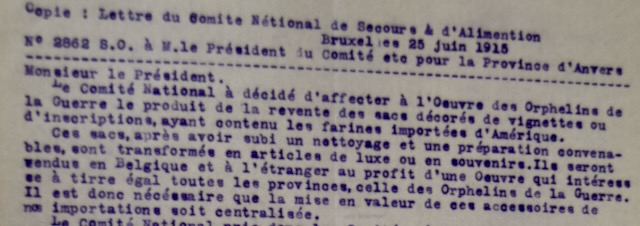
Centralisatie Het Département Secours/Hulp van het Nationaal Komiteit stuurde een brief aan de Provinciale Komiteiten[4]:
“Het Nationaal Komiteit heeft besloten de opbrengst van de wederverkoop van zakken versierd met merken van maalderijen of inscripties, waarin uit Amerika geïmporteerd meel verpakt zat, toe te wijzen aan het Werk van de Oorlogswezen. Deze zakken worden, na een goede reiniging en met de nodige voorbereiding, getransformeerd tot luxeartikelen of tot souvenirs. Ze zullen in België en in het buitenland verkocht worden ten behoeve van het Werk dat van gelijk belang is voor alle provincies, dat van de Oorlogswezen. Daarom is het noodzakelijk dat het opwerken van deze bijproducten van onze import wordt gecentraliseerd. Het Nationaal Komiteit verzoekt de Provinciale Komiteiten om alle zakken voorzien van een Amerikaans merk, een maalderijnaam of een inscriptie, op te halen en terug te sturen naar het adres van het Nationaal Komiteit te Brussel, op de meest directe en goedkope manier.
We verzoeken u maatregelen te nemen om de zakken die bij bakkerijen zijn achtergebleven uit de circulatie te halen; of op zijn minst de merktekens die op de zakken staan te verwijderen:
– om te voorkomen dat speculanten ze in bezit krijgen om ze voor eigen winst en ten koste van het Werk van de Oorlogswezen te verkopen;
– of om ze te gebruiken voor het verpakken van binnenlands meel, wat tot gevolg zou hebben dat, in het hele land, voor de huidige, toegestane meelsoorten het geldende controlesysteem ineffectief zal blijken te zijn.
Het Nationaal Komiteit verzoekt de Provinciale Komiteiten om vóór 15 juni[5] een nota te sturen over de maatregelen die zijn genomen om de centralisatie in Brussel te verzekeren van alle Amerikaanse zakken met merken van maalderijen en inscripties.”
Stapels lege meelzakken van 1915, bewaard in het War Heritage Institute, Brussel. Foto: auteur
Het Komiteit te Brussel leverde tweeduizend zakken Het Komiteit in Brussel gaf gehoor aan het verzoek tot retourzending.
“Wij hebben de eer u mede te delen dat wij in ons meelmagazijn ongeveer 2.000 bedrukte zakken tot uw beschikking houden, waarvan wij u vragen deze tegen ontvangstbewijs af te laten halen. Het afhalen dient plaats te vinden in de middag tussen twee en vier uur; de ochtend is gereserveerd voor de distributie van meel.”[6]
Zakken-monopolie
Stempel van het Werk voor de Krijgsgevangenen in Namen. A.R., foto:auteur
Het monopolie van de zakkenverkoop voor het Werk van de Oorlogswezen betekende dat andere liefdadigheidswerken, ook werkzaam binnen het Departement Hulp van het Nationaal Komiteit, het verbod kregen, gebruik te maken van de Amerikaanse zakken.
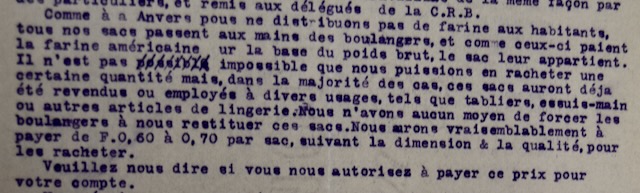
Bijvoorbeeld, het Werk voor de Krijgsgevangenen in Namen kwam bedrogen uit. “Naar aanleiding van uw brief van 8 juli hebben wij de eer u mede te delen dat wij het zeer betreuren dat wij geen gevolg kunnen geven aan uw verzoek om lege bloemzakken te bekomen voor het verpakken van pakketten bestemd voor krijgsgevangenen.
Alle zakken zijn zonder uitzondering volledig gereserveerd voor het Werk van de Oorlogswezen.”[7]
Anderzijds gaf het Nationaal Komiteit wel toestemming voor de verkoop, ten behoeve van het Provinciaal Komiteit van Henegouwen, van lege zakken zonder bedrukking; de zakken waren bestemd voor kledingproduktie.[8]
Bloemzak met maalderijmerk ‘Queen of Roses’, P. Haines & Son, Clarksburg, Ontario, 1914/15, coll. WHI, foto: auteur
Te laat De eerste oekaze van het Nationaal Komiteit tot centralisatie van de bloemzakken kwam in juni 1915 overduidelijk te laat. Sinds februari/maart 1915 was het versieren van de bloemzakken uitgegroeid tot een rage doorheen België. Vrouwenorganisaties, meisjesscholen, kloosterscholen en kunstenaars bewerkten de meelzakken met borduurwerk, naald- en kantwerk en beschilderingen en organiseerden tentoonstellingen waarbij de opbrengst ten goede kwam aan ieders lokale, charitatieve doelen.
Onrealistisch
Het was niet realistisch de lege zakken uit alle provincies te verzamelen en toe te sturen aan één magazijn in Brussel terwijl de Duitse bezetter talloze formaliteiten oplegde aan verplaatsingen en transport van goederen. Bovendien waren beide departmenten Voeding én Hulp van het Nationaal Komiteit, evenals die van de provinciale komiteiten, betrokken en vereisten afstemming. De zakken waren bijprodukten van de importgoederen (‘accessoires de nos importations’), die import was de verantwoordelijkheid van het Departement Alimentation/Voeding, zij organiseerden de logistiek. Het komiteit van de zakkenverkoop acteerde onder het Departement Hulp – ze ontbeerde de logistieke lijnen, had geen relatie met bakkerijen, maalderijen, transportmiddelen.
Meneer Pètre was dus afhankelijk van de goedwillendheid van de komiteiten, of zij aan zijn opeisingen tegemoet wilden komen.
Algemeen genomen werkten de provinciale komiteiten expliciet, of stilzwijgend, niet mee aan de centralisering. Het Provinciaal Komiteit Antwerpen verzette zich schriftelijk tegen de instructies.
Bloemzak met maalderijmerk ‘Monogram’, Globe Mills, Los Angeles, Californië, 1914/15, coll. WHI, foto: auteur
Nieuwe instructies Georges Pètre deed een volgende poging tot centralisatie en monopolisering. Hij stelde nieuwe instructies op, omdat het absoluut noodzakelijk was zijn oorlogssouvenirs veilig te stellen en een einde te maken aan speculatie en de handelspraktijken van wederverkopers.
Handgeschreven notitie Georges Pètre aan Emmanuel Janssen, 5 oktober 1915. A.R., foto: auteur
Toch bleek Pètre rekening te moeten houden met de diverse belangen[9] – zijn nieuwe instructies stonden bol van de compromissen en waren realistischer. In plaats van materiële centralisatie verschoof de instructie naar financiële verplichtingen.
“Het Nationaal Comité heeft besloten dat de opbrengst van de verkoop van de Amerikaanse zakken zal worden besteed aan het Werk van de Oorlogswezen. Deze beslissing wordt vooral gerechtvaardigd door het feit dat de genoemde zakken na de oorlog een zeer bijzondere waarde zullen vertegenwoordigen als oorlogssouvenirs. Het was dan ook logisch om de opbrengst toe te wijzen aan een Werk waarvan de werking zich overeen lange reeks van jaren zal uitstrekken.
Bepaalde provinciale komiteiten hebben de gegeven instructies niet opgevolgd en stelden de Amerikaanse zakken, voorzien van maalderijmerken en inscripties, beschikbaar voor andere werken, bijvoorbeeld het Werk voor de Krijgsgevangenen.
Deze uitzonderingen op het door het Nationaal Komiteit uitgevaardigde besluit kunnen worden getolereerd, op voorwaarde dat de volgende regels strikt worden nageleefd:
1) Zakken die vanwege hun afmetingen gebruikt kunnen worden voor het verpakken van de I9I5-oogst, worden uitsluitend voor dit doel bestemd.
2) Andere werken dan die van de Oorlogswezen kunnen nooit meer dan de helft van de zakken ontvangen die ter beschikking staan voor de provinciale komiteiten. Per merk zal een inventarisatie worden opgemaakt, die in kopie zal worden toegezonden aan het Speciaal Komiteit voor Verkoop van Zakken uit Amerika (66, Koloniënstraat in Brussel, 2d.). Van elk geïnventariseerd merk zal de helft worden gereserveerd ten behoeve van het Werk der Oorlogswezen.
Bloemzak met maalderijmerk ‘Good Luck’, John Ferns, Butte, Montana, 1914/15, coll. WHI, foto: auteur
3) Charitatieve Werken ontvangen alleen zakken op voorwaarde dat zij uitdrukkelijk beloven deze via de detailhandel te verkopen. Zij kunnen de zakken onder geen beding aan wederverkopers overdragen.
4) De regionale en lokale komiteiten kunnen zich niet ontdoen van de zakken die zij in bezit hebben. Ze moeten deze teruggeven aan de Provinciale Komiteiten, die eveneens zorg zullen dragen voor de teruggave van bloemzakken aanwezig bij maalderijen.
5) De organisaties die gemachtigd zijn om zakken als detailhandel te verkopen, zijn verplicht minimumprijzen vast te stellen en deze mee te delen aan het Komiteit voor Verkoop van Zakken uit Amerika.
Deze laatste heeft het recht om, indien het Komiteit dit nuttig acht, zakken terug te kopen tegen de aangegeven minimumprijs.”[10]
Bloemzak met maalderijmerk ‘White River’, Wasco Warehouse Milling Co., The Dalles, Oregon, 1914/15, coll. WHI, foto: auteur
Concurrentie Enkele lokale komiteiten in Brussel voegden zich niet naar de regels. Pètre constateerde overtredingen, met name van het komiteit in Sint-Gillis.
“Ik heb reden om te vrezen dat bepaalde lokale komiteiten, als ze zich onze eerdere instructies herinneren, een tegenstrijdigheid ervaren tussen de laatste instructies en de eerdere instructies die we hen hebben gegeven met betrekking tot zakken versierd met merknamen en inscripties. Vanwege deze tegenstrijdigheid negeren ze de huidige regels, zodat ze zakken op voorraad houden dan wel ze met winstoogmerk in de detailhandel doorverkopen, zoals het Komiteit van Sint-Gillis blijft doen.
Daarom wil ik u verzoeken in uw hoedanigheid van voorzitter van het ‘Departement Hulp’ een speciaal bericht naar de lokale komiteiten te sturen waarin u hen vertelt dat de instructies van het Nationaal Komiteit zonder onderscheid van toepassing zijn op alle zakken en dat ze allemaal -zonder uitzondering- moeten worden geretourneerd naar de Intercommunale Coöperatie van het Provinciaal Komiteit. Deze zal de interessante zakken – niet nodig voor utilitair gebruik- toewijzen aan het Werk van de Oorlogswezen.
Bloemzak met maalderijmerk ‘Baby-Face, Western Queen Flour’,Western Flour Mill Co., Davenport, Iowa, 1914/15, coll. WHI, foto: auteur
Gent, Namen en anderen doen in 1916 en later mee Het Provinciaal Komiteit Oost-Vlaanderen stortte de winst van hun lokale zakkenverkoop, 3500 franken, op rekening van het Werk van de Oorlogswezen. Het komiteit van Namen deed hetzelfde, het stortte 500 franken. Bergen en Charleroi gaven meldingen van zakkenverkoop in 1917.
Notulen Werk der Oorlogsweezen, 17 januari 1916. AR CNSA/NHVC I 446-285. Foto: auteur
Schenking lege meelzakken aan Museum Elsene in 1917
In najaar 1917 deed de lokale afdeling van het Nationaal Voedingskomiteit in Elsene een opmerkelijk aanbod aan het plaatselijke college van burgemeester en schepenen. Het komiteit had nog een voorraad lege Amerikaanse meelzakken in de magazijnen opgeslagen en wilde deze overdragen aan het gemeentelijke museum in Elsene. Het aanbod werd volgaarne geaccepteerd: ‘Leur exposition dans ce local, constituera en effet pour Ixelles un souvenir de la douloureuse période que nous traversons.’
Een lijst van 76 verschillende meelzakken was bijgesloten. De lijst rangschikte de zakken op inhoudsmaten van 10, 40, 50 of 100 kg en vermeldde de merknamen van het meel, zoals gedrukt op de zakken. Blijkbaar had het lokale voedingskomiteit in 1915 met zorg, conform instructie van de heer Pêtre, een collectie verschillende zakken bijeen verzameld. Deze werden niet langer voor de oorlogswezen bewaard, maar als souvenirs aan het museum overgedragen. [11A]
Schorten De Brusselse medewerksters in de kantines voor kinderen met een beperking verzochten in 1918 om nieuwe schorten ter vervanging van de schorten die ze al drie jaar droegen en versleten waren. Hun idee was om kosten en grondstoffen te besparen en de schorten zelf te maken van Amerikaanse zakken.[12]
Het antwoord bevindt zich niet in het dossier ‘Utilisation des Sacs Vides’. Of de zakken hen ter beschikking zijn gesteld blijft dan ook de vraag.
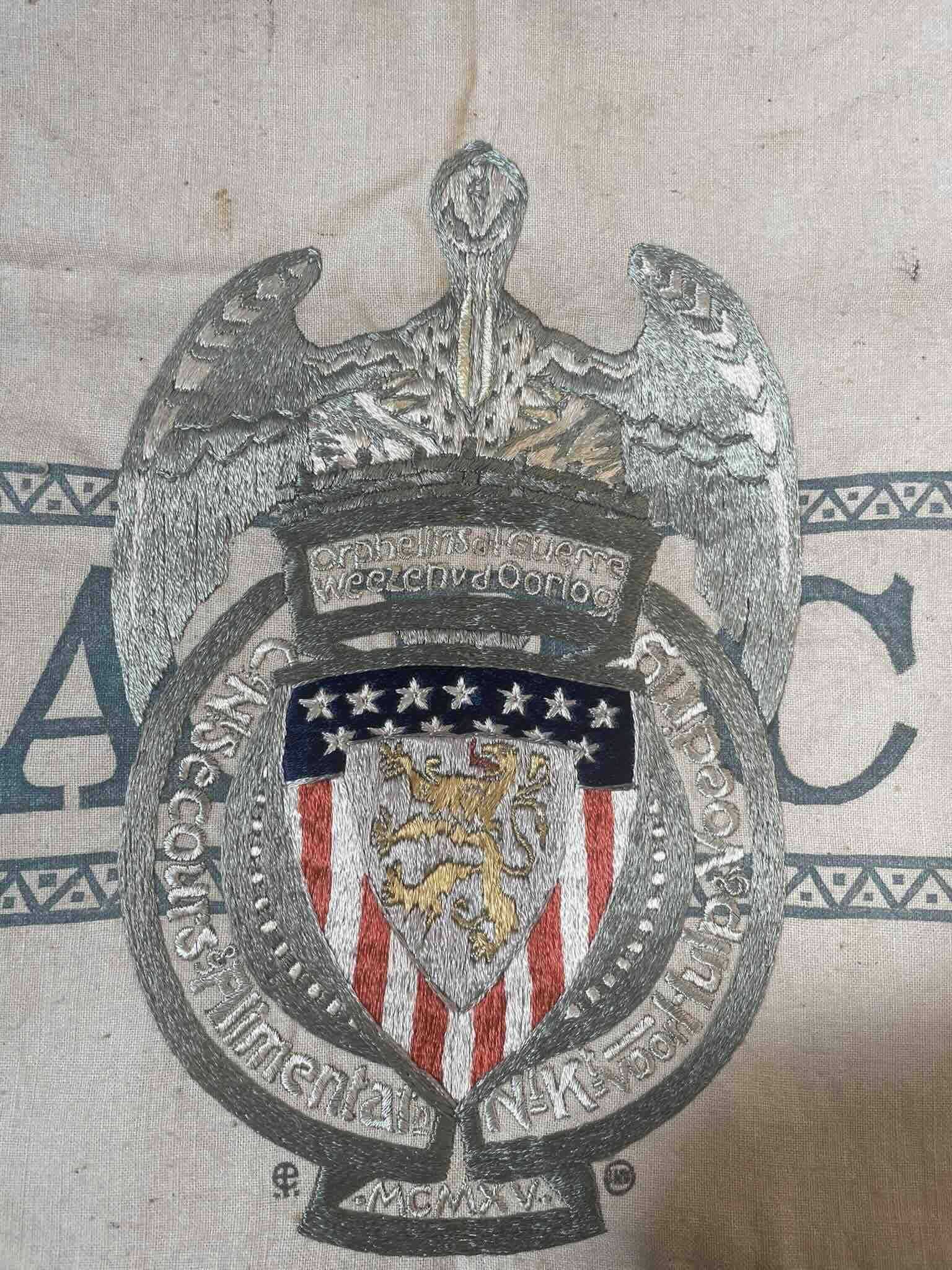
Stempel met beeldmerk Pelikaan met jongen, ‘Orphelins de la Guerre – Weezen van de Oorlog’, CNSA – NKHV, 1914-1918. Bloemzak ‘Chicago’s Flour Gift’, beschilderd, waarschijnlijk 1937/38. Geschenk Pierre Beeckmans aan Herbert Hoover. Coll. HHPLM 65.27.13, foto: auteurPelikaan met jongen, ‘Orphelins de la Guerre/Weezen van de Oorlog’, beeldmerk geborduurd op meelzak met inscriptie ‘ABC’ (mogelijkerwijs 1937/38?). Part. coll. België.
Conclusie Het bureaucratische optreden van het Nationaal Komiteit, in het bijzonder van de voorzitter van het Komiteit voor Verkoop van Zakken uit Amerika, richtte zich op centralisatie en monopolisering van de zakkenverkoop. De zakken waren oorlogsgedenkenis en moesten bewaard voor later, bestemd voor het Werk der Oorlogswezen.[13]
Zou dit beleid de opbrengsten voor het Werk van de Oorlogswezen na de oorlog omhoog hebben gestuwd? Of heeft het tijdens de oorlog de spontaniteit van het hergebruik en versieren van de bloemzakken doorheen België gefrustreerd?
Bloemzak met inscriptie 1914/15, coll. WHI, foto: auteur
Dank aan Hubert Bovens te Wilsele voor de opzoekingen van biografische aard.
Voetnoten: [1] Algemeen Rijksarchief, Archives de la Guerre. CNSA/NHVC (I 446) 1117 ‘Utilisation des Sacs Vides’.
[2] Georges Augustin François Pètre (St. Joost-ten-Node 29-05-1874 – St. Joost-ten-Node 31-12-1942) was advocaat en gemeenteraadslid toen hij huwde met Jeanne Puttemans (St. Joost-ten-Node 18-02-1882) op 23 april 1908 te St. Joost-ten-Node. Georges Pètre was burgemeester van St. Joost-ten-Node van 1926-1942. Tijdens WO II, op 31 december 1942, werd hij vermoord door het doodseskader van Robert Verbelen, als eerste slachtoffer in een reeks ‘vergeldingsmoorden’.
[3] Georges Pètre aan Emmanuel Janssen, 24 juni 1915. A.R. CNSA/NHVC 1117.
[4] Brief van NKHV, Brussel, aan de voorzitter van het Provinciaal Komiteit Antwerpen van 25 juni 1915. FelixArchief, Antwerpen, ‘De Amerikaansche Zak’, 2210#268.
[5] Merkwaardige datum 15 juni, want de brief was van 25 juni, misschien is bedoeld 15 juli?
[6] Brief Komiteit Brussel aan CNSA département Vente de Sacs Ornés au Profit des Orphelins de la Guerre, 2 augustus 1915. A.R. CNSA/NHVC 1117.
[7] Brief NKHV aan Comité National de renseignements pour les familles des prisonniers de la guerre, Namur, 13 juli 1915. A.R. CNSA/NHVC 1117.
[8] Notitie september 1915 – Voir correspondance classée sous ‘Hainaut Vêtements’. A.R. CNSA/NHVC 1117.
[9] Handgeschreven notitie G. Pètre aan E. Janssen, 5 oktober 1915. A.R. CNSA/NHVC 1117.
[10] Notitie G. Pètre, 5 oktober 1915. A.R. CNSA/NHVC 1117.
[11] Brief G. Pètre aan E. Janssen, 5 december 1915. A.R. CNSA/NHVC 1117.
[11A] Astrid Herkens van Museum Elsene heeft in het archief van het museum de verwijzingen gevonden naar deze schenking van zakken van het Comité National in 1917. Het betreft vier brieven van resp. 31 oktober en 3 november 1917 en 25 en 29 januari 1918.
De zakken in kwestie heeft ze echter nooit in de collectie gezien. Het is onbekend of ze doorheen de jaren effectief bewaard zijn gebleven.
[12] Notitie van E. Michel aan het Nationaal Komiteit, Brussel, 30 januari 1918. A.R. CNSA/NHVC 1117.
Het War Heritage Institute bewaart honderden bloemzakken, aangetroffen in een kist, die de zakken niet goed heeft geconserveerd. Mogelijk zijn deze bloemzakken afkomstig uit de voorraad die was aangelegd voor het Werk der Oorlogswezen. Lees het blog: Een kist waardevolle oorlogssouvenirs in het War Heritage Institute.
Aline Burls, né Bouquié, beschreef in 1917 de verzamelwoede als volgt:
‘Er waren mensen die zakken verzamelden, een liefhebber had inmiddels meer dan 700 verschillende exemplaren verzameld.
Het Jubelparkmuseum had een prachtige collectie samengesteld van 300 artistiek bewerkte exemplaren.’
(Burls, Aline, né Bouquié, Dans la Geôle Bruxelloise. Deux années sous le joug allemand. 1917, p. 176, 177)
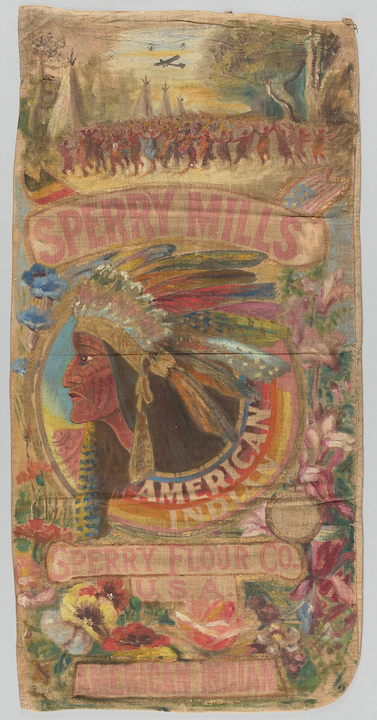
Postkaart Editions Maeck ‘WEAT FLOUR’ American Indian, U.S.A., 1915. Coll. HILA Alice Aron Gugenheim papers, foto: E. McMillan
Rondom het portret van de American Indian op deze postkaart schreef Alice Gugenheim-Aaron jaren na de Wapenstilstand:
‘Le Sac qui brodé eût le succès – 1914 – à Bruxelles! (De Zak die geborduurd hèt succes was – 1914 – Brussel).
Wrange geschiedenis
Het succes van de geborduurde meelzak met de American Indian voelt ongemakkelijk. De zak draagt een historie die belicht moet worden. Het wijst ons op de wrange geschiedenis van de Native Americans, de oorspronkelijke inwoners van het Amerikaanse continent; ze zijn verjaagd, vermoord, in reservaten geplaatst. Ook in 1915 was men zich in België terdege bewust van het onrecht dat Native Americans was en werd aangedaan blijkt uit onderstaande dagboeknotitie.
Karel van de Woestijne, december 1915 De Nederlandse correspondent van de Nieuwe Rotterdamsche Courant in Brussel, Karel van de Woestijne, schreef in zijn dagboek op 26 december 1915 over het bezoek van een vriend uit Wetteren, een provincieplaats in Oost-Vlaanderen. De vriend begreep niets van de schijnvreugde waarmee de bewoners van de hoofdstad gegeven de omstandigheden het Vrede-op-Aarde vierden; “omdat eene oprechte verveling, ook op Kerstmis, dan toch nog beter is”.
Nieuw afgoderij – uwe Roodhuiden-vereering De bezoeker uit Wetteren, had in Brussel rondgelopen en was hogelijk verbaasd. -Nóg iets dat ik van de Brusselaars niet kan begrijpen, en dat ten onzent zeker niet mogelijk zou zijn: dat is hunne nieuwe afgoderij, die ze nu juist op Kerstmis ten toon gaan spreiden.’
Mijne oogen moeten al heel verwonderd hebben gestaan, want mijn makker vervolgde, niet zonder ongeduld in de fraaie baryton-stem: ‘Wel ja, uwe Roodhuiden-vereering! Ik kom een winkel binnen: de juffer heeft een schort voor, dat versierd is met het wel-gelijkend konterfeitsel van zoo’n Sioux. Ik vraag, dat zij mij de laatste noviteiten toonen zou, in zake dames-snuisterijen: zij legt mij allerlei doosjes voor, waar dezelfde Comanche zijn facie op vertoont. Ik wil, voor mijn meisje, wat pralines koopen: van op het zakje grimt mij dezelfde authentieke Apache tegen. Ik ontmoet hem bij den banketbakker; ik zie hem bij den juwelier; hij maakt den slagerswinkel onveilig en den sigarenwinkel verdacht; en toen ik aan uwe deur belde, dan had ik maar ééne vrees: dat hij mij zou komen opendoen!’
Twee bloemzakken Sperry Mills – American Indian in originele staat en geborduurd, 1914/1915. Coll. en foto: auteur
Fetisjisme of erkentelijkheidsteken Van de Woestijne vervolgt:
Ik begreep wat hij bedoelde. Lachend zei ik hem: – ‘Maar jongen, dat is geen fetisjisme: ten hoogste de synecdoche der dankbaarheid! Niets, mijn waarde, dan een erkentelijkheidsteeken!’ Hij bezag mij met argwaan. Ik vertelde hem toen, dat, zoo de Roodhuid tegenwoordig de sterveling is die zich te Brussel in de minst-vermengde sympathie mag verheugen en kan bogen op eene populariteit, zooals hij er geene meer had gekend sedert den tijd van Fenimore Cooper en Gustave Aymard, dit ligt aan de boterhammen die wij eten. En daar ik merkte dat deze verklaring hem niet voldeed, zette ik ze voort in deze voege:
Bloemzak Sperry Mills – American Indian geborduurd, 1915. Coll. auteur, foto: M.Ensing
– ‘’t Brood dat wij eten, mijn vriend, is gemaakt van meel; dat meel wordt ons vriendelijk toegestuurd in zakken; en op die zakken prijkt weleens zoo’n Roodhuid, omdat zoo’n zak als meel ons toekomen uit Amerika. Nu is men van die meelzakken eerst kussens en teacosies, daarna damesschorten, en eindelijk allerlei zaken gaan maken, die, utile dulci, bij hunne sierlijkheid er steeds aan herinneren zouden wat wij aan de Vereenigde-Staten verschuldigd zijn. Maar dit was niet alles, mijn vriend. Kent gij de aesthetica van het ornament? Zoo ja, dan zult gij niet zijn zonder te weten, dat het lengerhand zijne aanvankelijke nuttigheidsbestemming verliest, om weldra niet meer dan decoratief te worden en van lieverlede zelfs toegepast op voorwerpen, waar het geenszins op hoort. Aldus onze Roodhuid in zijne tallooze verschijningen: geen fetisj dus, gelijk gij denken zoudt; alleen een teeken, nogal verkeerd toegepast, en dat reeds zijne beteekenis aan het verliezen is, van onze dankbaarheid aan het Amerikaansche volk, waarvan deze Sioux het verkorte beeld of – om het aldus te noemen – de synecdoche is.
Indians Residing in New York -.- For Belgians. Aquarel op papier. Coll. Keym, ca. 1915. Stadsarchief Brussel. Foto: auteur
Brusselsche lichtzinnigheid – ‘En is uncle Sam, die zijn best heeft gedaan om die Rooden uit te roeien, met die vereenzelviging tevreden?’ ondervroeg mijn vriend. Ik zag mij verplicht hem te antwoorden, daaromtrent geen onderzoek te hebben ingesteld. Hij mompelde iets van Brusselsche lichtzinnigheid, en wenschte mij goeden avond. Ik vrees dat hij van zijn bezoek aan Brussel geen gunstige herinnering draagt.” [2]
Kalender 1916 met zakje ‘Sperry Mills-American Indian, maandag 28 februari, ‘1914-1915 pendant l’occupation’, C. Du Prez. Coll. Stadsarchief Brussel. Foto: auteur
Conclusie De stem van Native Americans is gehoord geweest in België in 1915.
Nu de Amerikaanse bloemzakken, bewerkt in België, al een eeuw lang blijvend hun populariteit houden, ‘de afgoderij in Brussel – de Roodhuiden-vereering’ zich voortzet, dienen we ons te vereenzelvigen met het onbegrip van de vriend uit Wetteren en de tragische geschiedenis van de Native Americans te blijven vertellen. De zakken blijven een teken, verkeerd toegepast, van de Belgische dankbaarheid aan het Amerikaanse volk voor het meel dat de Belgen is toegekomen.
Kalender 1917 met zakje ‘Far West-Best American Flour’. Coll. Stadsarchief Brussel. Foto: auteur
Dank aan
– Evelyn McMillan voor het raadplegen van de Alice Aron Gugenheim papers in de Hoover Institution Library & Archives en het delen van foto’s en informatie.
– Hubert Bovens te Wilsele voor de opzoekingen van biografische gegevens.
– Mechel Ensing-Wijn voor haar intermediaire en logistieke diensten.
Voetnoten: [1] Editions Maeck: MAECK-JAMINON imprimeur litho-typographe, rue Jolly 129, Schaarbeek. Antoine Maeck, ºBrussel 19-06-1879.
Alice Gugenheim-Aaron. photo taken in 1924 at age 54. HILA Gugenheim (Alice Aron) Papers coll. nr. 61012. Foto: EMcM
On August 22nd, 1914, because of the war hundreds of buildings in the center of Charleroi were destroyed in a fire. Les Magasins Raphaël went up in flames. The owner of the department store, the Raphaël Gugenheim-Aaron family, scrambled from the ruins. Within a year they would sell the decorated Belgian relief flour sacks with great dedication for the benefit of the Comité National de Secours et d’Alimentation (CNSA).
The elements of this story are purely Belgian, although they have reached me through contacts with multiple American institutions.
The history is fascinating, but by no means complete; hence I have written this blog.
Department store with embroidery thread In September 2018 I found an online source about a Belgian department store with embroidery thread owned by the Gugenheim family in Charleroi, province Hainaut. [1]
‘In Charleroi, Belgium, Alice Gugenheim’s family had a warehouse of embroidery thread which had been used by the embroidery workers prior to the war. Because of the war there was no material to embroider, and the workers were out of business. She could find no bleach to remove the writing on the flour sacks, but the fabric was good and strong. Women began enhancing the designs which were used to cover lampshades, waste baskets, tea cozies, pillow covers and even school smocks. The items were sold on a prominent street in Brussels and yielded tens of thousands of gold-standard francs to the Belgium Relief.’
Remarkably, Alice Gugenheim had tried to bleach the Belgian relief flour sacks to remove the printing but was unsuccessful. Then the women had used the prints as patterns.
To know more I contacted the author of the article and asked “who was/is Alice Gugenheim and family who had the warehouse of embroidery thread in Charleroi? Where can I find more information about her?!”
The author, Polly Horn from Sunbury, Ohio, only remembered that the information came from the Hoover Institution in California.
Occupied with other priorities I dropped the subject.
Gugenheim (Alice Aron) Papers [2] On June 1st, 2022, I was doing research at the Hoover Institution Library & Archives (HILA) in California and received a message with photo included from Samira Bozorgi [3] : “One other reference photo of mine from the Alice Gugenheim Papers”.
Saleswomen at the display of decorated flour sacks. The sale is for the benefit of the CNSA. HILA Gugenheim (Alice Aron) Papers coll. No. 61012.
An interesting photo featuring ladies, apparently saleswomen, a display of decorated flour sacks and some scribbled names. Where did the photo come from and when was it taken? I was supposed to meet Samira in the Reading Room, but we missed each other.
Monsieur le Président Hoover On June 18th, 2022, I was doing research at the Herbert Hoover Presidential Library & Museum (HHPLM) in Iowa. In the Reading Room I flipped through boxes and files and saw a photocopy of a postcard addressed to “Monsieur Le Président Hoover” with a photo of a Belgian shop window displaying decorated flour sacks. That looked interesting. Craig Wright, HHPLM’s Supervisory Archivist, searched for the original photo, scanned it, and sent me the digital file. [4]
Postcard Madame Raphaël Gugenheim, Brussels, to Monsieur le Président Hoover, 1938. Photo: HHPLM 31-1919-66
I filed the photo among my research collection of thousands of digital documents and forgot about it.
The Hoovers and their flour sacks In June 2023 I was working on the blog The Hoovers and their flour sacks. By chance I saw the scan of the Belgian shop window with display of flour sacks and realized it was a postcard sent by Madame Raphaël Gugenheim, Brussels, to Monsieur le Président Hoover.
Postcard Madame Raphaël Gugenheim, Brussels, to Monsieur le Président Hoover, 1938. Photo: HHPLM 31-1919-66
Apparently, the Belgian lady had given Mr. Hoover a decorated flour sack as a gift because she asked Hoover to confirm he had received the decorated flour sack. The postcard had been written in 1938, at the time Hoover was in Brussels; the former American president received a royal reception in Belgium.
Anyway, I added the photo of the postcard to the blog and did not give it another thought.
Madame Raphaël GUGENHEIM is Alice AARON Then Hubert Bovens, specialist in biographical research, read the blog The Hoovers and their flour sacks. He spontaneously started looking for the antecedents of Madame Raphaël Gugenheim. His finds came unexpected and surprised me. “AliceAARON is the wife of Raphaël GUGENHEIM,” Hubert texted, “Both were born in Lorraine, France. They lived in Brussels from 1938.” [5]
Telephone consultation with Hubert followed. Why would a lady of French birth in 1938 donate a decorated flour sack and send such a postcard to Hoover visiting Belgium? Would she have known him personally?
We considered everything, until Hubert revealed that the Gugenheim couple had a daughter, born in Charleroi. Charleroi?
But then, is the name written Gugenheim, or would it be Guggenheim? No, it was definitely Gugenheim.
Hubert continued his research, finding three children of the couple born in Charleroi: Ida, Nathan and Lise; the birth certificates stated their father was “négociant” (salesman).
Grand Magasins Raphaël, Charleroi The second telephone consultation took place after Hubert had found photos of the Grands Magasins Raphaël on the website “charleroi-decouverte.be”.
The images showed the buildings radiant around 1900, they were prosperous and inviting. This was the department store of the Gugenheim-Aaron family!
This was the Alice Gugenheim from the department store with embroidery thread! The family had a large store in Charleroi, hence the postcards with photos of displayed decorated flour sacks. Everything seemed to come together.
However, what followed were shocking photos of the destroyed storefront. That was a big downer. When war broke out and the German army invaded Belgium, the center of Charleroi was set on fire and buildings went up in flames on August 22nd, 1914. Les Magasins de Raphaël lay in ruins, proven by two desolate photos. [6]
Conflict resonance The photos of the ruins echoed “conflict resonance” as described in Nicholas Saunders’ trench art articles.
‘Industrialised war creates and destroys on a larger scale than any other human activity. Modern war has an unprecedented capacity to remake individuals, cities and nations, and thus to shape conceptions of individual and collective identity.’[7]
Until that moment I did not believe the history of the decorated Belgian relief flour sacks would be touching on the materiality and Great War landscapes, the material destruction and reconstruction of cities, streets and shops. The elements of Alice Gugenheim-Aaron’s story proved otherwise.
Detail postcard: Alice Gugenheim (“moi”), daughter Ida and a third saleswoman amidst the display of decorated flour sacks, sold for the benefit of the CNSA. HILA Gugenheim (Alice Aron) Papers coll. no. 61012.
Evidently, the Raphael Gugenheim-Aaron family got back on their feet. Alice and her daughter Ida, together with fellow saleswomen, were confidently depicted on the postcard with decorated flour sacks. This would have been in 1915. Within a year they were eager to sell the decorated flour sacks for the benefit of the CNSA.
To be continued After August 22nd, 1914, where did the family members rebuild their lives and business? What meaning did they assign to the decorated flour sacks? What international relationships did they have? How did the events of the 20th century shape their lives, leading Madame Raphaël Gugenheim’s box of Belgian WW I war documents to be included as “Alice Aron Gugenheim Papers” in the American Hoover Institution Library & Archives, repository of archival collections pertaining to war, revolution and peace?
That needs to be further investigated.
Addition December 26, 2023
Evelyn McMillan managed to gain access to the Gugenheim (Alice Aron) Papers at HILA and photographed the album. A valuable document in the historiography of American flour sacks has emerged. You’ll read it in my blog: Rode Kerst, het oorlogsdagboek van Alice Gugenheim.
Addition May 5, 2024 The war book by Aline Burls, né Bouquié – Les Arts de la Femme [8]
Marie-Louise Rival, Les Arts de la Femme, flour sack Excelsior, embroidery, 1915. Coll. HHPLM 62.4.418. Photo: author
Marie-Louise Rival, Les Arts de la Femme, flour sack Excelsior, Goldberg, Bowen & Co., San Francisco & Oakland, embroidery, 1915. Coll. HHPLM 62.4.418. Photo: author
“Would you believe that several stores had exclusive sales of these sacks? For example, the large building that the English Red Star Line shipping company had necessarily abandoned, was equipped for this purpose (the shop of Alice Gugenheim and her daughters on Boulevard Anspach – AvK). The cheapest sacks cost four or five francs – they sold them for charity – but there were some “originals” (I mean before they were embroidered or decorated) that were bought and fetched as much as twenty-five or thirty francs each! When I asked one of the saleswomen (Alice Gugenheim-Aaron?!-AvK) about the sales successes, she told me that there were people who collected flour sacks, and that one amateur had now collected more than 700 different copies. The Cinquantenaire Museum had put together a beautiful collection of 300 artistically decorated specimens.” (Burls, Aline, né Bouquié, Dans la Geôle Bruxelloise. Deux années sous le joug allemand. 1917, p. 176, 177)
Marie-Louise Rival, exhibition Les Arts de la Femme, in La Libre Belgique, December 20, 1918
“Sacks are full of memories. Each sack cherishes a precious and fragile story.”
Thanks to:
– Hubert Bovens in Wilsele, Belgium, for researching the biographical data, his initiatives and thinking along about the life story of the Gugenheim-A(a)ron family, making the story a purely Belgian decorated flour sacks history.
Hubert also discovered the book by Aline Burls, né Bouquié.
– the contacts in the American institutions who have provided me elements of the Alice Gugenheim history over the years: thanks to Polly Horn, Myers Inn Museum, Sunbury, Ohio; Samira Bozorgi, HILA, Palo Alto, California; Craig Wright, HHPLM, West Branch, Iowa.
– Evelyn McMillan for consultation and photography of the HILA Gugenheim (Alice Aron) Papers coll. no. 61012.
Footnotes: [1] Polly Horn: ‘Burrer Mill’. Big Walnut Area History, Businesses. Mrs. Polly Horn, director of the Myers Inn Museum in Sunbury, Ohio, is the author of dozens of blogs on the website of the Big Walnut Area Historical Society.
In 2021 Polly Horn invited me to develop a program on the decorated Belgian relief flour sacks. The program is commissioned by the Big Walnut Area Historical Society, Ohio, and is available on YouTube “From Aid to Embroidery in Ohio, USA”.
[2] HILA Gugenheim (Alice Aron) Papers coll. nr. 61012.
Alice Aaron (°Toul, Meurthe-et-Moselle, Lorraine, F. 1872-02-29 +Paris 1955-03-25); on her birth certificate her maiden name is AARON; in her 1955 death certificate, made in Paris, 15th arrondissement, the name is written with one ‘a’, as ‘ARON’. Subsequently her maiden name is written “ARON” in the HILA archives.
[3] Samira Bozorgi is Assistant Archivist for Exhibitions, Hoover Institution Library & Archives, Palo Alto, Ca. She conceived and curated the HILA exhibition Women and the Great War in 2015. See also: Hoover Digest, 2015, No. 2, Spring, p. 188-198
[3a] Miss June Sanders (°Drummond, Mont., VS, 1902 +Carmel, Ca., VS, 1963-07-29) has been Palo Alto High School French teacher, world traveler and a devoted supporter of local music affairs. (June Sanders obituary, The Peninsula Times Tribune, Palo Alto, California, 1963-08-01).
[4] HHPLM 31-1919-66. Postcard Madame Raphaël Gugenheim, Brussel, to Monsieur le Président Hoover, 1938.
In 1938 the Embassy of the USA in Brussels was located Rue de la Science 33 (instead of 38).
[5] Alice Aaron married Raphaël Gugenheim (°Kolbsheim, Bas Rhin, Alsace, F. 09-03-1863 +South of France 1946) in March 1893 in Toul, France. Their three children were all born in Charleroi: Ida °1894-06-06 +1946; Maurice Nathan Simon °1895-10-15 +Paris 1971-01-16 ; Lisa °1896-11-19 +Antibes, F. 1989. From 1938 they lived Rue Antoine Bréart 135, Brussels.
Maurice married Suzanne Galerne, °Bobital, Bretagne, F. 1912 -07-17 +Asnieres-sur-Seine, Ile de France F. 2008-03-04. Lise married a man named Helge sometime between 1939 and 1941.
Alice Gugenheim-Aaron, 54 jaar in 1924. HILA Gugenheim (Alice Aron) Papers coll. nr. 61012. Foto: EMcM
Op 22 augustus 1914 verwoestten de Duitsers honderden gebouwen in het centrum van Charleroi. Ook Les Magasins Raphaël gingen in vlammen op. Uit de puinhopen krabbelde de eigenaar van het warenhuis, familie Raphaël Gugenheim-Aaron, weer op.
Ze zouden binnen een jaar met goesting de versierde meelzakken verkopen ten bate van het Comité National de Secours et d’Alimentation (CNSA/NKHV).
De elementen van dit blog zijn mij in de voorbije tijd toegestopt vanuit de Verenigde Staten, hoewel het een puur Belgische geschiedenis is.
Het verhaal is fascinerend, maar bij lange na niet compleet. Juist daarom begin ik met vertellen.
Warenhuis met borduurgarens In september 2018 las ik online over een warenhuis met borduurgarens van de familie Gugenheim in Charleroi.[1]
‘In Charleroi, Belgium, Alice Gugenheim’s family had a warehouse of embroidery thread which had been used by the embroidery workers prior to the war. Because of the war there was no material to embroider, and the workers were out of business. She could find no bleach to remove the writing on the flour sacks, but the fabric was good and strong. Women began enhancing the designs which were used to cover lampshades, waste baskets, tea cozies, pillow covers and even school smocks. The items were sold on a prominent street in Brussels and yielded tens of thousands of gold-standard francs to the Belgium Relief.’
Opmerkelijk, Alice Gugenheim had de Amerikaanse zakken willen bleken om de bedrukking eraf te halen, maar dat was niet gelukt. Daarom hadden de vrouwen de bedrukking gebruikt als patroon.
Ik stuurde een mail naar het contactadres met de vraag waar ik meer informatie over Alice Gugenheim zou kunnen vinden. ‘Who was/is Alice Gugenheim, whose family had the warehouse of embroidery thread in Charleroi? Where can I find more information about her and this story?!’ De auteur van het stuk, Polly Horn, herinnerde zich alleen dat de informatie van de Hoover Institution in Californië kwam.
Ik had andere prioriteiten en heb het laten rusten.
Gugenheim (Alice Aron) Papers[2] Op 1 juni 2022 deed ik onderzoek in de Hoover Institution in Californië en ontving van Samira Bozorgi [3], een bericht met foto: ‘One other reference photo of mine from the Alice Gugenheim Papers’.
Verkoopsters bij de uitstalling van versierde meelzakken. De verkoop is ten bate van het Comité de Secours et d’Alimentation (CNSA/NKHV). HILA Gugenheim (Alice Aron) Papers coll. nr. 61012.
Een interessante foto met dames, versierde meelzakken en enkele bijgeschreven namen. Waar kwam dit vandaan en wanneer was het? Ik zou Samira in de Reading Room ontmoetten, maar we liepen elkaar mis.
Alice Aron Gugenheim Papers, Hoover Institution Library & Archives
Monsieur le Président Hoover Op 18 juni 2022 deed ik onderzoek in de Herbert Hoover Presidential Library & Museum in Iowa. In de Reading Room bladerde ik door een aantal mappen en zag een fotokopie van een postkaart gericht aan Monsieur Le Président Hoover met foto van een winkeletalage met versierde meelzakken. Dat leek me interessant, dus Craig Wright, hoofdarchivaris, zocht de foto op, scande deze en stuurde me de digitale file. [4]
Postkaart Madame Raphaël Gugenheim, Brussel, aan Monsieur le Président Hoover, 1938. Foto: HHPLM 31-1919-66
Ik borg het bestand op tussen de honderden andere digitale documenten en vergat het volledig.
De Hoovers en hun meelzakken In juni 2023 werkte ik aan een blog over de Hoovers en hun meelzakken. Toevallig zag ik de scan van de winkeletalage met de meelzakken en besefte dat het een postkaart was, verstuurd door Madame Raphaël Gugenheim, Brussel, aan Monsieur le Président Hoover.
Postkaart Madame Raphaël Gugenheim, Brussel, aan Monsieur le Président Hoover, 1938. Foto: HHPLM 31-1919-66
Kennelijk had ze Hoover een versierde meelzak cadeau gedaan. Ze vroeg hem of hij de versierde meelzak toch wel ontvangen had. De kaart moest geschreven zijn in 1938, want toen was Hoover in Brussel en werd er als een vorst onthaald.
Ik voegde de postkaart dus toe aan mijn opsomming van contactmomenten van de Hoovers met de meelzakken. Verder dacht ik er niet over na.
Madame Raphaël GUGENHEIM is Alice AARON Hubert Bovens, gespecialiseerd in opzoekingen van biografische gegevens, las mijn blog over de Hoovers en hun meelzakken en ging spontaan op zoek naar de antecedenten van Madame Raphaël Gugenheim. ‘Alice AARON is de echtgenote van Raphaël GUGENHEIM’, meldde Hubert. ‘Beiden zijn geboren in Lorraine, Frankrijk. Zij woonden vanaf 1938 in Brussel.’[5]
Telefonisch overleg volgde. Waarom zou een dame van Franse geboorte in 1938 een versierde meelzak en zo een postkaart aan Hoover sturen, als hij België bezoekt? Zou ze hem gekend hebben?
We overwogen van alles, tot Hubert vertelde dat het echtpaar Gugenheim een dochter had, geboren in Charleroi. Charleroi? Maar schrijf je wel Gugenheim, zou het niet Guggenheim zijn? Neen, met zekerheid was het Gugenheim. Hubert werkte verder, hij vond drie kinderen van het echtpaar geboren in Charleroi: Ida, Nathan en Lise; op de geboorteacten was vader ‘négociant’.
Grand Magasins Raphaël, Charleroi Het tweede telefonisch overleg diende zich aan, nadat Hubert op de website ‘charleroi-decouverte.be’ foto’s van de Grands Magasins Raphaël had gevonden. De gebouwen straalden je toe omstreeks 1900, ze waren welvarend en uitnodigend. Dát was het warenhuis van de familie Gugenheim-Aaron! Dit was de Alice Gugenheim van het warenhuis met de boduurgarens! Ze hadden een grote zaak in Charleroi, vandaar dus die postkaarten met foto’s van uitgestalde versierde meelzakken. Alles leek samen te vallen.
Echter, wat erachteraan kwam, waren ontluisterende foto’s van het verwoeste winkelpand. Dat was een grote domper. Toen de oorlog uitbrak en het Duitse leger België binnenviel, ging door hun toedoen op 22 augustus 1914 het centrum van Charleroi in vlammen op. Les Magasins de Raphaël lag in puin; twee desolate foto’s toonden het. [6]
‘Le 22 août 1914, Charleroi sombre dans le chaos. Les allemands arrivent dans la région et incendient des centaines de bâtiments dans le centre et dans les communes avoisinantes. La signature du « Traité de Couillet » par les Allemands et les autorités carolorégiennes met un terme aux hostilités ; les séquelles dans la population sont cependant profondes. Les exigences imposées par l’Allemagne vont peser sur les habitants, désormais sous tutelle administrative allemande.’
‘L’Alsacien Raphaël Gugenheim fait construire en 1880 le grand magasin éponyme, au coin de la rue de la Montagne et du nouveau boulevard central (Yser / Audent). Les magasins Gugenheim seront totalement détruits en août 1914 lors de l’arrivée des allemands et l’incendie d’une partie de la ville. Le Palais du Peuple sera érigé par la suite à l’emplacement du magasin de Raphaël Gugenheim.’
‘Conflict resonance’ ‘Conflict resonance’ echoden de puinhopen op de foto’s. Ik heb er de trench-art artikelen van Nicholas Saunders bijgepakt.
‘Industrialised war creates and destroys on a larger scale than any other human activity. Modern war has an unprecedented capacity to remake individuals, cities and nations, and thus to shape conceptions of individual and collective identity.’[7]
Tot heden geloofde ik niet dat de geschiedenis van de versierde meelzakken zou raken aan de ‘materiality and Great War landscapes’, de materiële verwoesting en heropbouw van steden, straten en winkels.
De elementen van het verhaal van Alice Gugenheim-Aaron bewijzen anders.
Alice Gugenheim (‘moi’), dochter Ida en een derde verkoopster temidden van de uitstalling van versierde meelzakken. HILA Gugenheim (Alice Aron) Papers coll. nr. 61012.
Klaarblijkelijk krabbelde de familie Raphaël Gugenheim-Aaron, weer op. Alice en haar dochter Ida staan, samen met collega-verkoopsters, zelfverzekerd afgebeeld op de postkaart met versierde meelzakken. Dat moet in 1915 zijn geweest.
Dus binnen een jaar stonden zij met goesting de versierde meelzakken te verkopen ten bate van het Comité National de Secours et d’Alimentation (CNSA/NKHV).
Wordt vervolgd Hoe en waar herbouwden zij hun leven en zaken na 22 augustus 1914? Welke betekenis kenden zij toe aan de versierde meelzakken? Welke internationale relaties hadden zij? Hoe vormden de gebeurtenissen van de 20ste eeuw hun levens, waardoor de doos met Belgiche WO I-oorlogsdocumenten van Madame Raphaël Gugenheim opgenomen zou worden als ‘Alice Aron Gugenheim Papers’ in de Amerikaanse Hoover Institution Library & Archives, bewaarplaats van materie met betrekking tot oorlog, revolutie en vrede?
Dat is verder te onderzoeken.
Aanvulling 26 december 2023 Het oorlogsdagboek van Alice Gugenheim
Geborduurde bloemzak ‘Victor’, J.C. Voshell, Camden, Delaware, 10 lbs, 6 juni 1915, omslag van Alice Gugenheim’s album. HILA Gugenheim (Alice Aron) Papers coll. nr. 61012. Foto: EMcM
Evelyn McMillan is erin geslaagd toegang te krijgen tot de Gugenheim (Alice Aron) Papers in HILA en heeft het album gefotografeerd. Een bijzonder oorlogsdagboek met geschiedschrijving van de Amerikaanse bloemzakken is tevoorschijn gekomen. Zie het blog: Witte en Rode Kerst, het oorlogsdagboek van Alice Gugenheim.
Aanvulling 5 mei 2024 Het oorlogsboek van Aline Burls, né Bouquié – Les Arts de la Femme [8]
Marie-Louise Rival, Les Arts de la Femme, bloemzak Excelsior, 1915. Coll. HHPLM 62.4.418. Foto: auteur
Aline Burls, né Bouquié, was sinds 1908 secretaris van het bestuur van ‘Les Arts de la Femme‘ in Brussel. De neef van Aline was de Amerikaan Frederic William Meert die in Brussel woonde en van najaar 1914 tot zomer 1919 zijn beste krachten inzette voor de Commission for Relief in Belgium. Aline en haar gezin met twee zonen woonde tot 1916 ook in Brussel. Omdat haar oudste zoon toen 15 jaar was en de Duitse bezetter dreigde steeds meer Belgische jongens en mannen op te roepen voor tewerkstelling in Duitsland, ontvluchtte Aline’s gezin België en kwam uiteindelijk in Parijs terecht. Aline besloot een boek te schrijven over haar ervaringen ‘in de Brusselse gevangenis, twee jaar onder het Duitse juk‘.
Marie-Louise Rival, Les Arts de la Femme, bloemzak Excelsior, Goldberg, Bowen & Co., San Francisco & Oakland, borduurwerk, 1915. Coll. HHPLM 62.4.418. Foto: auteur
Haar boek verscheen in 1917, ze schreef over de verkoop van de versierde meelzakken: ‘Zou je geloven dat verschillende winkels de exclusieve verkoop van deze zakken hadden? Het grote pand dat het Engelse scheepvaartbedrijf van de Red Star Line noodzakelijkerwijs had verlaten, was bijvoorbeeld voor dit doel ingericht (de winkel van Alice Gugenheim en haar dochters aan de Boulevard Anspach – AvK). De goedkoopste zakken kosten vier of vijf frank – ze verkochten ze ten behoeve van liefdadige werken – maar er waren er die men onbewerkt kocht (ik bedoel voordat ze geborduurd of versierd werden) en wel vijfentwintig tot dertig frank per stuk opbrachten! Toen ik bij een van de verkoopsters (Alice Gugenheim-Aaron?!-AvK) informeerde naar het verkoopsucces, antwoordde ze me dat er mensen waren die zakken verzamelden, en dat een liefhebber inmiddels meer dan 700 verschillende exemplaren had verzameld.
Het Jubelparkmuseum had een prachtige collectie samengesteld van 300 artistiek bewerkte exemplaren.’
(Burls, Aline, né Bouquié, Dans la Geôle Bruxelloise. Deux années sous le joug allemand. 1917, p. 176, 177)
Marie-Louise Rival, tentoonstelling Les Arts de la Femme, in La Libre Belgique, 20 december 1918
‘Zakken zijn vol herinneringen. Iedere zak koestert een kostbaar en kwetsbaar verhaal’
Dank aan
– Hubert Bovens te Wilsele, voor de opzoekingen van biografische gegevens, zijn initiatieven en het meedenken over het levensverhaal van de familie Gugenheim-Aaron, waardoor het een puur Belgische versierde meelzakken-geschiedenis werd. Hubert ontdekte ook het boek van Aline Burls, né Bouquié.
– de personen die me in de afgelopen jaren elementen van het verhaal hebben toegestopt vanuit de VS: Polly Horn, Sunbury, Ohio; Samira Bozorgi, Palo Alto, Californië; Craig Wright, West Branch, Iowa.
– Evelyn McMillan voor de raadpleging en fotografie van de HILA Gugenheim (Alice Aron) Papers coll. nr. 61012.
[1] Polly Horn: ‘Burrer Mill’. Big Walnut Area History, Businesses. Mrs. Polly Horn, directeur van het Myers Inn Museum in Sunbury, Ohio, is auteur van tientallen blogs op de website van de Big Walnut Area Historical Society.
In opdracht van de Big Walnut Area Historical Society maakte ik een Engelstalige PowerPoint presentatie, te zien op YouTube: ‘From Aid to Embroidery in Ohio, USA’.
[2] HILA Gugenheim (Alice Aron) Papers coll. nr. 61012.
Alice Aaron (ºToul, Meurthe-et-Moselle, Lorraine, F. 29-02-1872 +Parijs, 25-03-1955); in haar geboorteakte is haar meisjesnaam AARON; in haar overlijdensakte van 1955, opgemaakt in Parijs, 15e arrondissement, is de naam geschreven met één ‘a’, als ‘ARON’. Vervolgens is in de HILA-archieven haar meisjesnaam geschreven als ‘ARON’.
[3] Samira Bozorgi is Assistant Archivist for Exhibitions, Hoover Institution Library & Archives, Palo Alto, Ca. Zij bedacht en was conservator van de tentoonstelling ‘Women and the Great War’, gehouden in de Hoover Institution in 2015. Zie ook: Hoover Digest, 2015, No. 2, Spring, p. 188-198
[3a] June Sanders (°Drummond, Mont., VS, 1902 +Carmel, Ca., VS, 29-07-1963) was lerares Frans geweest aan de Palo Alto High School, ze was een wereldreizigster en enthousiast supporter van de lokale muziekuitvoeringen in Palo Alto.
(In memoriam The Peninsula Times Tribune, Palo Alto, California, 01-08-1963)
[4] HHPLM 31-1919-66. Postkaart Madame Raphaël Gugenheim, Brussel, aan Monsieur le Président Hoover, 1938.
De Amerikaanse Ambassade in Brussel was in 1938 gevestigd Rue de la Science 33 (niet 38).
[5] Alice Aaron (ºToul, Meurthe-et-Moselle, Lorraine, F. 29-02-1872 +Parijs 25-03-1955) trouwde in maart 1893 in Toul, Frankrijk, met Raphaël Gugenheim (ºKolbsheim, Bas Rhin, Alsace, F. 09-03-1863 +Zuid-Frankrijk 1946). Ze woonden vanaf 1938 rue Antoine Bréart 135, Bruxelles. Hun kinderen, geboren in Charleroi: Ida °06-06-1894 +1946; Maurice Nathan Simon °15-10-1895 +Parijs 16-01-1971; Lise °19-11-1896 +Antibes, F. 1989.
Maurice huwde Suzanne Galerne, °Bobital, Bretagne, F. 17-07-1912 +Asnieres-sur-Seine, Ile de France F. 04-03-2008. Lise huwde een meneer Helge ergens tussen 1939 en 1941.
The modern view of the history of the decorated flour sacks in World War I is that they were transformed and decorated by Belgian girls, young women and artists in gratitude for food relief as gifts to the Americans, in particular hundreds of pieces of “artwork” were given as gifts to American former president Herbert Hoover. [1]
Uncertain if “artworks” were presents for Hoover My first encounter with an embroidered flour sack immediately called this notion into question. My sensory, tactile experience was part of this process. I saw, felt and smelled a piece of cotton in which flour had been packed, holes had been punched, on which a pattern had been embroidered with various embroidery stitches in different colors -brand names and logos of aid organizations and mills-, a piece of lace had been attached, a ribbon had been threaded through a traditionally made buttonhole; the cotton smelled slightly musty and from time to time flour residue fell out.
The embroidered years “1914 – 1915” marked the early years of the fierce war, battles, roaring cannons, muddy trenches, executions, gas attacks, prisoners of war and refugees. The flags and national colors of Belgium, the USA and Canada showed a deeply felt patriottisme.
Would these flour sacks really have been worthy gifts for the Hoovers who would become President and First Lady of the United States a decade later?
My doubt grew stronger when I studied the collection list of the Herbert Hoover Presidential Library and Museum (HHPLM), I got an impression of the quality of the work, the choice of sacks from the same origin (American Commission), the repetitions in embroidery and needlework, such as “good night bags”, tea cozies, tablecloths, aprons and book covers. How could the abundance of school projects be explained? Did the Hoovers indeed keep these as souvenirs at home?
The social life of the decorated flour sacks The meaning I assign to the flour sacks will be different from what the Hoovers assigned to the sacks. In comparison to them I am alive a whole century later; I am of a generation that has not personally experienced war; I grew up in Dutch culture; I did not work – or partner with anyone – in a prominent position in international business and later in national politics; I have not lived outside my country of nationality for many years; I didn’t move or have multiple houses to decorate.
I realize that in 2023 I occupy a different position in history.
The decorated flour sacks of WWI are trench art, they are items made by civilians directly from materials associated in time and place with the consequences of armed conflict.
Decorated flour sacks have a “social life” as objects, we humans come into contact with them, they move with us in time and space. [2]
The Hoovers and their decorated flour sacks. Collage AvK, 2023
The Hoovers and the decorated flour sacks During my American Sack Trip in 2022, I found a number of connections between the Hoovers and the decorated flour sacks. They follow chronologically.
During WWI 1915 – New York Lou Hoover had interfered in the sale of decorated flour sacks in the USA. She received a letter from a friend in New York who suggested selling “the touching flour sacks which could be used for porch pillow covers in the country and for laundry bags and various things” for $1.50 to $2. (1915) [3]
Herbert Hoover wrote a letter to William C. Edgar asking him to order more decorated flour sacks as the Belgian children were still “industriously embroidering” them. [4]
“Would you like some more flour bags? The Belgian children are still industriously embroidering them”. Herbert Hoover to William Edgar, December 13, 1915. HHPLM curator files
After WWI 1919/1920 – Victor Horta Lou Hoover was decorating her new home in California. She had written letters to Belgian architect Victor Horta about the furnishing of her Stanford home on the university campus, wanting a separate room designed specifically for Belgian memorabilia with a display rack for decorated flour sacks. [6]
The Brooklyn Daily Eagle, June 21, 1924
1924 – Brooklyn Scouts In 1924 Lou Hoover established a connection of the Brooklyn Girl Scouts with the Friends of Belgium who donated a flour sack painted by Paul Jean Martel to the Girl Scouts in gratitude for their contribution to the food relief. A ceremony in New York was held with the Belgian ambassador, but Lou Hoover was not able to attend. [7]
The Statesman Journal (Salem, Oregon), April 22, 1928
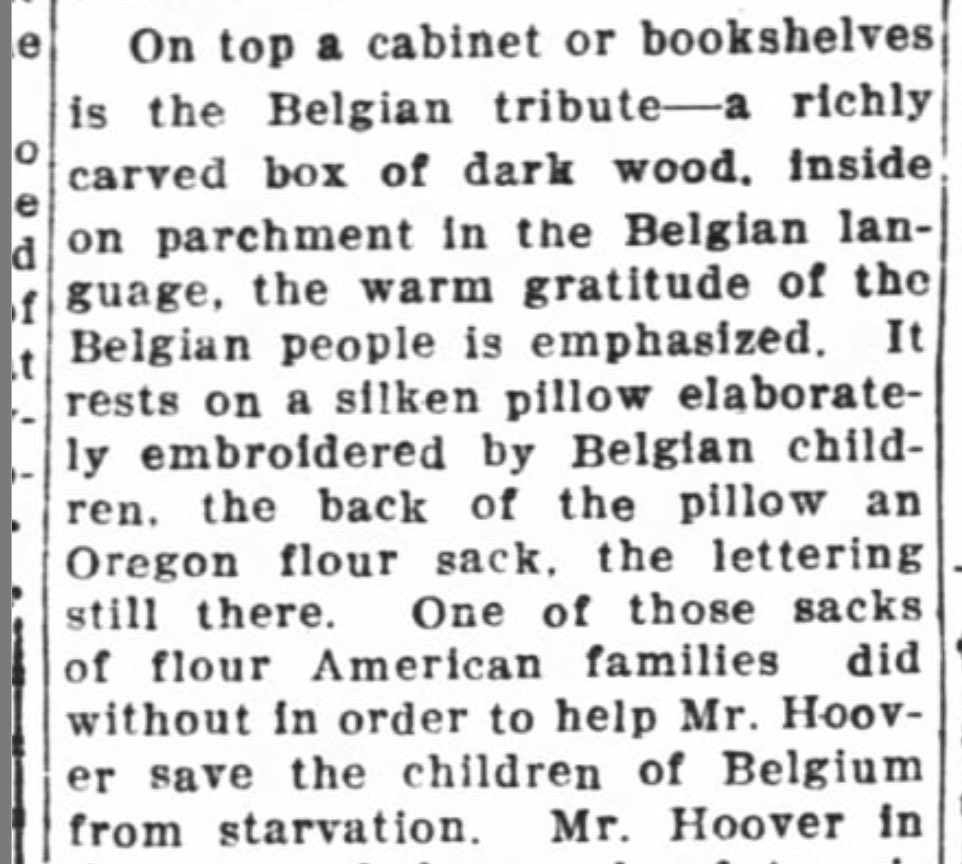
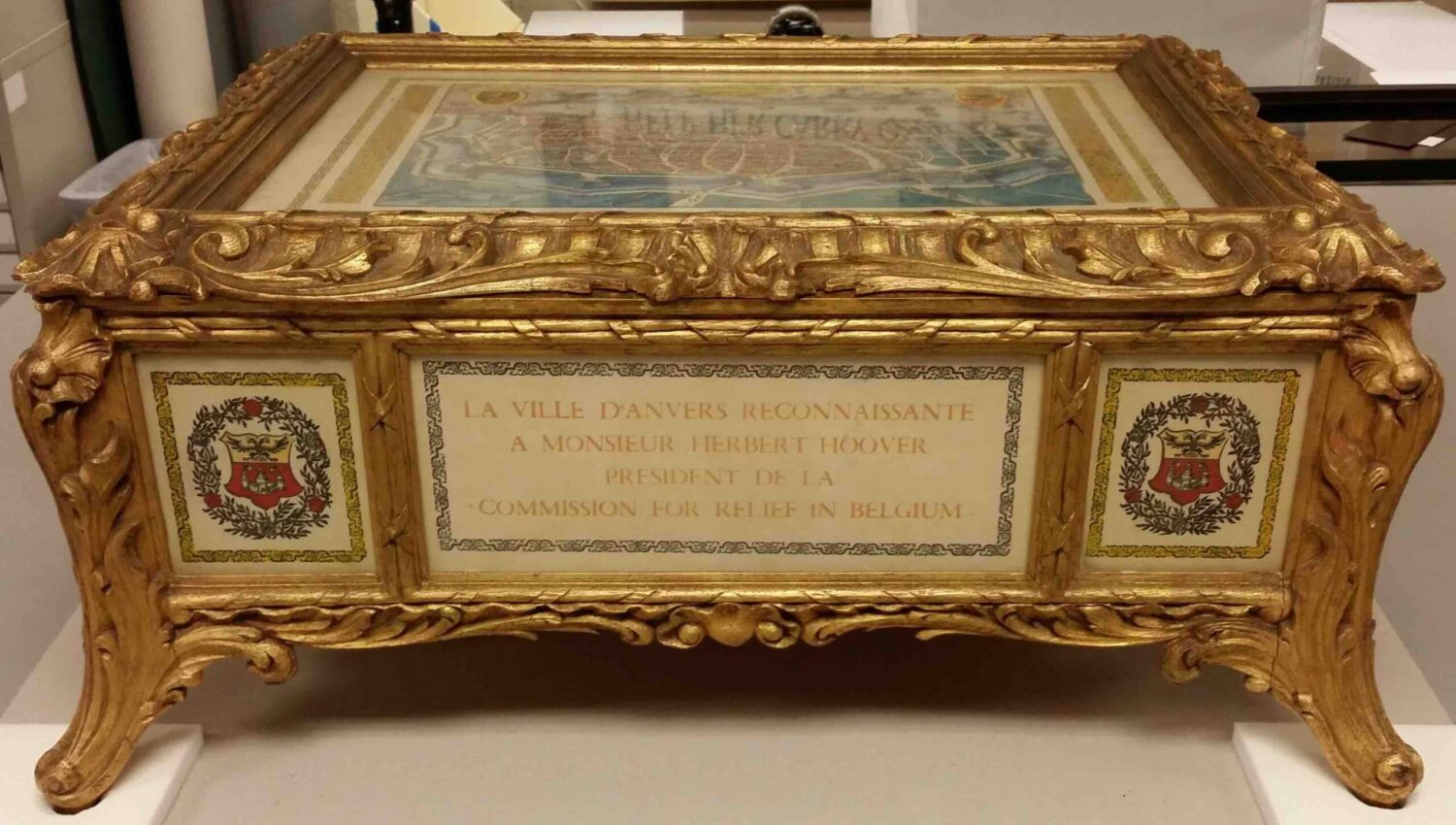
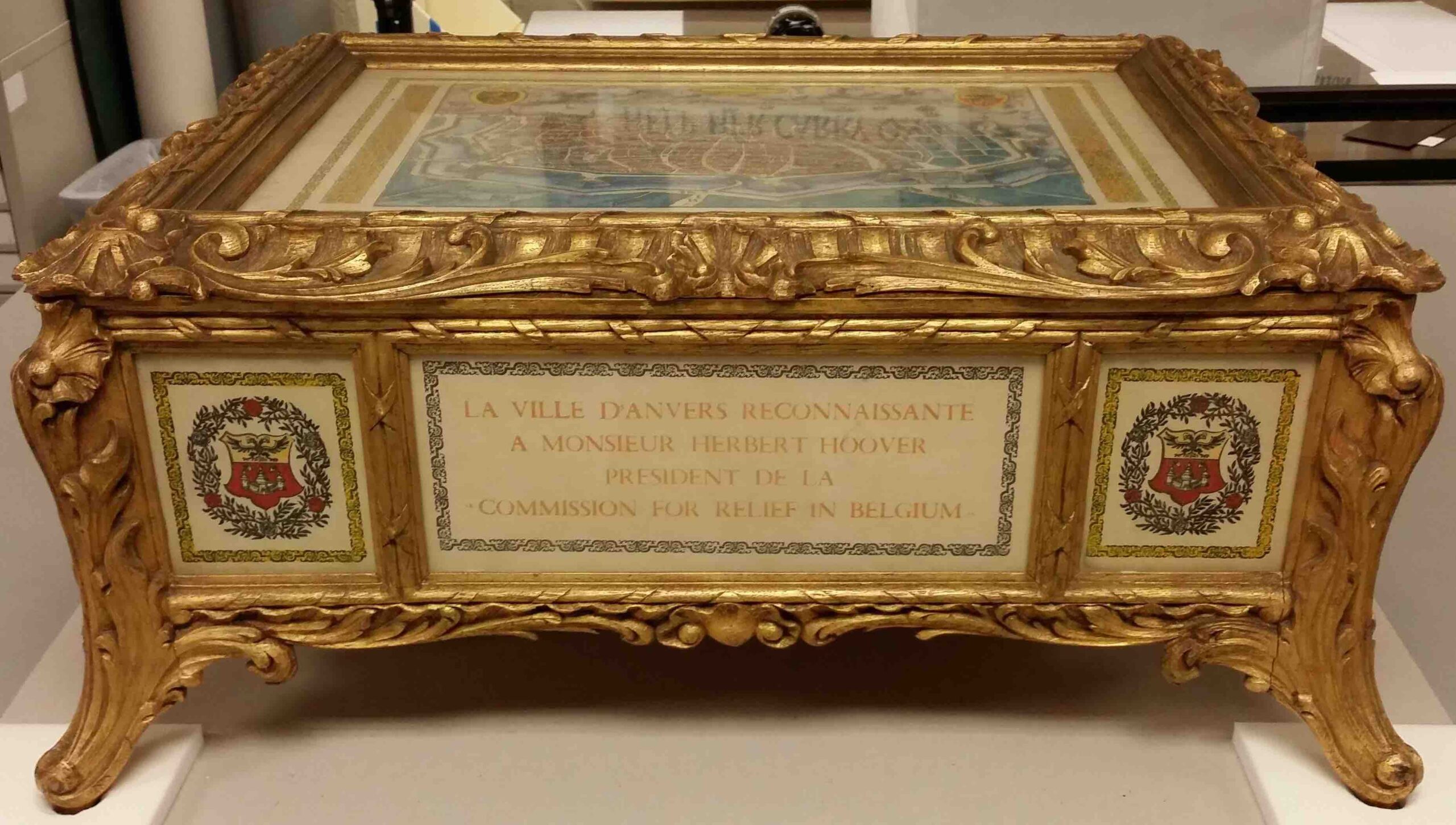
1928 – Oostkamp, Belgium Lou Hoover received an Oregon journalist at the Hoovers’ home in Washington. The journalist was shown an embroidered flour sack pillow from Portland, Oregon. The newspaper article described that the cushion was inside a dark, carved wooden box. On the pillow rested a Belgian acknowledgment written on parchment. The Belgian souvenirs were in Herbert Hoover’s study. [8]
During my research at the Hoover Institution Library & Archives (HILA), I photographed the pillow. The embroidered acknowledgment reads: “’t Dankbare Oostcamp aan hunne geliefde Weldoeners van Amerika.” ([From] The Grateful Oostcamp to their beloved Benefactors of America.) *)
It is a satin pillow embroidered with silk threads. The bottom is finished with a cotton flour sack of Oregon origin. The brand name is Cascadia from Portland Milling Co., Portland, Oregon.
Quote from: “Oostkamp and Hertsberge in the First World War” by Wim Deneweth. Historical Society Oostkamp, Belgium, 2017
The silk cushion was embroidered by the Sisters Maricolen on behalf of the Oostkamp municipal council, which paid 300 francs for the piece. The cushion was gifted to Mr. Brand Whitlock, American minister plenipotentiary in Belgium!
Apparently, the pillow later ended up in the Hoover household and was combined with the gilden, carved box and the parchment. [9]
The beautiful Belgian souvenir from Oostkamp, given as a gift to America, has led a life of its own over the past hundred years. It is a showpiece that likes to be displayed. On TV footage, the pillow and gilded box were shown by Dare Stark McMullin, Hoover’s secretary. [9c]
Dare McMullin showed Hoover’s Belgian souvenirs on TV: the Oregon flour sack as the back of the “Oostcamp” pillow in the gilden box. Photo col. HILA
1938 – Pierre Beeckmans, Antwerp, Belgium
Painted flour sack Chicago’s Flour Gift, 1914-1918, with flags of the nine Belgian provinces, gift from Pierre Beeckmans to Herbert Hoover, Brussels, 1938. Coll. HHPLM 65.27.13. Photo: authorFlour sack “Chicago’s Flour Gift”, (verso), gift of Pierre Beeckmans to Herbert Hoover, 1938. Coll. HHPLM 65.27.13. Photo author
In 1938, Herbert Hoover travelled to Brussels and received a painted Chicago Evening Post flour sack as a gift from Pierre (Petrus) Beeckmans, Antwerp. Beeckmans writes in his covering letter to Hoover dated February 22, 1938, that the flour sack “remembers excellently the remarkable philanthropic work you accomplished during the tragical years of the Belgian people”. [10]
In his letter, Beekmans refers to the year 1915 and to the original flour sack which had been in his family since that year.
The painting of the nine Belgian provincial flags is suggestive. The Belgian flag is missing; during the war years, the flag and/or the colors black, yellow, and red were always part of the decorated sacks’ iconography.
In third place a stamp on the reverse side of the sack mentions the “Orphans of the War”. The stamp’s design, the drawing and the font, is modern and businesslike, with a distinguished appearance. The stamp can be find on a variety of flour sacks decorated in the Ouvroir d’Anvers in Antwerp.
Beekmans donated the painted flour sack to Mr. Hoover on his own behalf, not at the behest of the Antwerp authorities. Beeckmans had an “Agency that prepares and carries out all publicity” and likely sought attention for himself and his work in 1938.
Beeckmans responsible for the Persecution of Jews in WWII Pierre (Petrus) Beeckmans (born in Gooik, Belgium, on August 10, 1894) was a front-line soldier in WWI and got wounded. He rose through the ranks of reserve cadre to lieutenant in the infantry and, after the war, served in the Belgian occupation forces in Germany.
Pierre Beeckmans was an outspoken, far-right Belgian nationalist and anti-Jewish. During WWII, he worked for the Anti-Jewish Central for Flanders and Wallonia, which he led from 1943. Upon liberation, Beeckmans fled to Germany but was arrested in May 1945. During the Volksverwering (People’s Defense) trial, he was sentenced to death; the sentence was commuted to life imprisonment in 1952; he was released in April 1960, at the age of 75. [10a]
A postcard has been preserved addressed to Monsieur le Président Hoover, Ambassade d’Amérique, rue de la Science 38, Bruxelles, sender Madame Raphaël Gugenheim, in which she asks him if he has received an embroidered flour sack “en symbole de temps de guerre et de la reconnaissance présente et durable.” (as a symbol of wartime and present and enduring recognition.) [11]
Herbert Hoover at the HILA Flour Sack Exhibit of flour sacks in Hoover Tower, Stanford University, Palo Alto, Ca., 1941. Photo: HHPLM
1941 – Stanford University On the occasion of the opening of Hoover Tower at Stanford University, Palo Alto, Ca., in June 1941, Herbert Hoover visited the Hoover Institution’s Flour Sack Exhibit. [12]
60’s (?) – New York The embroidered flour sack “Comet” by Globe Mills, Los Angeles, California, graced the couch in Mr. Hoover’s apartment at the Waldorf Astoria, New York.[13]
Flour sack “Comet”, 1915, on Mr. Hoover’s couch in the Waldorf Astoria, New York. Photo: HILA
Conclusion as follows from this chronology: The Hoovers came into contact with the decorated flour sacks and the objects moved with them in time and space. During the war, both Lou and Herbert Hoover helped to distribute the decorated flour sacks; Herbert Hoover was gifted one decorated flour sack. After the war, Lou Hoover decorated her home with Belgian memorabilia, consciously showing it to her guests; she helped distribute remaining sacks from the CRB archive.
Herbert Hoover has received decorated flour sacks from Belgian admirers. He once visited an exhibition of the decorated flour sacks in the basement of Hoover Tower.
What did the war memorabilia mean to the Hoovers, what did the flour sacks remind them of?
Lou Henry Hoover with the Hoovers sons Herbert Jr. and Allan, 1908. Photo: Coll. HHPLM
The Hoovers during the War The Hoovers, both 40 years old in 1914, were a prominent couple in the international business world. Herbert Hoover was born in Iowa but grew up in Oregon. Lou Henry Hoover was born in Iowa and grew up in California. They were both Stanford mining engineers, he led major global mining projects for raw materials and minerals for industry, she was his sounding board and he hers, they were a team. She created the conditions that made it possible for them to live and work, her task consisted of the home(s), the social networks, the schooling of their two sons. Their wealth was considerable; the Hoovers had the American nationality, but from 1899 they had been living and working outside the American continent, they had settled in London. Their network mainly consisted of American (mining) engineers, who just like them were both internationally active and established.
When Herbert Hoover was asked in October 1914 by the American ambassador Page to dedicate himself from London as director of the Commission for Relief in Belgium (CRB) to the supply of food to occupied Belgium, he agreed.
At the time Lou Henry Hoover was with their two sons Herbert Jr, age 11, and Allan, age 7, in California; she had brought the sons to safety from the dangers of the war in Europe. [14]
The Los Angeles Times, November 15, 1914
In California, Lou Henry Hoover worked tirelessly to get relief work for the population of occupied Belgium and the Belgian refugees.
The mass meeting in San Francisco: “Belgian Relief Ship meeting, Chamber of Commerce, San Francisco”. Left to right: Mrs. Herbert C. Hoover, Bishop Nichols and Bishop Hanna. San Francisco Chronicle, Nov. 7, 1914
Lou intended to stay in California with her sons. Herbert wanted his wife as a teammate next to him in London: “want you here mightily”. [15]
Lou gave in. She reluctantly left their sons in the hands of family and friends. Aware of the danger of war, she wrote farewell letters to her children in New York in case she would not survive the ocean crossing to the UK. [16] She departed New York on November 25, 1914.
Lou Hoover traveled back to America Six months later Lou Hoover traveled back to New York in early June 1915. An unimaginable event had happened.
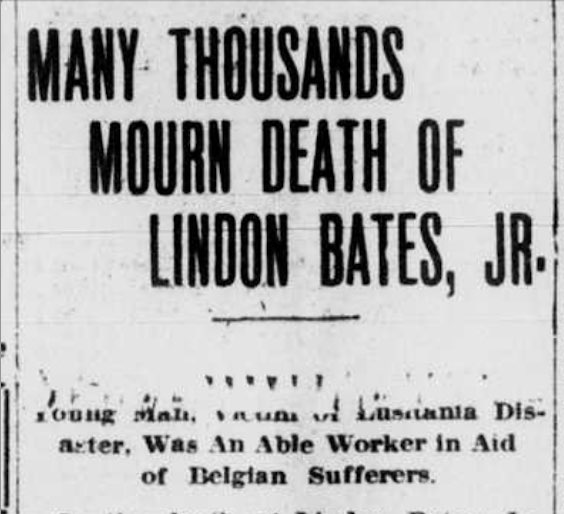
Lou Henry Hoover: “Womanhood pays tribute to Bates”. New York Tribune, June 11, 1915. Coll. HHPLM
Lou Hoover gave an impressive speech at the memorial service in New York in which she said, among other things:
“I speak in the name of womanhood and of childhood (…) For woman and for children he laid down his life and over his sacrifice we reach the sacred hands of maternity in benediction. He remained until the end, helping and comforting. Only as the ship gave her final plunge did he dive, but the suction had become too great for mortal combat.” [17]
Lou Hoover traveled on to California and reunited with her sons; from then on, she would not leave the boys alone during the war.
The Peninsula Times Tribune (Palo Alto, Ca.), October 19, 1915The Hoover family on the ship Olympia, 1918. From left to right. Allan, Herbert Sr., Lou Henry, and Herbert Jr. Hoover. Photo: HHPLM
1919 – After the war – Belgian possessions Lou Hoover was not the woman to refer to the personal war memories described above in relation to the flour sacks.
The Hoovers’ Stanford House, Palo Alto, Ca., floor plan, HHPLM museum exhibition. Photo: author
In December 1919, a year after the war Lou Hoover was focused on the design and furnishing of her new Stanford home: “the grouping and arrangement of various Belgian possessions.” She asked Belgian architect Victor Horta for advice and wrote him a letter. [18]
“I have many pieces of the most beautiful Belgian lace of the war period, many of them being of large table size. (…) On the other wall or at some point a panel might open to show a loop recess in which were many thin hinged panels, like those in art exhibitions mentioned, on which hung a selection of the quaint embroidered flour sacks presented by the Belgian girls.”
Lou Henry Hoover to Victor Horta, December 13, 1919. Coll. HHPLM
In her description of a painting by Baer of a Belgian peasant girl I read – mutatis mutandis – the significance of Belgian lace and embroidered flour sacks and the memories they evoke for her. “For instance, there is a very wonderful thing of a peasant girl done by Baer. (…) There is really nothing to describe but the repressed sadness of her face with its downcast eyes and the unutterable pathos of her peasant hand crushing a tear stained handkerchief. (…) we see her with the indefinite background of a ruined village.”
She continued: “But in those old days of before 1918, we used to say she was simply Belgium, sturdy in her sorrow, and even though with unutterable sadness in her heart, ready to look up and meet the problems before her when a turn of fate should come.”
Four months later Lou wrote again to Victor Horta. [19]
“Of course we have such happy memories of Belgium, although we saw her at her saddest. She was so wonderfully brave and marvelously in every way, that we could not be but lost in admiration for her and her people.”
Lou Hoover desired a Flemish interior for war memories In the continuation of her letter to Victor Horta an illustration can be seen of Lou Hoover’s attachment and preference to making and including physical memories of Belgium during the war.
For her new house she preferred to furnish a room completely in Belgian style. The best way to accomplish this would be to acquire old Flemish wood-carved panelling from one or more destroyed houses and ship it to California. “And of course, we have some very lovely Belgian things which have been given my husband as souvenirs of war days. My idea was to gather these all together in one room, and to have it decorated in purely Belgian style.
I could think of nothing better than some old Flemish panelling and carving. To me that would be lovely.
Would it be possible to find a room of appropriate decoration, which would be for sale? There must be a goodly number of old houses partly demolished by the war, where owners will wish to sell what is left, – and of them some one ought to be of suitable size and type for possible readjustment.”
She added in her letter that it would have to fit within her budget.
Conclusion The story of the Hoovers and the decorated flour sacks shows that for them the flour sacks were symbols of gratitude, souvenirs of the war and occupation of Belgium. In view of Hoover’s presidency, the decorated flour sacks even became status symbols of humanitarian aid.
But bringing together the social lives of the sacks and the Hoovers in words and images adds another dimension. The Belgian possessions, including a few decorated flour sacks belonging to the Hoovers were, above all, artifacts that embodied their intense, human experiences during and after the war.
NB. The hundreds of pieces of “artwork” were not a gift to the American president-to-be, Herbert Hoover. Thousands of thanks, including decorated flour sacks, were sent from Belgium and gifted to “the American people”.
After the war, The Friends of Belgium, based in New York, sorted through the thousands of Belgian thanks to America that came from Belgium. A special collection, including many decorated flour sacks, was sent to the Hoover War Library, forerunner of the Hoover Institution (HILA). CRB Bulletin, August 31, 1925. Coll. HHPLM curator files
*) Read my article in the Oostkamp Historical Society’s Newsletter:
Van Kempen, Annelien, Een Oostkamps borduurwerk gekoesterd door Amerika’s first lady (An Oostkamp embroidery cherished by America’s first lady). Oostkamp, Nieuwsbrief Heemkring Oostkamp, jrg 24, nr. 1, september 2023
Thanks
– Thanks to Matt Schaeffer, archivist of the Herbert Hoover Presidential Library and Museum, West Branch, Iowa. Matt wrote the Hoover Head “What You Learn After You Know it all is What Matters”, after we visited the exhibition at the museum together on June 22, 2022. He then extracted Lou Henry Hoover’s letters to Victor Horta, 1919/1920 from the archives. He realized after all these years that Lou Hoover definitely didn’t prioritize the decorated flour sacks in the decorative decor of her Stanford home.
– Thanks to Hubert Bovens in Wilsele, Belgium, for his searches of biographical data.
– Thanks to Wim Deneweth, author of the book “Oostkamp en Hertsberge in de Eerste Wereldoorlog, Heemkring Oostkamp, 2017”, (Oostkamp and Hertsberge in the First World War, Historical Society Oostkamp, 2017), for his information about the embroidered, silk pillow/flour sack ‘Cascadia’, Portland, Oregon, of the municipality of Oostkamp.
Footnotes [1] Montgomery, Marian Ann J., Cotton & Thrift. Feed Sacks and the Fabric of American Households. Lubbock, Texas: Museum of Texas Tech University, Texas Tech University Press, 2019.
[2] Saunders, Nicholas J., Culture, conflict and materiality: the social lives of Great War objects.
[3] HHPLM 31-Ihh-sub-b082-08 Belgian Flour Sacks undated letter to Lou Henry Hoover from New York (appr. 1915).
[4] Letter Herbert Hoover, CRB London, to William C. Edgar, Northwestern Miller, Minneapolis, Minn. December 13, 1915. HHPLM curator files.
[5] HHPLM 62.4.447. L’Indépendance Belge, parut en Angleterre, August 22, 1916.
[6] Letters from Lou Henry Hoover, Palo Alto, Ca. to Victor Horta, Brussels, Belgium, December 13, 1919, and April 30, 1920. HHPLM Lou Hoover Subject File box 145 Stanford house 1920.
[7] The Friends of Belgium: Whether the Brooklyn Girl Scouts still own the flour sack, painted by Paul Jean Martel, I have not been able to find out.
[8] Statesman Journal (Salem, Oregon) April 22, 1928. Lou Henry Hoover was in Washington, wanting to avoid journalist’s questions about her husband’s candidacy for president, so she suggested checking out Herbert Hoover’s study and “Belgium’s unique gift” but left this to an assisting friend.
[9]
9a) HILA 62008 box 20.1.
Oostcamp (now: Oostkamp) is located in the province of West Flanders, south of Bruges. Wim Deneweth of the Historical Society Oostkamp provided information on the embroidered silk pillow. The chronicle of Georges Claeys “Oostkamp onder de oorlog (Oostkamp under the war) 1914-1918”, (early 1970s, own limited edition, stencilled) is stating that the pillow was embroidered by the Sisters Maricolen, commissioned by the municipal council. The Sisters asked for a contribution of 300 francs, which the city council approved.
(Today the Sisters Maricolen live with 18 sisters in four communities in Bruges and the surrounding area.)
9b) The handwritten note “Document, on parchment in gilt wood box with embroidered satin pillow. Flour sack back – Oregon- embroidery Oostcamp.Handmade by City of Antwerp.”) is on a document in the HHPLM-curator files.
It is the photocopied statement to grant Herbert Hoover, director of the Commission for Relief in Belgium, “le droit de cite” (the city rights) by Mayor and Aldermen of the City of Antwerp, according to a decree of November 18, 1918. (Letter written on parchment from the Mayor and Aldermen of Antwerp, December 5, 1918.)
The HILA staff sent me a photo of the gilded box. This turned out to be a gift from the City of Antwerp to Herbert Hoover, director of the Commission for Relief in Belgium.
This gilded wood-carved box with inlays was a gift from the City of Antwerp to Herbert Hoover, director of CRB, 1918. Coll. and photo HILA
Note: the pillow/flour sack (HILA 62008 box 20.1), the gilded wood-carved box and the parchment are in HILA’s collections.
9c) Dare Stark McMullin (1896-1974). Dare Stark McMullin papers, HILA, Palo Alto, Ca.
[10] HHPLM 65.27.13. Pierre Beeckmans, Antwerp, letter February 22, 1938. HHPLM curator files.
Letter of Pierre Beeckmans to Herbert Hoover, February 22, 1938. HHPLM curator files.Herbert Hoover to Pierre Beeckmans, February 23, 1938. HHPLM curator’s files.
[10a] Saerens, Lieven, HET ARCHIEF PIERRE BEECKMANS, een nieuw licht op de Joodse gemaanschap en de Jodenvervolging in België. (THE PIERRE BEECKMANS ARCHIVES, a new light on the Jewish community and the persecution of Jews in Belgium). SOMA Berichtenblad 40 – June 2007, p. 26-31.
[11] HILA Gugenheim (Alice Aron) Papers coll. nr. 61012.
HHPLM 31-1919-66. Postcard Madame Raphaël Gugenheim, Brussels, to Monsieur le Président Hoover, 1938.
In 1938 the Embassy of the United States of America in Brussels was located Rue de la Science 33 (instead of 38).
Alice Aaron (°Toul, Meurthe-et-Moselle, Lorraine, F. 1872-02-29 +Paris 1955-03-25) married Raphaël Gugenheim (ºKolbsheim, Bas Rhin, Alsace, F. 1863-03-09 +1946) in Toul, France, March 1893. From 1938 they lived rue Antoine Bréart 135, Brussels.
[17] Lou Henry Hoover: “Womanhood pays tribute to Bates”, speech at the memorial service for Lindon W. Bates jr. in New York on the evening of June 10, 1915, New York Tribune, 1915-06-11. HHPLM: BAEF: CRB London Office News Cuttings, 1915 May-August (Box 24).
[18] Lou Henry Hoover to Victor Horta, December 13, 1919. HHPLM Lou Hoover Subject File box 145 Stanford house 1920.
[19] Lou Henry Hoover to Victor Horta, April 30, 1920. HHPLM Lou Hoover Subject File box 145 Stanford house 1920.
I am unaware if any of Lou Henry Hoover’s plans were actually realized.
De moderne opvatting over de geschiedenis van de versierde meelzakken in WO I is dat zij door Belgische meisjes, jonge vrouwen en kunstenaars in dank voor voedselhulp gemaakt zijn als geschenk voor de Amerikanen, in het bijzonder zijn er honderden ‘kunstwerkjes’ cadeau gedaan aan de Amerikaanse oud-president Herbert Hoover.[1]
Twijfel over de cadeaus aan Hoover
Mijn eerste confrontatie met een geborduurde meelzak stelde die opvatting direct in twijfel. De sensorische, tactiele ervaring bracht het mee. Ik zag, voelde en rook een stuk katoen waarin meel verpakt had gezeten, gaten waren getrokken, waarop met diverse borduursteken in verschillende kleuren een patroon was geborduurd -merknamen en logo’s van hulporganisaties en maalderijen-, een stuk kant was aangezet, een lint was geregen door een ambachtelijk gemaakt knoopsgat, dat licht schimmelig rook en waar soms meelresten uitvielen. De jaartallen 1914 – 1915 markeerden de beginjaren van de heftige oorlog, veldslagen, bulderende kanonnen, modderige loopgraven, executies, gasaanvallen, krijgsgevangenen en vluchtelingen. De vlaggen en landskleuren van België, de VS en Canada gaven blijk van een diepgevoeld patriottisme.
Zouden dit werkelijk waardige geschenken zijn geweest voor het echtpaar Hoover dat een decennium later President en First Lady van de Verenigde Staten zou zijn?
Mijn twijfel groeide toen ik de collectielijst van de Herbert Hoover Presidential Library and Museum bestudeerde, ik kreeg een indruk van de kwaliteit van het werk, de keuze voor zakken van een en dezelfde origine (American Commission), de herhalingen in borduur- en handwerk, zoals ‘goede nacht-tasjes’, theemutsen, tafelkleedjes, schortjes en boekomslagen. Hoe waren de overvloed aan schoolprojecten te verklaren? Hebben de Hoovers deze inderdaad als souvenirs thuis bewaard? Mijn onderzoek bewijst: neen.
Het sociale leven van de versierde bloemzakken
De betekenis die ik toeken aan de meelzakken zal een andere zijn dan de Hoovers hebben toegekend aan de zakken. Ik leef een eeuw later; ik ben van een generatie die oorlog niet aan den lijve heeft meegemaakt; ik ben opgegroeid in de Nederlandse cultuur; ik werkte niet -of was geen partner van iemand- op een vooraanstaande positie in het internationale zakenleven en later in de nationale politiek; ik woonde nooit jarenlang buiten het land waar ik de nationaliteit van bezit; ik verhuisde niet of had meerdere huizen om in te richten.
Ik realiseer me dat ik anno 2023 een andere positie in de geschiedenis inneem.
De versierde meelzakken van WO I zijn trench art, loopgravenkunst. Het zijn items gemaakt door burgers, rechtstreeks uit materiaal dat in tijd en plaats wordt geassocieerd met de gevolgen van gewapend conflict. Versierde bloemzakken hebben als objecten een ‘sociaal leven’, wij mensen komen ermee in contact, ze bewegen met ons mee in tijd en ruimte. [20]
De Hoovers en hún versierde meelzakken. Collage AvK, 2023
De Hoovers en de versierde meelzakken Tijdens mijn Amerikaanse Zakkenreis in 2022 heb ik connecties van de Hoovers met de versierde meelzakken gevonden. Ze volgen hier chronologisch.
Tijdens WO I
1915 Lou Hoover heeft zich bemoeid met de verkoop van versierde meelzakken in de VS. Zij ontving een brief van een vriendin in New York die voorstelde ‘de aandoenlijke meelzakken’ te verkopen voor $ 1,50 tot $ 2 (1915). [2]
Herbert Hoover schreef een brief aan William C. Edgar en vroeg of hij nog meer versierde meelzakken wilde bestellen, omdat de kinderen in België de zakken nog steeds vlijtig aan het borduren waren. [3]
‘Wil je meer bloemzakken? Belgische kinderen borduren ze nog vlijtig’. Herbert Hoover aan William Edgar, 13 december 1915. HHPLM curator files
Na WO I 1919/1920 – Victor Horta Lou Hoover was bezig met de inrichting van een nieuw huis in Californië. Lou Hoover schreef brieven aan de Belgische architect Victor Horta over de inrichting van haar Stanford huis op de universiteitscampus, ze wilde een aparte ruimte ontworpen hebben, speciaal voor memorabilia van België met een show-rek voor versierde meelzakken.[6]
1924 – Brooklyn Girl Scouts
The Brooklyn Daily Eagle, 21 juni 1924
Lou Hoover heeft in 1924 een connectie tot stand gebracht van de Brooklyn Girl Scouts met de ‘Friends of Belgium’[7] die een door Paul Jean Martel beschilderde meelzak schonken aan de Girl Scouts als dank voor de bijdrage aan de voedselhulp; het was een plechtigheid in New York met de Belgische ambassadeur, Lou Hoover kon er niet bij aanwezig zijn. [8]
The Statesman Journal (Salem, Oregon), 22 april 1928
1928 – Oostkamp, Zusters Maricolen Lou Hoover ontving in haar huis in Washington een journaliste uit Oregon. De journaliste kreeg een geborduurd kussen met bloemzak uit Portland, Oregon, te zien. Het krantenartikel beschrijft dat het kussen opgeborgen lag in een donkere, houtgesneden kist. In de kist, op het kussen lag een Belgische dankbetuiging, geschreven op perkament. De Belgische souvenirs bevonden zich in de studeerkamer van Herbert Hoover. [9]
Tijdens mijn onderzoek in de Hoover Institution Library & Archives heb ik het zijden kussen gefotografeerd. De geborduurde dankbetuiging luidt: ’t Dankbare Oostcamp aan hunne geliefde Weldoeners van Amerika.*)
Het is een satijnen kussen met zijden garens geborduurd. De onderzijde is afgewerkt met een katoenen meelzak met origine de staat Oregon. De merknaam is Cascadia van Portland Milling Co., Portland, Oregon.
Citaat uit: Oostkamp en Hertsberge in de Eerste Wereldoorlog door Wim Deneweth. Heemkring Oostkamp, 2017
Het zijden kussen is geborduurd door de Zusters Maricolen in opdracht van het gemeentebestuur van Oostkamp, die betaalde daar 300 franken voor. Het kussen is geschenk gegeven aan Brand Whitlock, Amerikaans gevolmachtigd minister in België!
Klaarblijkelijk is het kussen later in het huishouden van de Hoovers terecht gekomen en daar op creatieve wijze gecombineerd met de vergulde kist uit Antwerpen, en het perkament. [5]
Het prachtige Belgische souvenir van Oostkamp, geschenk gegeven aan Amerika, heeft de afgelopen honderd jaar een geheel eigen leven geleid. Het is een pronkstuk dat graag tevoorschijn wordt gehaald.
Bij tv opnamen is het kussen met de kist getoond door Dare Stark McMullin, Hoover’s secretaresse.
Dare McMullin laat Hoover’s Belgische souvenirs zien op TV: de Oregon meelzak als achterzijde van het ‘Oostcamp’ kussen in de vergulde kist. Foto coll. HILA
1938 – Antwerpen, Pierre Beeckmans
Beschilderde meelzak Chicago’s Flour Gift, 1914-1918, met vlaggen van de negen Belgische provincies, schenking Pierre Beeckmans aan Herbert Hoover, Brussel, 1938. Coll. HHPLM 65.27.13. Foto: auteurBloemzak “Chicago’s Flour Gift”, (verso), geschenk van Pierre Beeckmans aan Herbert Hoover, 1938. Coll. HHPLM 65.27.13. Foto auteur
In 1938 was Herbert Hoover in Brussel en ontving van Pierre (Petrus) Beeckmans uit Antwerpen, als geschenk een beschilderde meelzak Chicago Evening Post. Beeckmans schrijft in zijn brief aan Hoover van 22 februari 1938 dat de bloemzak ‘remembers excellently the remarkable philantropic work you accomplished during the tragical years of the Belgian people’.[10]
Beekmans verwijst in zijn brief naar 1915, de meelzak was sindsdien in zijn familie.
Op de andere zijde van de zak staat een stempel. Het ontwerp van het stempel, de tekening en het lettertype, is modern en zakelijk, het heeft een voornaam voorkomen. Het stempel komt ook voor op andere bloemzakken, bewerkt in de Ouvroir d’Anvers en is kennelijk een speciaal in Antwerpen ontworpen beeldmerk.
De schildering van enkel de negen Belgische provincievlaggen is opmerkelijk. De Belgische vlag ontbreekt, tijdens de oorlogsjaren maakten de vlag en/of de kleuren zwart, geel en rood altijd onderdeel uit van de iconografie op de versierde zakken.
Beekmans schonk de beschilderde bloemzak namens zichzelf, niet in opdracht van het Antwerpse bestuur. Beeckmans had een ‘Agentschap welke alle publiciteit voorbereidt en uitvoert’ en vroeg in 1938 waarschijnlijk aandacht voor zichzelf en zijn werk.
Beeckmans verantwoordelijk voor de Jodenvervolging in WO II
Pierre (Petrus) BEECKMANS (ºGooik 10-08-1894) was frontsoldaat in WO I en raakte gekwetst. Hij bracht het via het reservekader tot luitenant der infanterie en maakte na de oorlog deel uit van de Belgische bezettingstroepen in Duitsland.
Pierre Beeckmans was een uitgesproken, extreemrechts georiënteerde Belgisch-nationalist en anti-Joods. Tijdens WO II werkte hij voor de Anti-Joodsche Centrale voor Vlaanderen en Wallonië, die hij vanaf 1943 leidde. Bij de bevrijding vluchtte Beeckmans naar Duitsland, maar werd in mei 1945 gearresteerd. Tijdens het groepsproces Volksverwering werd hij ter dood veroordeeld; het vonnis werd in 1952 omgezet in levenslange gevangenisstraf; in april 1960, op 75-jarige leeftijd, kwam hij alsnog vrij. [10a]
Er is een postkaart bewaard gebleven gericht aan Monsieur le Président Hoover, Ambassade d’Amérique, rue de la Science 38, Bruxelles, afzender Madame Raphaël Gugenheim, waarin ze hem vraagt of hij toch wel een geborduurde meelzak heeft ontvangen ‘en symbole de temps de guerre et de la reconnaissance présente et durable’.[11]
Herbert Hoover bij de CRB-collectie meelzakken in Hoover Tower, Hoover Institution Library & Archives, 1941. Foto: HHPLM
Jaren ’60 (?) – New York De geborduurde bloemzak ‘Comet’ van Globe Mills, Los Angeles, Californië, prijkte op de bank in het appartement van Hoover in het Waldorf Astoria, New York.[13]
Meelzak ‘Comet’, 1915, op de bank bij de Hoovers in Waldorf Astoria, New York. Foto: HILA
Conclusie uit deze chronologie:
De Hoovers zijn in contact gekomen met de versierde meelzakken en de objecten bewogen met hen mee in tijd en ruimte. Tijdens de oorlog werkten zowel Lou als Herbert Hoover mee aan de distributie van de meelzakken; Herbert Hoover nam één versierde meelzak in ontvangst. Na de oorlog richtte Lou Hoover haar huis in met Belgische memorabilia, toonde deze bewust aan haar gasten; ze werkte mee aan distributie van resterende zakken uit het CRB-archief.
Herbert Hoover kreeg versierde meelzakken toegestuurd door Belgische bewonderaars. In de VS bezocht hij éénmaal de basement van Hoover Tower met tentoonstelling van de versierde meelzakken in het CRB-archief.
Welke betekenis hadden de oorlogssouvenirs voor de Hoovers, waar herinnerden de zakken hen aan?
Lou Henry Hoover met de Hoovers zonen Herbert jr. en Allan, 1908. Foto: coll. HHPLM
De Hoovers in de oorlog De Hoovers, beiden 40 jaar in 1914, waren een vooraanstaand echtpaar in de internationale zakenwereld. Herbert Hoover was geboren in Iowa, maar groeide op in Oregon. Lou Henry Hoover werd in Iowa geboren en groeide op in Californië. Zij waren beide Stanford-mijningenieurs, hij leidde wereldwijd omvangrijke ontginningsprojecten van grondstoffen, bestemd voor de industrie, zij was zijn klankbord en hij de hare, zij schiep de condities die hem het werken mogelijk maakte, haar taak was de huisvesting, sociale netwerken, opvoeding en scholing van hun twee zoons, zij vormden een team. Hun vermogen was aanzienlijk, ze hadden de Amerikaanse nationaliteit, maar vanaf 1899 waren ze buiten het Amerikaanse continent werkzaam, ze hadden zich gevestigd in Londen. Hun netwerk bestond vooral uit Amerikaanse (mijn)ingenieurs, net als zij zowel internationaal werkzaam als gevestigd.
Toen Herbert Hoover gevraagd werd in oktober 1914 door de Amerikaanse ambassadeur Page om zich vanuit Londen in te zetten voor de voedselverstrekking aan bezet België als directeur van de Commission for Relief in Belgium (CRB), ging hij akkoord.
Lou Henry Hoover was op dat moment met hun twee zoons Herbert jr, 11 jaar en Allan, 7 jaar, in Californië. Naar eigen zeggen had ze de zoons in veiligheid gebracht buiten de gevaren van de oorlog in Europa.[14]
The Los Angeles Times, 15 november 1914
In Californië zette Lou Henry Hoover zich onvermoeibaar in om hulpverlening voor de bevolking in bezet België en de Belgische vluchtelingen op gang te krijgen.
De massa-meeting in San Francisco: ‘Belgian Relief Ship meeting, Chamber of Commerce, San Francisco’. Vlnr: Mrs. Herbert C. Hoover, Bisschop Nichols en Bisschop Hanna. San Francisco Chronicle, 7 november 1914
Lou wilde bij haar zoons in Californië blijven.
Herbert Hoover wilde zijn vrouw als teammaat naast zich in Londen: ‘want you here mightily’. [15]
Lou zwichtte.
Ze liet hun zonen met tegenzin achter in de handen van familie en vrienden. Bewust van het oorlogsgevaar schreef ze in New York afscheidsbrieven aan haar kinderen voor het geval ze om zou komen bij de oversteek op haar schip naar Engeland.[16] Ze vertrok op 25 november 1914 uit New York.
Lou Hoover reist terug naar Amerika Lou Hoover reisde begin juni 1915 terug naar New York. Een onvoorstelbare gebeurtenis had plaatsgevonden.
The Richmond Virginia, 15 mei 1915
Hun dierbare vriend Lindon W. Bates jr., zoon van Lindon W. Bates, vice-voorzitter van de CRB in Amerika en Josephine White Bates, voorzitter van de CRB’s Woman’s Section, was omgekomen bij de ramp met het passagiersschip Lusitania. De Duitse onderzeeër U-Boat 20 had het Britse schip met torpedo’s aangevallen. Lindon Bates jr. hielp tot het laatst met de reddingsacties van zijn mede-passagiers, maar kwam zelf om. Zijn lichaam werd pas weken later gevonden op de kust van Ierland.
Bates was onderweg naar de Hoovers in Londen om instructies van hen te krijgen over het CRB-werk dat hij in Europa zou aanvatten.
Lou Henry Hoover: Womanhood pays tribute to Bates. New York Tribune, 11 juni 1915. Coll. HHPLM
Lou Hoover hield tijdens de herdenkingsdienst in New York, de avond van 10 juni 1915, een indrukwekkende toespraak waarin ze onder meer zei:
“I speak in the name of womanhood and of childhood (…) For woman and for children he laid down his life and over his sacrifice we reach the sacred hands of maternity in benediction. He remained until the end, helping and comforting. Only as the ship gave her final plunge did he dive, but the suction had become too great for mortal combat.” [17]
“Ik spreek in naam van alle vrouwen en kinderen (…) Voor vrouwen en kinderen gaf hij zijn leven en over zijn opoffering strekken wij de heilige handen van het moederschap in zegening uit. Hij bleef tot het einde, helpend en troostend. Pas toen het schip ten onder ging, dook hij ervan af, maar de zuigkracht was te groot geworden voor een dodelijk gevecht.”
Lou Hoover reisde door naar Californië en herenigde zich met haar zoons; ze zou de jongens niet meer alleen laten gedurende de oorlog.
The Peninsula Times Tribune (Palo Alto, Ca.), 19 oktober 1915De Hoover family op het schip Olympia, 1918. Vlnr. Allan, Herbert sr., Lou Henry en Herbert jr. Hoover. Foto: HHPLM
1919 – Na de oorlog – Belgische bezittingen Lou Hoover was er de vrouw niet naar om te verwijzen naar de hiervoor beschreven persoonlijke oorlogsherinneringen in relatie tot de meelzakken.
Het Stanford House van de Hoovers, Palo Alto, Ca. Plattegrond in HHPLM museumtentoonstelling. Foto: auteur
Een jaar na de oorlog, in december 1919, was Lou Hoover gefocust op het ontwerp en de inrichting van haar nieuwe Stanford huis: ‘the grouping and arrangement of various Belgian possessions.’ ‘How to display them?’ Ze vroeg om advies aan de Belgische architect Victor Horta in Brussel en schreef hem een brief.[18]
‘I have many pieces of the most beautiful Belgian lace of the war period, many of them being of large table size. (…) On the other wall or at some point a panel might open to show a loop recess in which were many thin hinged panels, like those in art exhibitions mentioned, on which hung a selection of the quaint embroidered flour sacks presented by the Belgian girls.
Lou Henry Hoover aan Victor Horta, 13 december 1919. Coll. HHPLM
‘een paneel zou kunnen openschuiven waardoor een alkoof met een grote lus tevoorschijn zou komen waarin vele dunne scharnierende panelen zijn aangebracht, zoals je wel ziet in kunsttentoonstellingen, waarin dan een selectie zal hangen van de curieuze, knusse, geborduurde meelzakken gemaakt door de Belgische meisjes.‘
De betekenis van Belgisch kant en geborduurde meelzakken voor de herinneringen die deze bij haar oproepen, lees ik -mutatis mutandis- in haar beschrijving van een schilderij van Baer van een Belgisch boerenmeisje. ‘For instance, there is a very wonderful thing of a peasant girl done by Baer. (…) There is really nothing to describe but the repressed sadness of her face with its downcast eyes and the unutterable pathos of her peasant hand crushing a tear stained handkerchief. (…) we see her with the indefinite background of a ruined village.’
Ze vervolgde: ‘But in those old days of before 1918, we used to say she was simply Belgium, sturdy in her sorrow, and even though with unutterable sadness in het heart, ready to look up and meet the problems before her when a turn of fate should come.’
‘Maar in die oude dagen van vóór 1918 zeiden we altijd dat zij gewoon ‘België’ was, standvastig in haar verdriet, en hoewel met onuitsprekelijke droefheid in haar hart, klaar om op te kijken en de problemen die voor haar lagen het hoofd te bieden, mocht een wending van het noodlot zich aandienen.’
Vier maanden later schreef Lou opnieuw aan Victor Horta.[19] ‘Wij hebben natuurlijk zulke gelukkige herinneringen aan België, hoewel we haar op haar droevigst zagen’:
‘she was so wonderfully brave and marvelously in every way, that we could not be but lost in admiration for her and her people.’
Want hoewel we haar op haar droevigst zagen, was ze zo wonderbaarlijk dapper en verbazingwekkend in ieder opzicht, dat we ons volledig hebben verloren in bewondering voor haar en haar volk.’
Lou Hoover wil een Vlaams interieur voor oorlogsherinneringen [20] Een mooie illustratie hoe Lou Hoover zich hechtte aan het maken van ruimtelijke herinneringen aan België in de oorlog blijkt uit het vervolg van haar brief aan Victor Horta.
Voor haar nieuwe huis wil zij het liefst een kamer inrichten volledig in Belgische stijl. Dat zou het beste kunnen door oude, Vlaamse lambrizeringen met houtsnijwerk uit een of meer verwoeste huizen op de kop te tikken en te verschepen naar Californië. Er zou toch een passend Vlaams interieur voor haar beschikbaar moeten zijn?
‘And of course we have some very lovely Belgian things which have been given my husband as souvenirs of war days. My idea was to gather these all together in one room, and to have it decorated in purely Belgian style. I could think of nothing better than some old Flemish panelling and carving. To me that would be lovely. Would it be possible to find a room of appropriate decoration, which would be for sale? There must be a goodly number of old houses partly demolished by the war, where owners will wish to sell what is left, – and of them some one ought to be of suitable size and type for possible readjustment.’
Ze zal in haar brief eraan toevoegen dat het wel binnen haar budget zal moeten passen.
Conclusie Het verhaal van de Hoovers en de versierde meelzakken toont aan dat de meelzakken voor hen souvenirs van de oorlog in en bezetting van België waren, ze vormden symbolen van dankbaarheid. Ten behoeve van Hoover’s presidentschap verwerden de zakken zelfs statussymbolen van humanitaire hulp.
Het sociale leven van de zakken en de Hoovers in woorden en beelden bijeenbrengen voegt een dimensie toe.
Ik heb met de bronnen, gevonden tijdens mijn Amerikaanse Zakkenreis, een reconstructie kunnen maken, waaruit blijkt dat de Belgische bezittingen, waaronder een aantal versierde meelzakken, van de Hoovers bovenal artefacten waren, die een belichaming vormden van hun intense, menselijke ervaringen tijdens en na WO I.
NB. De honderden ‘kunstwerkjes’ zijn niet cadeau gedaan aan de Amerikaanse president-to-be, Herbert Hoover. Duizenden bedankjes, inclusief versierde meelzakken werden uit België ontvangen voor ‘Amerika’.
The Friends of Belgium, gevestigd in New York, sorteerde na de oorlog de duizenden Belgische bedankjes aan Amerika, die uit België kwamen. Een speciale collectie, inclusief vele versierde meelzakken, werd gestuurd naar de Hoover War Library, voorloper van de Hoover Institution (HILA). CRB Bulletin, 31 augustus 1925. Coll. HHPLM curator files
*) Lees ook het artikel:
Van Kempen, Annelien, Een Oostkamps borduurwerk gekoesterd door Amerika’s first lady. Oostkamp, Nieuwsbrief Heemkring Oostkamp, jrg 24, nr. 1, september 2023
Dank
– Dank aan Matt Schaeffer, archivaris van de Herbert Hoover Presidential Library and Museum, West Branch, Iowa. Matt schreef de Hoover Head “What You Learn After You Know it all is What Matters”, nadat we samen op 22 juni 2022 de tentoonstelling in het museum hadden bezocht. Vervolgens lichtte hij de brieven van Lou Henry Hoover aan Victor Horta, 1919/1920 uit de archieven. Hij realiseerde zich na al die jaren dat Lou Hoover de versierde meelzakken beslist niet op de eerste plaats heeft gezet bij de decoratieve inrichting van haar Stanford huis.
– Dank aan Hubert Bovens te Wilsele voor zijn opzoekingen van biografische gegevens en Jacques Laperre voor het leggen van contact met de heemkring Oostkamp.
– Dank aan Wim Deneweth, auteur van het boek Oostkamp en Hertsberge in de Eerste Wereldoorlog, Heemkring Oostkamp, 2017, voor zijn informatie over het geborduurde, zijden kussen van de gemeente Oostkamp.
[1] Montgomery, Marian Ann J., Cotton & Thrift. Feed Sacks and the Fabric of American Households. Lubbock, Texas: Museum of Texas Tech University, Texas Tech University Press, 2019
[2] HHPLM 31-Ihh-sub-b082-08 Belgian Flour Sacks undated letter, New York
[3] Brief Herbert Hoover, CRB Londen, aan William C. Edgar, Northwestern Miller, Minneapolis, Minn. 13 december 1915. HHPLM curator files
[4] HHPLM inventory nr 62.4.447. L’Indépendance Belge, parut en Angleterre, 22 augustus 1916
[5]
5a) HILA 62008 box 20.1.
Oostcamp (nu: Oostkamp) ligt in de provincie West-Vlaanderen, ten zuiden van Brugge. In WO I was dit ‘Etappengebiet’. Vanuit de Heemkring Oostkamp ontving ik van Wim Deneweth informatie over het geborduurde, zijden kussen. In de kroniek van Georges Claeys ‘Oostkamp onder de oorlog 1914-1918‘, (begin jaren ’70, eigen uitgave in beperkte oplage, gestencild) staat vermeld dat het kussenovertrek is geborduurd door de Zusters Maricolen, in opdracht van het gemeentebestuur. De Zusters Maricolen vroegen een bijdrage van 300 frank, de gemeenteraad keurde deze betaling goed.
(De Zusters Maricolen leven vandaag met 18 zusters in vier gemeenschappen in Brugge en omgeving.)
5b) Volgens een fotokopie in HHPLM-curator files zat in de vergulde kist een verklaring, op perkament geschreven, van 5 december 1918 volgens besluit van 18 november 1918 om Herbert Hoover, directeur van de Commission for Relief in Belgium, te verlenen ‘le droit de cité’ door Burgemeester en Schepenen van de stad Antwerpen. (‘Brief Burgemeester en Schepenen Antwerpen, 5 december 1918. ‘Document, on parchment in gilt wood box with embroidered satin pillow. Flour sack back – Oregon- embroidery Oostcamp.Handmade by City of Antwerp’.’)
De staf van HILA stuurde mij een foto toe van de vergulde kist. Deze blijkt een geschenk van de Stad Antwerpen aan Herbert Hoover, directeur van de Commission for Relief in Belgium.
Deze vergulde houtgesneden kist met inlays was een geschenk van de Stad Antwerpen aan Herbert Hoover, directeur CRB, 1918. Coll. en foto HILA
5c) Dare Stark McMullin (1896-1974). Dare Stark McMullin papers, HILA, Palo Alto, Ca.
[6] Brieven Lou Henry Hoover, Palo Alto, Ca. aan Victor Horta, Brussel, België, 13 december 1919 en 30 april 1920. HHPLM Lou Hoover Subject File box 145 Stanford house 1920
[7] ‘Friends of Belgium’ was een soort voortzetting van de CRB inzake de connecties tussen de VS en België. Of de Brooklyn Girl Scouts de bloemzak, beschilderd door Paul Jean Martel, nog bezitten heb ik niet kunnen achterhalen tot nu toe.
[9] Statesman Journal (Salem, Oregon) 22 april 1928. Lou Henry Hoover is in Washington, ze wil ontkomen aan vragen over de kandidaatstelling voor het presidentschap van haar man, dus stelt ze voor om de werkkamer van Herbert Hoover te gaan bekijken en ‘het unieke geschenk van België’ en laat dit over aan een assisterende vriendin.
[10] HHPLM 65.27.13. Pierre Beeckmans, Antwerpen, brief 22 februari 1938. HHPLM curator files.
Brief van Pierre Beeckmans aan Herbert Hoover, 22 februari 1938. HHPLM curator files.Brief van Herbert Hoover aan Pierre Beeckmans, 23 februari 1938. HHPLM curator’s files.
[10a] Saerens, Lieven, HET ARCHIEF PIERRE BEECKMANS, een nieuw licht op de Joodse gemaanschap en de Jodenvervolging in België. SOMA Berichtenblad 40 – Juni 2007, p. 26-31.
[11] HILA Alice Gugenheim Papers coll. nr. 61012.
HHPLM 31-1919-66. Postkaart Madame Raphaël Gugenheim, Brussel, aan Monsieur le Président Hoover, vermoedelijk 1938.
De Amerikaanse Ambassade in Brussel was in 1938 gevestigd Rue de la Science 33 (niet 38).
Alice Aaron (ºToul, Meurthe-et-Moselle, Lorraine, F. 29-02-1872 +Parijs, 25-03-1955) trouwde in maart 1893 in Toul, Frankrijk, met Raphaël Gugenheim (ºKolbsheim, Bas Rhin, Alsace, F. 09-03-1863 +1946). Ze woonden vanaf 1938 rue Antoine Bréart 135, Bruxelles.
[17]Womanhood pays tribute to Bates New York Tribune 1915 06 11. HHPLM: BAEF: CRB London Office News Cuttings, 1915 May-August (Box 24)
[18] Lou Henry Hoover, VS, aan Victor Horta, Brussel, 13 december 1919. HHPLM Lou Hoover Subject File box 145 Stanford house 1920
[19] Lou Henry Hoover, VS, aan Victor Horta, Brussel, 30 april 1920. HHPLM Lou Hoover Subject File box 145 Stanford house 1920.
Ik weet niet of en hoe de plannen van Lou Hoover gerealiseerd zijn.
[20] Saunders, Nicholas J., Culture, conflict and materiality: the social lives of Great War objects.
My previous blog about the German occupiers and the Belgian Relief flour sacks generated several responses that made me reflect on my findings. In particular, this response from Nick Saunders: “Fantastic example of trench art, at the other extreme from the shell cases, but still full of conflict resonance”!? [1]
Far from trench art Wow, including the decorated flour sacks from WWI within the category of “trench art”? That felt strange… So far, I have followed my own path with the research into the decorated flour sacks. I spontaneously listed seven reasons why the flour sacks do not belong to trench art.
1 Death and destruction The word “trench art” did not appeal to me. Simply because the colorful, carefully embroidered, delicate textiles that have been preserved did not have to be dragged through the mud of the trenches a hundred years later, let alone the mire of the earth that had been stained red by the blood of the hundreds of thousands of young men who died on the battlefields.
Edouard Verschaffelt, “Pour l’Absent” (For the Absent, The prayer of two Belgian women), flour sack Lake of the Woods Milling Co., Keewatin, Canada, 1915. Moulckers Collection, St. Edwards University
2 Girls and women What had been their role? Women were nurses at the war front, they cared for wounded soldiers, assisted them in their dying days. In Great Britain, women in the munitions factories took over the tasks from men who had left for the front.
The decorated flour sacks formed the other extreme. Their hidden story was revealed; finally, the contribution of hundreds of Belgian girls and women emerged, their works as part of a charitable effort under the German occupation.
I wanted their stories to stand on their own and not be grounded in the horrors of military conflict.
3 Well-to-do bourgeoisie Ladies of good standing and nuns in convents and parishes organized charitable works. They propagated gratitude, expressed in many words in Flemish, French and English. Under their leadership, industrious girls and young ladies from the well-to-do bourgeoisie made a hype out of the decorated flour sacks in 1915; after that it was over (quite suddenly).
4 Royal lace, folksy sacks Attempting to associate between the decorated flour sacks with the “war lace”, coming from their backgrounds in textile material and production period, was seen to be impertinent. Historically, Belgian lace has centuries-old traditions, it was intended for queens and kings, the rich and powerful of the earth. War lace and the thousands of Belgian lacemakers had patron saints in the highest Western European, aristocratic and American circles.
In contrast, sacks belonged to the people, to bakers and millers, to industry.
Remainder of flour in a flour sack, 1915. Coll. MVW Liège
5 Marginal Moreover, the story was about sacks, a marginalized piece of cloth, associated with poverty when reused, after all, in the industrialized Western world it was only intended for temporary use as packaging for the storage and transport of food, after which it could be discarded or if necessary reused
Charitably, it could be said that the decorated flour sacks were works of art, but in reality this notion could not be sustained. The makers showed goodwill, expressed their feelings in a way that their work is best classified as folk art.
7 Art! Well-known Belgian artists have painted the flour sacks in a communal expression of gratitude to the suppliers of the food relief. However, the “real” art went as unnoticed as the embroideries. Only once did the German occupier censor exhibited sacks.
In 1919 the artists’ association held a sale of the painted sacks with the announcement “strictly speaking not an art exhibition”, “these are far from masterpieces”; they were sold for unit prices. [2]
Besides, serious art history seems to prefer to skip the years 1914-1918 in general.
Seven reasons to create my own path with my research, which allowed me – without delving into the subject – to stay away from the term “trench art”.
Feed back Now that my research and the presentation of the results are generating reactions and positive feedback, it dawns on me that the meaning of my stories about the decorated flour sacks naturally resonates with the stories and field of activity of others.
Nicholas J. Saunders is the founder of the contemporary vision on trench art. He saw the resonance of the conflict in my blog about the German occupier and the flour sacks, he recognized the flour sacks as trench art, as part of the material culture. To make it clear to me what he meant, he sent me four of his articles to read.
At first reading I at once understood what Saunders recognized in the sack stories. The articles opened my eyes: the knowledge of the decorated flour sacks will deepen by exploring the interfaces they have with trench art and their place in material culture, as described by him.
To me it feels like a paradigm shift, it demands that I take a different position when considering the flour sacks.
That’s quite a job, which I decided to tackle while blogging. It allows others to share in the process. Hence this blog.
‘Trench Art and the Great War Recycled’ In 2000, Saunders formulated as the definition of trench art: “Any item made by soldiers, prisoners of war, and civilians, from war matériel directly, or any other material, as long as it and they are associated temporally and/or spatially with armed conflict or its consequences.” [3]
Belgian young women in Mons collect money for “Malette du Prisonnier”, Belgian prisoners of war in Germany. Photo: coll. MVW, Liège
This definition certainly applies to the flour sacks, as they are “items made by civilians directly from material associated in time and place with the consequences of armed conflict”.
“Trench art is war art, sensory and tactile, it evokes memories,” said Saunders.
That fits seamlessly with my adage: “Sacks are full of memories. Each sack cherishes a precious and fragile story.”
Are the sacks trench art? Let me reconsider my seven reasons for forging my own path and keeping my distance from the concept of trench art, in a first attempt to bring the decorated flour sacks under this heading.
“Valiant Hero Die Comforted! America Cares for Spouse and Offspring”. Oppuurs, 1916, embroidered, lace, flour sack without origin indication. Belgian private coll.
1 Death and destruction One flour sack immediately came into my mind’s eye: “De Koene Held” (The Valiant Hero), 1914-1916.
Previously I blogged about the sack decoration in amazement. “It is a Belgian war souvenir with comforting words and images for men who threatened to lose their lives on the battlefield, while they worried whether their wives and children would be cared for. The answer was yes, America takes care of women and children. In a way the text seemed naive to me, I would not embroider this if I had, as a married woman, a husband or son, fighting in the trenches, let alone, as a girl in school with a father or brother on the battlefield. The only way I could imagine it was that this cloth had been embroidered by nuns in a convent, skilled embroiderers and bringers of care and comforting, edifying words.”
An alienating embroidery, it is uncomfortable, evoking a feeling of disbelief.
Saunders denominates this as the power of trench art: the embroidery contains tension, capturing the paradox of war – it destroys and creates at the same time.
2 Girls and women Some of the decorated flour sacks bear characteristics of the identity of the maker, her name, her school, her town or village, the craft group. The sacks and decorations can be traced, the objects can be personalized. Families have kept sacks as war souvenirs, as memories of the maker. They live on through the stories.
Flour sack Sperry Mills American Indian, embroidered, 1915-11-9, belonged to nurse Emilie Gerard. Photo: Europeana Collections
The story of a nurse and the embroidered flour sack (1915-11-9) that she kept, comes together in the life of Emilie Gerard, it is similarly uncomfortable.
Emilie Gerard was a nurse, she worked for Dr. Delporte. Emilie is sitting, left, 1914. Photo: Europeana Collections
“A flour sack from California belonged to grandmother, Emilie Gerard. It is not known who embroidered the sack. Emilie was a nurse during World War I. She lived in Brussels. She gave birth to her baby in Antwerp, but the son was placed elsewhere after three days. The father of the son has always remained unknown. She never revealed the father’s identity. Her son has often asked who he was. It was a great disgrace at the time, which Emilie suffered greatly from. Emilie Gerard has worked for Dr. Delporte.” [4]
3 Well-to-do bourgeoisie The creative reuse of the empty flour sacks was conceived by institutions, schools, parishes, women’s organizations, sewing workshops and committees, it was institutionalized within the existing social organizations and networks of the well-to-do bourgeoisie. In particular higher-class women were active in charitable work.
Anna Osterrieth, née Lippens, Antwerp, flour sack American Commission. Coll. HILA 62008 box 11.2
They considered it their moral duty to employ girls and young women from the lower classes.
“It was our duty to encourage the young girls to come and work in our workshop, because we are sure to keep them there in a moral and happy atmosphere, saving them from the dangers of the street, because we allow these who live alone to save light and fire and because we are confident our workshop is more to them than the daily bread earning.” [5]
For their own class-based morality, the driving force was as well to enthuse young women about sack decorating “since the holidays this year will be completely stripped of their attractive country residences and will therefore provide most of them with free hours, which they could certainly not use for any nobler purpose.” [6]
The Belgian ladies were very well aware that the flour that arrived in occupied Belgium had been sent thanks to appeals to and donations by their female counterparts in American society. However, those donations were short-lived – four to six weeks in November/December 1914 at the most, after which the enthusiasm cooled down. [7]
The reuse of flour sacks by the Belgian girls took longer, a year was spent decorating the flour sacks, exhibitions were organized, and raffles were held. At the beginning of 1916 the enthusiasm waned, other impulses were needed to raise money for charity.
By the middle of 1915, the organization of international food supply to the population of occupied Belgium functioned on a large scale and was commercially viable. For the Commission for Relief in Belgium and the Comité National de Secours et d’Alimentation grain transports and transshipments via elevators had been the industrial approach from the beginning. Charity was part of marketing and propaganda; it was just no longer materially visible.
4 Folk sacks Sacks or bags represented business. They were functional, used by farmers, millers and bread bakers. Food production was industrialized to feed the growing population, workers in factories, in urban environments.
Bag Factory Trio, Stockton. Photo in: The Sperry Family, October 1918, p. 17. Coll. E. McMillan
The size of a bag made it functional for individual handling by the artisan baker, but bags in 1914 were industrial products, produced by the thousands.
Large American and Canadian mills supplied the bulk of the flour to occupied Belgium. They had a ‘Bag Department’. Other mills bought their bags from bag factories, Bemis Bag Company was a leading supplier.
If bags were deployed for local use, they remained the property of the mill, the bags were cleaned, reused and administratively the mill used a deposit system.
American food supplies went overseas, so the flour was packaged for export, printed with millers’ logos and names. The sacks had to be strong enough to withstand transport in trains, ocean liners, barges, carts and transshipment in ports.
Flour sack Sperry Mills-American Indian-California in original condition (recto). Stamp Mons, Hainaut. Coll. IFFM
The printing provided the sender with an identity, confirmed his or her charitable works. However, the millers were not unfamiliar with direct or derived commercial interest in the name on the bags. The Sperry Flour Co. designed a special brand and logo to print on the cotton sacks: “We are putting out an especial brand. Our factory is working on the sacks which bear an Indian head imprint with the word “California” across the front.” The flour sack is printed in the Belgian colors black, yellow and red.
One of the bakery windows decorated with flour sacks. Photo: L’ Actualité Illustrée, March 27, 1915
Once in Belgium, they became the property of the bakeries, the companies that bought the flour, including the sacks. But then what? Where did the sacks go then? The bakers who wanted to get rid of the sacks sought financial gain and found willing customers in Belgian souvenir hunters, among other things.
5 Marginal The American relief workers showed great opportunism regarding the flour sack reuse. That can feel alienating.
In November 1914 they chose American cotton as the packaging for the flour, so that the cloth of the solid cotton sacks could be reused for undergarments and home textiles. They positioned their choice for their American audience as a win-win situation: they donated food and clothing.
“Instructions were issued at the same time for packing the flour.These stipulated that a strong forty-nine-pound cotton sack be used…. Most important, after the flour was eaten, the empty cotton sack could be used by the housewife for an undergarment, the package thus providing both food and clothing.” [8]
Group photo with Jeanne Caterine Charleer. Children in clothing made from “American Commission” flour sacks. The photo is a family heirloom. Photo: Europeana Collections
The suggestion has been followed in Belgium. In Heverlee near Louvain, for example, 80 children, mostly girls from about 4 to 6 years old, had their picture taken, dressed in flour sack dresses with the “American Commission” logo. [9]
One year later, money was needed for clothing and the American relief workers changed their strategy. The Belgian re-use of sacks was marginalized, it was precisely the argument to show the American public how bad it was seeing as the Belgians could not even procure children’s clothing.
P. H. Chadbourn brought Belgian gifts to U.S. President Wilson in Washington, including decorated flour sacks. Acting on behalf of the Commission for Relief in Belgium (CRB), Chadbourn used the publicity he received to call on Americans to donate money for clothing for the Belgians.
Chadbourn said that many Belgian children wore no shirts other than those made from flour sacks with holes cut for the head and arms. There was therefore the greatest need for clothing!
“Mr. Chadbourn told the President clothing was now the greatest need of the Belgians. He described how flour bags, with holes cut for the head and arms, were being used as shirts by many children”. [10]
Orlando Evening Star, April 27, 1916
The CRB provided the newspapers with a press release, along with a photo of a girl in a flour sack dress, to underline the statement.
The baseball game of CRB delegates in flour sack uniforms, “American Commission,” in Brussels on July 4, 1916. HHPLM Collection.
6 Art? Is trench art art, as the word says? Art historians generally reject this, as trench art fails to conform to aesthetic principles. They group it under the heading of primitive art or folk art. Another approach to art emphasizes the function-oriented nature, in combination with the social component that connects the creator of the object. [11]
Orphanage of St. Joseph, Sisters of Providence, Hoesselt, Flour sack Dement Bros Co., Walla Walla, Washington, 1915. Coll HHPLM 62.4.329
Girls’ schools’ students in Brussels decorated flour sacks in class. Young women in Antwerp were invited in groups to decorate flour sacks. “The most special aim is to make use of the American Flour Sack, thus immediately becoming a memorial and an object of art. Experience has proven that it lends itself to the most artful arrangements …
It would, however, be desirable that every performance should include a reflection on the circumstances of the times.”[12]
The creativity shown by children to express the conditions of 1915 in the purest form often gives me the feeling of holding a “work of art” when studying the flour sacks.
Josue Dupon, Detail American Commission flour sack, Belgian lion with a steaming food bowl. Coll. and photo: National WWI Museum Kansas City Missouri.
7 Art! The painting of the flour sacks was a fundraiser held by the Belgian artists’ associations to raise money for those artists and their families who desperately needed support because of the occupation and war conditions.
Georges Vanzevenberghen, silhouette standing on Belgian flag. Moulckers collection St. Edwards University, Austin, TX. Photo: Linzee Kull McCray
On the sacks they have decorated, references to the circumstances of 1915 are diverse, often food related. The academically trained painters did not yet seem to be fully aware of their misery, or at least in June 1915 they painted the picture of a better time that now lay behind them. With lovely images they “marketed” their country to the Americans for whom the sacks were intended as a sign of gratitude. They reprinted their own popular works, previously made on paper, on flour sacks. Also, they literally copied the photos of (American) war photographers in paint.
In that sense their work seemed easy, barely innovative or original. Although this conclusion also evokes some discomfort. Unless the artists really felt the threatening power and censorship of the German occupier and kept their paintings rather superficial.
Conclusion That concludes my ideas so far about where the decorated flour sacks touch on the definition of trench art and can be placed in material culture. The paradigm shift offers me a guideline.
The definition of trench art explicates the association with armed conflict. For me it was obvious that the flour sacks were decorated during war and occupation, that was self-evident and did not have to be explicitly mentioned.
The suggestion to start from the consideration of flour sacks and their decorations from the perspective of the tension of the conflict, to examine their makers from the perspective of discomfort, to see the paradox imprisoned in the objects, can offer me additional focus.
In any case, these sacks, these colorful, carefully embroidered and painted textiles are associated with death, loss and mourning; with the mud of the trenches and the mire of the earth stained red by the blood of the hundreds of thousands of young men who died on the battlefields.
Sacks are full of memories. Each sack cherishes a precious and fragile story.
Continued July 21, 2024 Recycled flour sacks from WWI – a Belgian field of tension
In my blog “Recyclede meelzakken in WO I – het Belgische spanningsveld” (Recycled flour sacks in WWI – a Belgian field of tension) I further elaborate my vision on “trench art and the decorated flour sacks”.
The blog is written in Dutch. For English, French, Italian or Spanish, please use the orange “Translate” button, bottom left on the page.
Thanks to – Nicholas J. Saunders for his intervention and the wealth of articles he sent me.
– Georgina Kuipers for her attentive corrections to the English translations of my blogs.
Footnotes [1] Comment Nick Saunders to my post of June 16, 2023, Lizerne Trench Art Facebook group
[2] L’Indépendance Belge, April 21, 1919, La Libre Belgique, May 3, 1919 / La Nation Belge, May 5, 1919
[3] Saunders, Nicholas J., Bodies of Metal, Shells of Memory: ‘Trench Art’, and the Great War Re-cycled. SAGE Publications, Journal of Material Culture, 2000; 5; 43-67.
[5] Letter from Anna Osterrieth-Lippens to Edward Hunt, Antwerp, August 17, 1915. HILA CRB records 22003, box 324.2
[6] Letter Antwerp Committee for Aid to families ravaged by the war – Middenkomiteit, Antwerp, July 22, 1915. FelixArchief
[7] Letters American Belgian Relief committees to Lindon W. Bates, CRB New York office, December 1914, coll. HILA
[8]The Millers’ Belgian Relief Movement 1914-15 conducted by The Northwestern Miller. Final Report of its director William C. Edgar, Editor of the Northwestern Miller, MCMXV
Mijn vorige blog over de Duitse bezetters en de Amerikaanse meelzakken leverde verscheidene reacties op die me tot nadenken hebben gestemd. Met name deze reactie van Nick Saunders:
“Fantastic example of trench art, at the other extreme from the shell cases, but still full of conflict resonance!” (‘Fantastisch voorbeeld van loopgraafkunst, aan het andere uiterste van de granaathulzen, maar toch vol ‘weerklank van strijd’!)?[1]
Verre van trench art Amai, de versierde meelzakken van WO I onder de noemer ‘trench art’ brengen? Dat voelde raar… Tot nog toe ben ik mijn eigen weg gegaan met het onderzoek naar de versierde meelzakken. Zeven redenen noemde ik spontaan achter elkaar op.
1 Dood en verderf Het woord ’trench art’, loopgravenkunst, zinde mij niet. Simpelweg omdat het kleurrijke, met zorg geborduurde, delicate textiel dat bewaard is gebleven, niet honderd jaar na dato alsnog door de modder van de loopgraven moest worden gehaald, laat staan door het slijk van de aarde dat rood gekleurd was door het bloed van de honderdduizenden jonge mannen die stierven op de slagvelden.
Edouard Verschaffelt, ‘Pour l’Absent’ (‘Voor de Afwezigen’, twee biddende vrouwen), beschilderde bloemzak Lake of the Woods Milling Co., Keewatin, Canada, 1915. Moulckers Collection, St. Edwards University
2 Meisjes en vrouwen Wat was hun rol? Vrouwen aan het front waren verpleegster, zij verzorgden gewonde soldaten, stonden hen bij in de stervensfase. In Engeland namen vrouwen in de munitiefabrieken de taak over van naar het front vertrokken mannen.
De versierde meelzakken waren het andere uiterste. Hun verborgen verhaal openbaarde zich en eindelijk kwam de bijdrage tevoorschijn van honderden Belgische meisjes en vrouwen, haar werken voor het goede doel onder de Duitse bezetting.
Ik wilde dat hun verhalen op zichzelf zouden staan en niet gegrond zouden worden in de horrors van het militaire conflict.
3 Gegoede burgerij Dames van goede stand, religieuzen in kloosters en parochies, organiseerden liefdadige werken. Zij propageerden vanuit patriottisme dankbaarheid, in velerlei woorden in Vlaams, Frans en Engels uitgedrukt. Onder hun leiding maakten vlijtige meisjes en jonge dames uit de gegoede burgerij in 1915 een hype van de versierde meelzakken, daarna was het voorbij.
4 Koninklijk kant, volkse zakken Een poging om vanuit de textiele materie en de productie-periode een associatie te maken tussen de versierde meelzakken en ‘oorlogskant’ bleek een gotspe. Belgisch kant heeft historisch een eeuwenlange traditie, het was bestemd voor koninginnen en koningen, de rijken en machtigen der aarde. Oorlogskant en de duizenden Belgische kantwerksters hadden beschermheiligen in de hoogste West-Europese, adellijke, en Amerikaanse kringen.
Zakken waren van het volk, van broodbakkers en maalderijen, de industrie.
Resten bloem in een meelzak, 1915. Coll. MVW Luik
5 Marginaal Bovendien, het verhaal ging over zakken, een gemarginaliseerd stuk stof, bij hergebruik geassocieerd met armoede, immers, het was in de geïndustrialiseerde Westerse wereld slechts bestemd voor tijdelijk gebruik als verpakking voor het bewaren en vervoer van voedsel, waarna het kon worden afgedankt of desnoods hergebruikt.
6 Kunst? Dat de versierde bloemzakken kunstwerken waren, was in enthousiasme wel te zeggen, maar in realiteit niet vol te houden. De maaksters getuigden van goede wil, gaven uitdrukking aan hun gemoed op een manier dat hun werk op zijn best te vatten is onder volkskunst.
7 Kunst! Belgische kunstenaars van naam beschilderden vanuit vaderlandse plicht de meelzakken in een gemeenschappelijke dankbetuiging aan de brengers van de voedselbevoorrading. De werkelijke kunst bleef echter net zo onopgemerkt als de borduurwerken. Eenmaal censureerde de Duitse bezetter tentoongestelde zakken. In 1919 hield de kunstenaarsvereniging uitverkoop van de beschilderde zakken met de aankondiging ‘strikt genomen geen kunsttentoonstelling’, ‘dit zijn geen meesterwerken’; ze gingen voor een eenheidsprijs weg.[2]
De serieuze kunstgeschiedenis slaat überhaupt de jaren ’14-’18 bij voorkeur over.
Zeven redenen om mijn eigen weg te gaan met mijn onderzoek, dus ook -zonder me er verder in te verdiepen- weg te blijven van de noemer ‘trench art’.
Feed back Nu mijn onderzoekswerk en de presentaties van de resultaten reacties en positieve feedback opleveren, begint het me te dagen dat de betekenis van mijn verhalen over de versierde meelzakken uiteraard resoneren op de verhalen en het werkterrein van anderen.
Nicholas J. Saunders is grondlegger van de hedendaagse visie op trench art. Hij hoorde in mijn blog over de Duitse bezetter en de meelzakken de weerklank van het conflict, hij herkende de meelzakken als trench art, deel uitmakend van de materiële cultuur. Om mij duidelijk te maken wat hij ermee bedoelde stuurde hij me inmiddels vier van zijn artikelen ter lezing op.
Bij eerste lezing al begreep ik wat hij herkende in de zakkenverhalen. Saunders opende mijn ogen: de kennis van de versierde meelzakken zal zich verdiepen door te onderzoeken welke raakvlakken er zijn met trench art en hun plaats in materiële cultuur, zoals door hem beschreven.
Voor mij voelt het als een paradigma-verschuiving, het vraagt een andere positie in te nemen bij beschouwing van de meelzakken.
Dat is een fors karwei dat ik voor mezelf het beste al bloggend aan kan gaan. Het stelt anderen in staat te delen in het proces. Vandaar dit blog, gepubliceerd in juni 2023.
In juli 2024 publiceerde ik een tweede blog: ‘Recyclede meelzakken in WO I – het Belgische spanningsveld’.
‘Trench Art and the Great War Recycled’ Saunders formuleerde in 2000 als definitie van trench art: ‘Any item made by soldiers, prisoners of war, and civilians, from war matériel directly, or any other material, as long as it and they are associated temporally and/or spatially with armed conflict or its consequences.’ [3] (Elk item gemaakt door soldaten, krijgsgevangenen en burgers, rechtstreeks uit oorlogsmaterieel, of enig ander materiaal, zolang het en zij tijdelijk en/of ruimtelijk worden geassocieerd met gewapend conflict of de gevolgen ervan’).
Belgische jonge vrouwen in Bergen zamelen geld in voor ‘Malette du Prisonnier’, Belgische krijgsgevangenen in Duitsland. Foto: coll. Musée de la Vie wallonne
Deze definitie is beslist toepasbaar op de meelzakken, want het zijn “items gemaakt door burgers, rechtstreeks uit materiaal dat in tijd en plaats wordt geassocieerd met de gevolgen van gewapend conflict”.
‘Trench art is oorlogskunst, zintuiglijk en tactiel, het roept herinneringen op’, volgens Saunders.
Dat past naadloos op mijn adagium: ‘Zakken zijn vol herinneringen. Iedere zak koestert een kostbaar en kwetsbaar verhaal’.
Is het trench art? Laat ik mijn zeven redenen om mijn eigen weg te gaan en afstand te houden tot het begrip trench art opnieuw ter hand nemen, in een eerste poging om de versierde meelzakken dit keer wel onder deze noemer te brengen.
Koene Held Sterf Getroost! Amerika Zorgt voor Gade en Kroost. Oppuurs, 1916, geborduurd, kant; zonder herkomst aanduiding. Belgische part. collectie.
1 Dood en verderf Eén meelzak verscheen direct op mijn netvlies: ‘De Koene Held’, 1914-1916
Ik schreef erover in verwondering. ‘Het is een Belgisch oorlogssouvenir met troostrijk woord en beeld voor mannen die dreigden hun leven op het slagveld te verliezen, terwijl zij zich bekommerden of hun vrouwen en kinderen wel verzorgd achter zouden blijven. Het antwoord was ja, Amerika zorgt voor vrouw en kinderen. Op een manier komt het mij naïef over, als getrouwde vrouw met een man of zoon, vechtend in de loopgraven, zou ik dit niet borduren, evenmin als meisje op school met een vader of broer op het slagveld. De enige voorstelling, die ik mij kon maken, is dat dit doek geborduurd is door religieuzen in een klooster, vaardige borduursters en brengers van zorg en troostende, stichtelijke woorden.’
Een vervreemdend borduurwerk, het schuurt, is ongemakkelijk, roept een gevoel van ongeloof op. Saunders noemt dat de kracht van trench art: het borduurwerk bergt spanning in zich, vangt de paradox van oorlog – het vernietigt en creëert tegelijk.
2 Meisjes en vrouwen Een deel van de versierde meelzakken draagt kenmerken van de identiteit van de maakster, haar naam, haar school, haar stad of dorp, de handwerkgroep. De zakken en versieringen zijn te herleiden, de objecten te personaliseren. Families hebben zakken bewaard als souvenirs van de oorlog, als herinneringen aan de maakster. Zij blijven leven door de verhalen.
De bloemzak Sperry Mills American Indian, geborduurd, 9-11-1915 was van de verpleegster Emilie Gerard. Foto: Europeana Collections
Het verhaal van een verpleegster en de geborduurde meelzak (9-11-1915) die zij bewaarde, komt samen in het leven van Emilie Gerard, het schuurt, is ongemakkelijk.
Emilie Gerard was verpleegster, ze heeft gewerkt voor dr. Delporte. Emilie zittend, links, 1914. Foto: Europeana Collections
‘Een bloemzak uit California was eigendom van grootmoeder, Emilie Gerard. Wie de zak borduurde is niet bekend. Emilie was verpleegster tijdens Wereldoorlog I. Zij woonde in Brussel. Zij is van haar kindje bevallen in Antwerpen maar het zoontje werd na drie dagen geplaatst. De vader van het zoontje is altijd onbekend gebleven. Zij heeft nooit de identiteit van de vader prijsgegeven. Haar zoon heeft er wel dikwijls naar gevraagd. Het was destijds een grote schande waar Emilie erg onder geleden heeft. Emilie Gerard heeft bij Dr. Delporte gewerkt als verpleegster.’ [4]
3 Gegoede burgerij Het creatief hergebruik van de lege meelzakken is opgevat door instituten, scholen, parochies, vrouwenorganisaties, naaiateliers en komiteiten, het was geïnstitutionaliseerd binnen de bestaande sociale organisaties en netwerken van de gegoede burgerij. Vooral vrouwen uit de hogere kringen waren actief in het werk bestemd voor liefdadigheid.
Anna Osterrieth, née Lippens, Antwerpen, bloemzak American Commission. Coll. HILA 62008 box 11.2
Zij achtten het hun morele plicht om meisjes en jonge vrouwen uit lagere standen aan het werk te zetten.
“It was our duty to encourage the young girls to come and work in our workshop, because we are sure to keep them there in a moral and happy atmosphere, saving them from the dangers of the street, because we allow these who live alone to save light and fire and because we are confident our workshop is more to them than the daily bread earning.” [5]
Ook voor de eigen stand was de moraliteit de drijfveer om het zakken versieren te enthousiasmeren ‘daar de vacantiën dit jaar gansch van hun aantrekkelijk buitenverblijf zullen ontdaan zijn, en dus aan de meeste onder hen vrije uren zullen bezorgen, welke ze voorzeker tot geen edeler doel konden gebruiken.’[6]
De dames waren ermee bekend dat het in België gearriveerde meel in zakken, was toegestuurd dankzij giften en inzamelingen door hun vrouwelijke evenknieën in de Amerikaanse samenleving. Die inzamelingen waren kortstondig – vier weken in november/december 1914, daarna bekoelde het enthousiasme.[7]
Het hergebruik van meelzakken door de Belgische meisjes duurde langer, een jaar is gewerkt aan versiering van meelzakken, zijn tentoonstellingen georganiseerd en tombola’s gehouden. Sinds juni 1915 was door de bureaucratische houding van NKHV’s Comité de Vente des Sacs d’Amérique de spontaniteit van het versieren van de bloemzakken volledig de kop ingedrukt.
Begin 1916 was het enthousiasme weg, om geld in te zamelen voor liefdadigheid waren nieuwe impulsen nodig.
De organisatie van de internationale hulp aan de bevolking in bezet België stond halverwege 1915 grootscheeps en bedrijfsmatig op poten. Graantransporten met overslag via elevatoren waren de industriële aanpak. Liefdadigheid maakte deel uit van marketing en propaganda, was niet langer materieel zichtbaar.
4 Volkse zakken Zakken representeerden business. Ze waren functioneel, in gebruik van boeren, maalderijen en broodbakkers. De voedselproductie was geïndustrialiseerd om de groeiende bevolking, werknemers in fabrieken, in stedelijke omgevingen, te voeden.
‘Bag Factory Trio’ (het trio van de zakken fabriek), Stockton. Foto in: The Sperry Family, October 1918, p. 17. Coll. E. McMillan
De afmeting van een zak maakte deze functioneel voor individuele handling door de ambachtelijke bakker, maar zakken waren in 1914 industriële producten, die bij duizenden tegelijk werden geproduceerd.
Grote Amerikaanse en Canadese maalderijen hebben de bulk van het meel aan bezet België geleverd. Zij beschikten over een ‘Bag Department’. Andere maalderijen kochten hun zakken in bij zakkenfabrieken, Bemis Bag Company was een vooraanstaand leverancier.
Als zakken voor lokaal gebruik werden ingezet bleven ze eigendom van de maalderij, werden de zakken gekuist, hergebruikt en administratief hanteerde de maalderij een statiegeldsysteem.
De Amerikaanse voedselhulp ging overzee, dus kreeg het meel een exportverpakking, bedrukt met logo’s en namen van de maalderijen. De zakken moesten stevig genoeg zijn om het transport in treinen, oceaanstomers, binnenvaartschepen, wagens en karren en de overslag in havens goed te doorstaan.
Bloemzak Sperry Mills-American Indian-California in originele staat (recto). Stempel Mons, Hainaut. Coll. IFFM
De bedrukking gaf identiteit aan de afzender, bevestigde zijn of haar liefdadige werken. Direct of afgeleid commercieel belang was de maalderijen echter niet vreemd bij de naamsvermelding op de zakken. De Sperry Flour Co. ontwierp een speciaal merk en logo om op de katoenen zakken te drukken:“We are putting out an especial brand. Our factory is working on the sacks which bear an Indian head imprint with the word “California” across the front.” De meelzak is bedrukt in de Belgische kleuren zwart, geel en rood.
Eén van de bakkerij-etalages gesierd met meelzakken. Afb. L’ Actualité Illustrée 27 maart 1915
Eenmaal in België werden ze eigendom van de bakkerijen, de bedrijven die meel kochten inclusief de zakken. Maar ja, wat toen? Waarnaartoe met de zakken? De bakkers die zich wilden ontdoen van de zakken zochten geldelijk gewin en vonden onder meer willige klanten in Belgische souvenirjagers.
5 Marginaal De Amerikaanse hulpverleners getuigden bij het hergebruik van de meelzakken van groot opportunisme. Dat is bevreemdend.
In november 1914 kozen zij hun Amerikaanse katoen als verpakking voor het meel, zodat de degelijke katoenen zakken konden worden hergebruikt voor onderkleding en huishoudtextiel. Ze positioneerden hun keuze voor hun Amerikaanse publiek als win-win situatie: ze schonken voedsel en kleding. ‘Instructions were issued at the same time for packing the flour.These stipulated that a strong forty-nine-pound cotton sack be used…. Most important, after the flour was eaten, the empty cotton sack could be used by the housewife for an undergarment, the package thus providing both food and clothing.’[8]
Groepsfoto met Jeanne Caterine Charleer Kinderen in kledij van zakken ‘American Commission’. De foto is een familiestuk. Jeanne Caterine Charleer was de moeder van Robert Bruyninckx. Foto: Europeana Collections
In België is de suggestie opgevolgd. Bijvoorbeeld in Heverlee bij Leuven gingen 80 kinderen, meest meisjes van ongeveer 4 tot 6 jaar oud, op de foto, gekleed in jurkjes van meelzakken met het logo ‘American Commission’.[9]
Eén jaar later was er geld nodig voor kleding en gooiden de Amerikaanse hulpverleners hun strategie om. Het Belgische hergebruik van zakken werd gemarginaliseerd, het was juist het argument om te tonen aan het Amerikaanse publiek hoe slecht het gesteld was met de kleding van Belgische kinderen.
P. H. Chadbourn bracht de Amerikaanse president Wilson in Washington Belgische geschenken, waaronder versierde meelzakken. Chadbourn handelde in opdracht van de Commission for Relief in Belgium (CRB) en gebruikte de publiciteit die hij kreeg om Amerikanen op te roepen geld te schenken voor kleding voor de Belgen.
Chadbourn vertelde dat veel Belgische kinderen geen andere hemden droegen dan die gemaakt van meelzakken waarin gaten voor hoofd en armen waren geknipt. Er was dan ook de grootste behoefte aan kleding! ‘Mr. Chadbourn told the President clothing was now the greatest need of the Belgians. He described how flour bags, with holes cut for the head and arms, were being used as shirts by many children’.[10]
Orlando Evening Star, 27 april 1916
De CRB leverde de kranten een persbericht aan, tesamen met de foto van een meisje in een meelzak jurkje, om het statement te onderstrepen.
De honkbalwedstrijd van CRB-gedelegeerden in meelzakkentenues ‘American Commission’ in Brussel op 4 juli 1916. Coll. HHPLM.
In juli 1916 speelden de CRB-gedelegeerden honkbalwedstrijden op de sportvelden van Club Léopold in Brussel. Hun sporttenue was gemaakt van meelzakken door de vooraanstaande kleermaker John Accent. De naam ‘American Commission’ stond fier voorop hun honkbalshirts in de originele blauwe bedrukking.
6 Kunst? Is trench art kunst, zoals het woord zegt? Kunsthistorici wijzen dit in het algemeen af, bij gebrek aan het voldoen aan esthetische principes. Zij scharen het onder de noemer van primitieve kunst of volkskunst. Een andere benadering van kunst legt de nadruk op het functiegerichte in combinatie met de sociale component die de maker van het object ermee verbindt.[11]
Bloemzak Dement Bros Co., Walla Walla, Washington. Orphanage of St. Joseph, Sisters of Providence, Hoesselt, 1915. Coll HHPLM 62.4.329
Leerlingen van meisjesscholen in Brussel versierden meelzakken klassikaal. Jonge vrouwen in Antwerpen werden groepsgewijze uitgenodigd meelzakken te versieren. ‘Het bijzonderste doel is het benuttigen van den Amerikaansche Bloemzak, alzoo meteen gedenkenis en kunstvoorwerp wordend. De ondervinding heeft bewezen dat hij zich tot kunstigste bewerkingen leent …
Het ware nochtans wenselijk dat alle uitvoering een gedacht over de omstandigheden van dezen tijd bevatte.’[12]
Bloemzak High Loaf, The Dowd Milling Co., Pakenham, Ont., Canada. Ontwerp en borduurwerk Nassogne, Prov. Luxemburg, 1915. Coll. HHPLM 62.4.404
De creativiteit die door kinderen aan de dag is gelegd om de omstandigheden van 1915 in de meest pure vorm tot uitdrukking te brengen, geven mij bij de bestudering van de zakken regelmatig het gevoel een ‘kunstwerk’ in handen te hebben.
Josue Dupon, Detail bloemzak American Commission, Belgische leeuw met dampende terrine soep. Coll. en foto: National WWI Museum Kansas City Missouri.
7 Kunst! Het beschilderen van de meelzakken was een actie van de kunstenaarsverenigingen om geld in te zamelen voor die kunstenaars en hun gezinnen die onder de oorlogsomstandigheden en de bezetting, de steun hard nodig hadden.
Georges Vanzevenberghen, silhouet staand op Belgische vlag. Moulckers Coll. St. Edwards Uni, foto: Linzee Kull McCray
Op de zakken die zij versierden zijn de verwijzingen naar de omstandigheden van 1915 uiteenlopend, vaak eten gerelateerd. De academisch gevormde schilders waren doordrongen van de misère, maar toch kwastten zij in juni 1915, behalve afbeeldingen van ruïnes en heroieke soldaten, voort met beelden van een betere tijd die achter hen lag. Ze ‘verkochten’ met lieflijke platen hun land in toeristische beeldtaal aan de Amerikanen voor wie de zakken bedoeld waren als teken van erkenning. Ze kopieerden in verf letterlijk de foto’s van (Amerikaanse) oorlogsfotografen. Ze herdrukten populaire werken, eerder gemaakt op papier, op meelzakken.
In die zin is hun werk escapistisch, gemakkelijk, beperkt vernieuwend en origineel. Hoewel in het escapisme dan weer ongemak zit. De kunstenaars hebben de dreigende macht en censuur van de Duitse bezetter wel degelijk gevoeld. Hun schilderingen zijn voor de betrokken beschouwer gevuld met verborgen patriottisme.
Anderlecht, Bruxelles, 1915, bloemzak American Commission, borduurwerk. Coll. HHPLM 62.4.30
Conclusie Tot zover mijn eerste ingevingen waar de versierde meelzakken raken aan de definitie van trench art, onder te brengen zijn in de materiële cultuur. De paradigma-shift biedt me een leidraad.
De definitie van trench art expliciteert de associatie met het gewapend conflict. Voor mij was het vanzelfsprekend dat de meelzakken zijn versierd ten tijde van oorlog en bezetting, dat was inclusief en hoefde niet benoemd.
De handreiking om de zakken en versieringen vooreerst en altijd te beschouwen vanuit de spanning van het conflict, de makers ervan te onderzoeken vanuit het ongemak, de paradox te zien die in de objecten gevangen zit, dat biedt focus.
Deze zakken, dit kleurrijke, met zorg geborduurde en beschilderde textiel is hoe dan ook verbonden met dood, verlies en rouw; met de modder van de loopgraven en het slijk van de aarde dat rood gekleurd was door het bloed van de honderdduizenden jonge mannen die stierven op de slagvelden.
Zakken zijn vol herinneringen. Iedere zak koestert een kostbaar en kwetsbaar verhaal’.
Vervolg 21 juli 2024 Recyclede meelzakken in WO I – het Belgische spanningsveld’
In het blog ‘Recyclede meelzakken in WO I – het Belgische spanningsveld’ werk ik mijn visie op het onderwerp trench art en de versierde meelzakken verder uit.
Dank
Dank aan Nicholas J. Saunders voor zijn interventie en de rijkdom aan artikelen die hij me toestuurde.
Voetnoten [1] Opmerking Nick Saunders op mijn post van 16 juni 2023 in de Fb groep Lizerne Trench Art.
[2] L’Indépendance Belge, 21 april 1919, La Libre Belgique, 3 mei 1919 / La Nation Belge, 5 mei 1919
[3] Saunders, Nicholas J., Bodies of Metal, Shells of Memory: ‘Trench Art’, and the Great War Re-cycled. SAGE Publications, Journal of Material Culture, 2000; 5; 43-67.
[5] Brief Anna Osterrieth-Lippens aan Edward Hunt, Antwerpen, 17 augustus 1915. HILA CRB records 22003, box 324.2
[6] Brief Antwerpsch Komiteit voor Hulp aan gezinnen geteisterd door den oorlog – Middenkomiteit, Antwerpen, 22 juli 1915. Felixarchief
[7] Brieven Amerikaanse Belgian Relief comités aan Lindon W. Bates, CRB New York office, december 1914, coll. HILA
[8]The Millers’ Belgian Relief Movement 1914-15 conducted by The Northwestern Miller. Final Report of its director William C. Edgar, Editor of the Northwestern Miller, MCMXV
Online I discovered a remarkable portrait of German soldier Ludwig Jacobi, painted on a flour sack in 1916.
I’ve come across another flour sack which was in German possession; a beautifully painted Sperry Flour – American Indian flour sack has been in the collection of German physician Leo Jacobsohn.
German soldiers on outpost duty near Antwerp sharing their food with little Belgian orphans. The New York Times, December 13, 1914. Photo: Underwood & Underwood
What do I know about the German occupiers in Belgium and the Belgian relief flour sacks?
I am collating it in this blog.
1) Ludwig Jacobi, soldier, portrait on flour sack [1]
Ludwig Jacobi, Offr.-Stellv. gef. June 19, 1915, Res. Feldart. Reg. 51, portrait on flour sack, oil, 1916 (recto). Coll. Hoover Institution Library and Archives, No. 19001.126
An artist painted the portrait of the German soldier Ludwig Jacobi on flour sack in 1916. On the back is written: ‘Offr.-Stellv. gef. June 19, 1915, Res. Feldart. Reg. 51’. It is an oil painting; dimensions 36×29 inches (91×74 cm). The portrait is preserved in the Hoover Institution Library & Archives (HILA) collection. I have no further information. Is it a flour sack? A German one? Could it be a Belgian relief flour sack?
Until now I have seen portraits of dignitaries painted on Belgian relief flour sacks: a few Belgians, namely King Albert, Queen Elisabeth and Minister of State Emile Vandervelde, as well as the American Minister Brand Whitlock. These are portraits painted from photographs. Artists also painted using models, with women and children modeling.
But here on a flour sack the portrait of an ordinary person whose identity is to be established. And again, a German soldier!?!
Addition Kris Vandenbussche via Lizerne Trench Art Facebook group: “Vize-Wachtmeister” Ludwig Jacobi (°Mannheim, Germany, 1883-03-23) was appointed “Offizier-Stellvertreter” (a non-commissioned officer could, in the absence of officers, perform the function of Officer) in the 9th battery of the “Reserve Feldartillerie Regiment 51”. This unit was in 1915 in Belgium around Ypres (Poelkapelle, Langemark, St-Julien).
Obituary Ludwig Jacobi, born in Mannheim, died in Hanover, Germany on June 19, 1915. Preussische Verlustlisten Nr 270
After being wounded near Ypres, Belgium, Ludwig Jacobi was transferred to the Red Cross Vereinslazarett Clementinenhaus in Hanover, Germany. He died on June 19, 1915.
Ludwig Jacobi’s obituary, June 21, 1915. General-Anzeiger der Stadt Mannheim und Umgebung – badische neueste Nachrichten
His grave is located at the Jüdischer Friedhof in Mannheim. Ludwig was the only son of the cigar manufacturer Berthold Jacobi and Elise Sterner. Ludwig’s sister, Jeanette Johanna (“Hanna”) Jacobi (°Mannheim, Germany, 1887-04-29 + Santa Clara, Ca., USA, 1962-10-10) married Stefan Blum (°Mannheim 1877-06-11 +1962-11-15), the couple had four children; they emigrated to the US in 1938. In the Landesarchives of Baden-Württemberg there is a file, 10 cm in width about the Wiedergutmachung of expropriations of Jewish families + about the diminished German nationality of emigrated Jews in the name of Jeanette Jacobi (“Hanna”) and Stefan Blum.
Ludwig’s sister Hanna Blum-Jacobi emigrated to California, USA, in 1938. Photo: ancestry
About the painting: it appears to have been painted from a studio photograph, as it is dated after his death. The uniform bears the insignia of a “vize-Feldwebel” or in his case: a “vize-Wachtmeister”. The sleeve covers are typical for artillery. The grenade on the shoulder pad also indicates a “Feldartillerie” unit. In his buttonhole we see two ribbons: the upper one for the Iron Cross 2nd class; below that of the “Badische Silberne Verdienstmedaille des Militär Karl Friedrich”.
2) Dr. Leo Jacobsohn, doctor, flour sack painted by P. Jean Velghe [2]
Jean Velghe, “Dance”, flour sack Sperry Mills-American Indian, painted. Coll. Dr. Leo Jacobsohn, University of Southern California (USC), Special Collections.Detail P. Jean Velghe, flour sack Sperry Mills-American Indian. Stamp Secours aux Prisonniers Mons. Coll. Dr. Leo Jacobsohn, USC, Special Collections.
The origin of the painted flour sack of Dr. Leo Jacobsohn is the miller “Sperry Mills American Indian – California”, the sack bears the stamp “Secours au Prisonniers, Rue Lamir, Mons”. [3] An intriguing painting. A crowd of happy people (Native Americans?) are dancing around in an open field, tipis sticking out above the crowd, an airplane in the sky. A Belgian and American flag is waving above exuberant flower garlands with cornflowers, poppies and violets. The feathers on the Native American’s head have been colorfully painted.
Jean Velghe, “Echarpe de la Reine,” 1929. Photo: online, askART
It is difficult to read the painter’s signature, but Hubert Bovens, Belgian specialist in researching artists’ biographical data, has succeeded in deciphering the name: P. Jean Velghe. Who was he?
One possibility is: Pierre Jean Aimé Velghe (°Neuilly-sur-Seine 1889-03-22 +Paris (9e Arr.) 1939-11-10). Velghe was an antiquarian, two uncles were painters. He was married to Louis Benoite Antoinette Camous.
P. Jean Velghe’s name does not appear in databases of Belgian artists. Online we believe to have found one other painting by him: Echarpe de la Reine, 1929.
Dr. Leo Jacobsohn (°Putzig, Germany, 1881-05-21) obtained his doctor’s degree from the University of Freiburg in 1905. He traveled to New York and Brazil in 1907. From 1914 on he worked in a hospital in Berlin; during World War I he was part of the Berlin Health Commission. Jacobsohn frantically collected printed matter and newspaper clippings. Through connections in higher circles, he had access to printed matter that was not publicly available. Even after the war he continued to expand his collection of posters, leaflets, and newspaper articles. When Hitler came to power in 1933, collecting stagnated. Jacobsohn was Jewish, he left Germany in 1938 and moved to Los Angeles; he worked as a doctor in a hospital and died in 1944.
Where and when did Jacobsohn come into possession of the flour sack? During the German occupation of Belgium, Jacobsohn traveled through Belgium by train; his archive contains train tickets from Charleroi to Brussels and Charleroi to Antwerp between July 27, 1915, and October 25, 1917. He may have bought the painted flour sack at that time. Had he been in contact with American delegates of the Commission for Relief in Belgium (CRB)? Did he meet William Sperry, descendant of the Sperry Mills family?
3) German propaganda about food distribution to the Belgian population
German soldiers in Malines distribute food to needy Belgians. New York Times, Sunday, November 8, 1914. Photo: Underwood & Underwood
Germany worked hard on its image in the neutral countries. The population in occupied Belgium is being supplied with food, was the message in November and December 1914 as conveyed through photos in the authoritative American newspaper New York Times.
German soldiers distribute bread to the poor in Antwerp. Photo: The New York Times, December 27, 1914. Underwood & Underwood (?)
The Dutch newspaper Haagsche Courant published a photograph as well.
German soldiers feeding Belgian children. Photo: Haagsche Courant, December 3, 1914
German regulations and censorship In spring 1915, the German occupier issued decrees throughout Belgium, which would have influenced the decorations applied to the flour sacks. An example of the Ghent region.
In Ghent, the German commander first made an “Announcement”: the sales and offering of photographs and images of the Belgian royal family in warehouses or on the street was prohibited. Persons preparing printed matter or images ‘which allegedly contained an insult to Germans‘ were threatened with prison and fines (Ghent, April 21, 1915).
Next an Ordinance of the “Etappen-Kommandant” came into effect: the sales and wearing of signs in French, Russian, English and Japanese colors, in particular together with the Belgian colors, was prohibited for the area of the “Etappen-Kommandatur” (Ghent, 25 April 1915).
Three months later the Belgian national holiday was enthusiastically celebrated on July 21. A new Ordinance of the Etappen-Kommandantur followed, which banned: the wearing, display and sales of the Belgian colors, of statues and portraits of the royal family, of green leaves with and without inscription and of all signs and color combinations “which are suitable to display a political inclination” (Ghent, July 23, 1915).
Flour sack Gold Dust, The Belgian princess Marie-José, postcard attached in embroidery, Anderlecht, probably 1915 (recto and verso). Coll. HPLM 62.4.360. Photo: author
Almost all flour sacks bear patterns and tokens of patriotic symbols. Were most flour sacks decorated before the German bans came into effect? Or did the schoolgirls, young women and artists consider the decoration of the Belgian relief flour sacks an eminently suitable project to willfully ignore the occupier’s prohibitions? Did they feel protected by the local relief committees and the American delegates of the Commission for Relief in Belgium (CRB)?
Flour sack sales and censorship In my research I have established the intervention of Germans at an Antwerp flour sack exhibition once before.
Allegedly, the Germans did dare to interfere with the flour sacks, despite the protection of committees and the CRB, although I have found only one true example in January 1916 at an exhibition in Antwerp: “… the Germans came on inspection in the halls of the “Harmonie Maatschappij”. They naturally are not liking the fact that the starvation of Belgium under German rule and the protective action of a neutral country are thus made public. They practice “censorship” on the sacks and several copies that they thought were too patriotic were taken away. Including those on which the Antwerp painter Hagge (note: should be Halle*) had depicted King Albert and Queen Elisabeth at the front.” [4]
5) Keep the flour sacks out of the hands of the German occupiers?
The German occupying forces march into Antwerp on October 12, 1914. Photo: Donald C. Thompson, American war photographer.
Over the years, both in Belgium and the USA, a public perception has emerged that the flour sacks have been decorated because they “should stay out of the hands of the German occupiers”. The story goes that the Germans would like to use the flour sacks for war purposes. To prevent this, the sacks were handed over to Belgian women and had to be transformed into clothing and decorative objects.
The Lace Center in Bruges refers to keeping it out of the hands of the Germans.
At another instance, visiting an exhibition, I read the remark that the Germans wanted to use the cotton flour sacks as sandbags – meaning the use of sacks for military defense.
The Herbert Hoover Presidential Library – Museum (HHPLM), West Branch, Iowa, mentions another military use – the intention to use the cotton of the flour sacks for military assault. It states on display boards that the Germans could produce ammunition from the flour sacks: “Since the Germans needed cotton to manufacture ammunition, the Commission for Relief in Belgium carefully monitored who received the flour sacks”.
Looking for resources
Sack-race, playful use of sacks by Belgian soldiers on leave. Vlaamsch Leven, January 9, 1916
For years I have been intrigued by the concept that the Belgian relief flour sacks were decorated because they had to stay out of the hands of the Germans.
Honestly, after five years of intensive research, I have never come across a primary source (a file or document from 1914/1915), mentioning this reason for decorating the flour sacks.
Neither in Belgium nor in the USA have I found any indication that in 1914 and early 1915 – the period when the sacks with Belgian relief flour were sent to Belgium – concerns were raised about how to care for the empty sacks, as they would be of interest to the German army. Nor have I found it as a motive or precaution to therefore hand over the flour sacks to girls’ schools and sewing workshops.
An awkward paradox: how do I refute a belief that presumably has never existed at the time?
Let’s discuss possible sources which may have given rise to the conception of this idea.
Abuse and financial gain in Belgium
L’avenir: journal quotidien d’Anvers, January 17, 1915
“Loot
Curious case: two men accused of theft of flour. They were detained while driving a cart loaded with sacks. “German soldiers have claimed the sacks,” they declared, “for the transport of goods intended for the supply of the army”. When they had accomplished this task, the soldiers rewarded the two men by encouraging them to take sacks for themselves.”
The judge did not believe their story and convicted them of theft.
Het Vlaamsche Nieuws, Saturday May 29, 1915
Another primary source on apparent abuse and financial gain of flour sacks is a newspaper article that mentioned the attitude of local bakeries and Belgian individuals. The Comité National de Secours et d’Alimentation (CNSA) in Brussels decided that they wanted control over the empty Belgian relief flour sacks. The Committee wanted these to be distributed because the proceeds had to benefit their relief work. [5]
This CNSA decision came late, at the end of May 1915 – to be carried out in June 1915. At that time, decorating the flour sacks had been a craze throughout Belgium for months. Moreover, the provincial committees did not spontaneously cooperate in the desire for centralization. [6]
“We centralize the Belgian relief flour sacks for the work of the war orphans.” Letter from the CNSA to the Antwerp provincial committee, June 25, 1915. FelixsArchief Antwerp“We will have to buy back the sacks from the bakeries for 0.60 to 0.70 francs, may we charge this to you?” Letter from the Antwerp provincial committee to the CNSA, Brussels, July 7, 1915. FelixsArchief Antwerp
“The public should know that the proceeds from the decorated flour sacks are for the benefit of our Relief Work. [Other] sellers pretended this would benefit our relief efforts, that’s why we banned it [the sale by other sellers].” Letter from the CNSA to the Antwerp provincial committee, July 10, 1915. FelixsArchief Antwerp“Flour sacks as sandbags”?
Queen Elisabeth visiting the trenches. Photo: Raskin, Evrard, “Elisabeth van België. Een ongewone koningin” (Elisabeth of Belgium. An unusual queen). Antwerp, Houtekiet, 2005
Would the German military have intended to use the empty Belgian relief flour sacks as sandbags in early 1915? Were the cotton sacks suitable as sandbags in the trenches? Who supplied the regular sandbags for the German military? What specifications did the sandbags have to meet, material strength, dimensions, volume? Under what conditions could the empty Belgian relief flour sacks be reprocessed for use as sandbags? Would the German soldiers have dared to offend the neutral Americans by claiming their empty Belgian relief flour sacks?
Filling sandbags: Soldiers loosen the earth and then fill the bags. Photo: online, accessed September 2023
I have traced two sources – from after World War II – with stories of two people who played an active, prominent role in Belgian relief in 1914-1918.
Indeed, they both stated that the flour sacks were given for reuse to the Belgian girls and artists, as a precaution because German soldiers had used the empty flour sacks incidentally or were intending to use them as sandbags.
However, are their memories reliable, over thirty years after the war efforts? What would have been the influence of having lived through two subsequent world wars, famines, and German occupations?
An American source – Herbert Hoover
Herbert Hoover, 1915. Photo: The Times, History of the War – The Relief of Belgium, London, August 10, 1915. HHPLM: BAEF: CRB London Office News Cuttings, 1915 May-August (Box 24)
Herbert Hoover (ºWest Branch, Iowa, 1874-08-10 +New York, NY, 1964-10-20), was director of the Commission for Relief in Belgium from October 1914, based in London In one of his many books he mentioned the reuse of sacks as sandbags by the Germans. It happened in northern France in the third year of the war, 1916. According to the story, the flour sacks – although on a deposit – were resold and used as sandbags. Hoover would then have ordered the empty flour sacks to be sent to clothing workshops in Lille and Brussels. Hoover recalled the event in a book that was published in 1959 [7].
“The British had discovered on captured German trenches sandbags made from C.R.B. flour sacks. The British indignation was only a little less violent than the French when they imagined our condensed milk tins were being used for hand grenades. The French Committee for “benevolence” in the Communes had been making a little money for their charities by selling the empty sacks to dealers who, in turn, sold them to the Germans. After the discovery of this practice, I had stopped it by requiring every maire to deposit 10 francs for each sack to be repaid when the empties were returned. We put the sacks into the clothing workrooms at Lille and Brussels and saw that they were turned into children’s clothes, although the indelible words “Belgian Commission” appeared on many a youngster’s front or back.”
Comments on Hoover’s story I comment on Hoover’s story based on my research results.
1. Relatively few cotton Belgian relief flour sacks entered occupied Belgium and northern France in 1914-1918. The period of entrance was short, late 1914 to April 1915, and it was only the packaging of the Belgian relief flour that had been collected as charity by the American citizens and mills. The Belgian relief flour sacks were never on deposit; the Americans had intended the sacks to be reused in Belgium. Hence the Belgian “flour sack hype” took place in 1915.
Hoover’s story refers to an event in 1916 in Northern France.
Relief ship for suffering Belgians. Wheat and rice on board a ship which left the Thames in October, 1914. HHPLM: BAEF: CRB London Office News Cuttings, 1915 May-August (Box 24)
2. The CRB, with a focus on efficiency, bought wheat in bulk, which was transshipped from the ocean steamers into Belgian barges by grain elevators in the port of Rotterdam. In Belgium, the wheat was ground by local mills. The mills used local deposit flour sacks of 100 kg to distribute the flour to the bakers.
3. In December 1915, the CNSA, co-operating with the CRB, introduced a strict system of deposits on all packaging imported by the CRB. This was strictly supervised. [8]
4. The sacks of Belgian relief “charity” flour, in general made of cotton, exceptionally of jute, of 49 LBS and 98 LBS have been recognized as such by the Belgian population and therefore used by them for charity in return.
5. There are no Belgian relief flour sacks with the printing “Belgian Commission”. The sacks were printed with: “Belgian Relief Flour” or “American Commission”.
6. The only “C.R.B. flour sack” I have encountered – once, among the almost thousand WW I flour sacks I have seen – is in the collection of Scott Kraska. Where and when will the red stamp C.R.B. have been put on the back of the flour sack?
It is interesting to read how Hoover played with his neutral American role between the British, French and Belgians on the one hand and the Germans on the other.
Herbert Hoover visiting an exhibition of flour sacks in the Hoover Tower basement, Hoover Institution Library & Archives, June 1941. Photo: HHPLM 1941-68A [Allan Hoover 1980]Due to my research, I view the entertaining book “An American Epic” by Herbert Hoover as an American epic story. Although elements are recognizable, the epic does not offer a historically reliable document about the German occupier and the Belgian Relief flour sacks.
A Belgian source – Marthe Boël
Marthe Boël, 1936. Photo: R. Marchand, Brussels, publ. Christian Science Monitor 1957-04-08
Marthe Boël, né de Kerchove de Denterghem (°Ghent 1877-07-03 +Brussels 1956-01-18), prominent Belgian politician for the liberal party and feminist, wrote her undated story “Story of the American Flour Sacks” in a letter which is attached to a decorated flour sack, preserved by HHPLM since 2015.
“Béni soit l’America! (America be blessed!) Bruxelles 1916.” Flour sack Belgian Relief Flour, Russell – Miller Milling Co., Minneapolis, Minn., USA. Drawing, watercolor, embroidered. Coll. HHPLM 2015.3.1
According to the museum’s data, the flour sack in question was purchased in Belgium after World War II by an American soldier, commander of the “US district”, who had been stationed in Belgium. He took the flour sack and Boël’s story back home. After his death, the flour sack passed to an American family who framed the flour sack and hung it in their daughter’s room. Years later, they donated the flour sack with Boël’s story to the museum. The story is typed on thin sheets of yellow paper, it looks like a carbon copy.
The paper and the story give the impression that Marthe Boël wrote down her story after WWII, in 1945 or later.
Her story is as follows: “The Germans seeing all that could be done with these sacks even when emptied of their contents had bought through means of third persons and use them as trench sand bags. …. It was then secretly forbidden to the Belgians to sell the sacks then on the market except for such high prices as would make them prohibitive for the Germans. It was then that people began to decorate and embroider the sacks. … These special “painted sacks” were started at the beginning of 1915. It was the moment where it was most important to prevent the Germans from seizing the sacks. People made large hordes of them in their private homes where the Germans could not get at them, buying them up under the pretext of collecting them. …. Then I was arrested and sent to Germany. The work being started it was continued without me until the moment of America’s entering the war. The Germans then forbade to continue selling or exposing or fabricating objects made out of American flour sacks.”
Comments on Boël’s story
Boël’s memories about the flour sacks understandably bear witness to a strong bias against the German occupier; she wrote down the story about the WWI Belgian relief flour sacks for an American soldier who had fought successfully in WWII for the liberation of Belgium, thirty years later.
For Marthe Boël, the main point was that the enemy had to be thwarted by all means, literally at all costs; according to her, the Belgians were only allowed to sell the sacks at such high prices that they became inaccessible to the Germans. However, this was a secret.
The entire reasoning in Boël’s story is so at odds with my research findings that I repeat: elements are recognizable, but it does not offer a historically reliable document about the German occupier and the Belgian relief flour sacks.
In his blog Subversive Flour Sacks of Thanks, Thomas Schwartz, director of the Herbert Hoover Presidential Library and Museum, discusses Boël’s letter. He describes decorating the flour sacks as proof of “the act of subversion and defiance against German occupation”. [9]
A Belgian primary source – Virginie Loveling
About sandbags in Ghent and the embroidery of flour sacks in Belgian cities
Virginie Loveling. Photo: online
The war diary of Virginie Loveling mentions the sewing of sandbags and the embroidery of flour sacks within a span of nine days.
“Working women are sewing sandbags for the Germans” – Virginie Loveling, War Diary, May 12, 1915
Virginie Loveling (°Nevele, 1836-05-17 +Ghent, 1923-12-01) was a Belgian poet and novelist. She mentioned in her War Diary [1914-1918] the production of sandbags for the Germans in Ghent. [10] Her notes of May 12, 1915: For “the German army administration”, a manufacturer in Ghent “weaves a kind of linen, which later coated with a certain greenish mixture, forms an impenetrable oilcloth. It serves for sacks filled with sand or cement that are used as shelter in the trenches. There are working women who sew such sacks.”
“Belgian ladies are embroidering sacks”. Virginie Loveling, War Diary, May 21, 1915
On May 21, 1915, Loveling reported “the embroidering of the sacks which America graciously sent here filled with flour.All will be returned as a token of gratitude. Not only ladies, but also talented painters and fabric designers selflessly offered their help.”
Loveling does not refer to any German interference.
Cotton in 1914/15 – ammunition? In newspaper reports, I read about the collapse of the world cotton market. But I also read about American ships with cotton freight for Germany, ships which were brought in by the British navy and later released, enabling the ships to supply German customers with cotton.
On August 21, 1915, Britain declared cotton contraband, ie. raw cotton, cotton linters, cotton waste and cotton yarns. The Netherlands no longer received British raw materials for their Twente cotton industry all of a sudden and noted “Cotton was the most important war material!” [11].
The Anderson Intelligencer (Andersen, S.C.), December 18, 1914
How and when could the German military industry have used empty cotton flour sacks from occupied Belgium in their arms production during WWI? In the production of ammunition? Were the references intended to indicate gun cotton?
An American source – Phyllis Foster Danks Phyllis Foster Danks, HHPLM curator from 1977 to 1986, did research on the flour sack history in the year 1979. She reportedly discovered this intriguing information: “the Germans could use the cotton for gun wadding”. [12]
Information sign in the Herbert Hoover Presidential Library & Museum, June 2023. Photo: author
Therefore, signs in the museum display at West Branch read: “Because cotton was in high demand from the German munitions manufacturers, the CRB carefully counted all emptied flour sacks.”
I am unaware of the sources on which Danks based her information.
What specifications did this cotton have to meet? Was it possible to upgrade the cotton of the flour sacks to this specification on an industrial scale? Were there no alternatives?
Addition August 2, 2023 I submitted the “cotton-ammunition questions” to the staff of the Herbert Hoover Presidential Library-Museum and received the following response from them:
“Annelien, This is what our Archivist uncovered. It doesn’t answer your questions definitely but, like you, casts doubt on the existing explanations.”
Quote “While I stated that “guncotton isn’t really cotton,” the standard method of manufacturing guncotton (a form of nitrocellulose) during the Great War period was to expose cotton to a combination of sulfuric and nitric acids. Other starches or wood pulp could be used, however.
So, guncotton wasn’t strictly cotton, although it was most commonly derived from it. From what I can tell, the British at least required 60 percent unspun cotton fiber for their process. However, by mid-war, cotton shortages had the Germans working with wood pulp. (American manufacturers also did.)
Burlap per se is made from jute. In September 1915, the British government placed an embargo on jute exports, in order to save the fiber for manufacturing sandbags. Bindings around cotton bales had previously been made from jute, so cotton was then used to create bindings. However, the British also went to great lengths to restrict cotton from reaching Germany, which had no cotton-producing capability (witness the use of paper bandages and clothing late in the war).
If there were concerns about the Germans turning flour sacks into nitrocellulose, I’d think burlap would have been preferred over cotton. I’m sure the civilian recipients would have preferred cotton to make garments from, though! (It came to mind, too, that clean fibers were needed to manufacture nitrocellulose. Heavy printing on the bags might have made them unusable for such a purpose, even if the sacks could have been unspun.)”
Unquote
Conclusion In this blog I have assembled what I know about the German occupier and the Belgian relief flour sacks. At issue were:
1) the portrait of the fallen German officer Jacobi has been painted on a flour sack.
2) the Belgian relief flour sack in the collection of German physician Dr. Jacobsohn.
3) the German propaganda about food distribution to the Belgian population.
4) a German ban on images of members of the Belgian royal family, flags, arms and national colors of Belgium and the Allies; censorship on a sales exhibition of flour sacks.
5) the modern conception that the flour sacks were decorated to keep the sacks out of the hands of the Germans, because they could be used for military defense, and worse, for military attack, seems to have no basis in the actual events in 1914/1915.
I wonder if we are no longer able to imagine that in 1914-1918, the starting point for the flour sack decorating was charitable work and the expression of gratitude for humanitarian food relief? Do the decorated flour sacks have to be seen in a military context, do they need the creation of an enemy, to get attention nowadays?
In any case, we have proof that one decorated flour sack fell into the hands of a German!
Thanks to: – Evelyn McMillan for the discussions on this topic and for pointing out the secondary sources on the flour sacks-sandbags issue.
Evelyn’s flour sack collection contains the English version of the flour sack with the two children in pajamas in front of the open doors: “God bless America”. Marthe Boël described that she asked some necessitous artists to paint the sacks on the condition that the images would express gratitude to the American people.
“God bless America! (God bless America!)”. Flour sack Belgian Relief Flour, Wm. Lindeke Roller Mills, St. Paul, Minn., USA. Writing case, drawing, watercolor, embroidered (appr. 1915). Private Coll. USA
– Marcus Eckhardt for the information about the flour sack “Béni soit l’Amérique! Brussels 1916” / Belgian Relief Flour, Russell – Miller Milling Co., Minneapolis, Minn., USA. Coll HHPLM 2015.3.1 including Marthe Boël’s explanation.
– Hubert Bovens for deciphering the name of painter P. Jean Velghe, researching the artist’s life and biographical data on artists.
– Jacques Laperre for the correction of the artist name “Hagge” to Halle, Oscar, and his biographical data; also, Gregory Boite, Mu.ZEE Ostend.
– F. Brenders for his research in the FelixArchief, Antwerp.
– Kris Vandenbussche, via Facebook group Lizerne Trench Art, for the information about Ludwig Jacobi and the Jacobi and Blum families.
*) Oscar Halle (°Bärwalde, Pommern (D), 1857-08-19 +1921?). Decided to become an artist at the age of 21. Took drawing classes in Berlin, took courses at Dresden’s Art Academy, left for Antwerp and became a student of the Belgian artist Verlat. From 1885 he participated in exhibitions in Antwerp and Brussels.
[3] USC coll. nr. 0080, Box 29, File 1.
P. Jean Velghe lived in Paris. His parents were married in Paris but were both born in Belgium, resp. in Courtrai and Tielt (West Flanders). One of P. Jean Velghe’s two uncles may have been his teacher: Auguste VELGHE (1831-1912), who lived in Paris for a long time.
[4]
– Text posters and wall messages Etappen-Kommandantur Ghent 1915
– L’Indépendance Belge (Edité en Angeleterre), March 4, 1916; De Stem uit België, March 31, 1916 (published in London from 1916 to 1919)
[6] Antwerp Provincial Committee, correspondence of June 28, July 7 and 10, 1915. FelixArchief, Antwerp.
[7] Herbert Hoover, An American Epic. The Relief of Belgium and Northern France 1914-1930. Volume I. Chicago: Henry Regnery Company, 1959, p. 316.
[8] Amara, M., Inventaire des archives du Comité national de Secours et d’Alimentation. Rapport général sur le fonctionnement et les opérations du Comité National de Secours et d’Alimentation. Deuxième partie. Le Département Alimentation. Tome II: Appendice: Le Service Stock général et Fabrications, 1921. Brussels: The State Archives in Belgium, General State Archives, 2009
[10] Van Raemsdonck, Bert, Virginie Loveling’s War Diary [1914-1918]. Ghent, KANTL and University Library, electronic version, 2005; diary May 12, 1915, and May 21, 1915.
[11] ‘Proclamation, dated august 20th, 1915, specifying various forms of cotton to be treated as contraband’. (Van Manen, Dr. Charlotte A., De Nederlandsche Overzee Trustmaatschappij. “Middelpunt van het verkeer van onzijdig Nederland met het buitenland tijdens den wereldoorlog 1914-1919” (Center of the relations of neutral Netherlands with foreign countries during World War 1914-1919)).
[12] Florman, Jean C., ‘Out of War, A Legacy of Art‘. Artikel in: Hemingway, Joanne, Hinkhouse, Belle, Out of War. A Legacy of Art. West-Branch, Iowa: The Iowa City Questers Reciprocity Committee, 1995