Madame Vandervelde Fund 3: Home on the Lusitania (ENG)

To me, the WWI decorated flour sacks of the Madame Vandervelde Fund stand out. It makes me happy to know that there was a woman who came to the rescue of the Belgian people with conviction. That woman was Lalla Vandervelde-Speyer (Camberwell, England, April 4, 1870 – Putney, England, November 8, 1965). She is one of the many women who worked determinedly towards her goal: care for destitute Belgian compatriots. Her decorated flour sacks also tell the story of charity, gratitude and food aid.
This is part 3 of a series of three blogs.
(See my blogs: Madame Vandervelde Fund 1 and Madame Vandervelde Fund 2)

Decorated flour sack “War Relief Donation Flour from Madame Vandervelde Fund”, 1914-1915-1916. The embroidery looks official and is in three sections; left section has an eagle on an American shield; right section has a Belgian coat of arms with a crown on top; the center section has the coat of arms of the Belgian Congo. Wheat stacks and cornflowers are in each corner. Wide crocheted lace sewn around edges and between each section; machine made Torchon bobbin lace. Embroiderer was Miss Honorma Lambert, Lillois (Nivelles). Courtesy Herbert Hoover Presidential Library Museum nr. 62.4.446. Photo: E. McMillan

The decorated flour sacks are surprisingly featured in Lalla Vandervelde’s biography “Monarchs and Millionaires”.[1]
She reflects on her relationship with American men during her stay, which leads to the sacks of flour she sent to Belgium and her name on these sacks. She was in fear about added print, because the Germans did not accept that there would be names of senders on the relief goods. It turned out fine and later Lalla saw decorated flour sacks: they had been sent to her by schoolgirls, who had embroidered the stamped letters of her name “Madame Vandervelde” on the sacks.

In a few paragraphs, Lalla summarized it in her book: “Men did not try to make love to me. I suppose they realized that being in mourning, very much upset about what was going on in Europe, and very hard worked with speaking all over the country, any advances would have been discountenanced immediately. But some of them were distinctly sentimental. One, who was also very energetic and helpful, wrote me almost passionate letters about my work. He compared me to Joan of Arc and Diana of Ephesus: a curious mixture. Knowing that my chief interest in peace time had lain in questions pertaining to art, he used to send me long disquisitions on Berenson’s latest book, at the same time quoting prices, in the most business-like way, of commodities that I might buy and send to Europe.’

Marthe Robinet, Ecole Moyenne St. Gilles, Brussels, embroidered this flour sack “Madame Vandervelde Fund”. Collection Hoover Institution Archives. Image taken by HILA Staff. Photo: E. McMillan

About the choice of cotton flour sacks: ‘It was this kind and generous friend who helped me to send off the first lot of sacks filled with flour to Belgium, the country that needed bread most at the time. It was his idea to choose linen of which the sacks were made in such fine quality that when washed and bleached it could be used for men’s shirts or for little frocks or overalls for children.’

About stamping the name Madame Vandervelde on the flour sacks: ‘My name was stamped on each one of the sacks, and I remember my anguish when, shortly after they had been shipped, the news came that the Germans would not allow any object marked with a name to enter a country they were occupying. I spent a sleepless night wondering what would happen to the flour that was wanted so badly. Much to my relief, the German Embassy in Washington, to whom my kind friend had wired, answered that permission would be given for the sacks to be landed.

Decorated flour sack “Madame Vandervelde Fund”, embroidery and open stitching. Collection Hoover Institution Archives. Image taken by HILA Staff. Photo: E. McMillan

About the embroidered flour sacks that she sees later: “Later I had the great joy to see some of them again. They were sent to me by school children who had embroidered the letters of my name on them surrounded by pretty designs of their own making.’ 

Contrary to the impression that arises from these paragraphs about the contributions to food aid, Madame Vandervelde herself preferred to use the money she collected mainly for the real heroes: the Belgian soldiers, who fought in the trenches on the small piece of Belgian land that was still in their occupation. However, this was impossible. America’s neutrality only allowed the collection of money for aid to the civilian population of the war countries. Nevertheless, in private conversations, she managed to acquire some donations for the help of soldiers. She bought and shipped the following goods to them: 10,284 pairs of socks, 2,160 sets of underwear and 400 blankets.

Manhattan, New York, 1914. Photo: Wolfgang Wiggers online Flickr album

Despite her mission’s success, Lalla experienced her six-month stay in the US as a major burden on her nerves. She didn’t know what it was like to be unhappy for so long, she couldn’t forget the horrible war for a moment, she was tired and depressed. ‘The mere fact of being so very far away from my own people, from my compatriots and friends, on another continent, in another world, where, however kindly received, the whole point of view, the whole outlook on life, was different, seemed more than I could bear sometimes. Almost every time I opened a European paper I saw news of the death of a friend, and I used to leave my letters from Europe unopened for days, so terrified was I of finding bad news.

Bad news from home, continual speaking in public, equally important private engagements, when I tried to enlist the sympathies of influential individuals for the cause of the Allies, long railway journeys by night, at the end of which there were always crowds of reporters anxious to interview me before I even had a bath or breakfast; such conditions were not destined to improve an already uncertain nervous system.”

At Yale College in New Haven, she was the first woman to speak to the students: “they attended my meeting en masse”. She also visited Harvard. Then she went to Canada where she spoke in Ottawa in the presence of the Duke and Duchess of Connaught and Princess Patricia. At her farewell, the Duke pressed a $ 600 check in her hands.

Manhattan, New York, 1914. Photo: Wolfgang Wiggers online Flickr album

Back in New York in December 1914, she tried to express her sense of art, attended several concerts, and went to museums and galleries to view paintings. During her visits to millionaires, she was usually given the opportunity to see these people’s private art collections.

American praise
In mid-March 1915, Lalla Vandervelde was in Carnegie Hall, New York, where she delivered the last speech of her mission. Mr. Choate, one of the foremost lawyers in the US, praised her. The speech is fully printed in her book.

The illustrated Sunday edition of The New York Times posted this photo of Lalla Vandervelde after her departure from America to Europe on April 11, 1915. Photo: “Photo by Mathilde Weil, from Paul Thompson”

“TO MADAME LALLA VANDERVELDE:
On the eve of your departure for your home in Belgium it seems fitting that there should be some expression, inadequate though it must be, of the great regard in which you are held by hosts of men and women in this country.
During the five months since you came to us, shortly after the outbreak of the War, you have presented all over the United States the dire need of your unhappy countrymen. More than any other person you have made us realize the urgency of this need, its appaling extent and its heartrending appeal. You have been inspired by an eloquence born of your noble mission and you have won the response which could not fail to come.
There are forms of patriotic service which demand courage of a higher order even than that of the soldier in battle, a courage which has not the spur of excitement or impulse, a courage in the face of suspense, of heart-sickness far from home, family and friends, of utter weariness of body and spirit. Such courage, dear lady, since first you came to these shores to this present moment, has been yours.
We honor you as a brave souled woman; we thank you for making so clear our privilege of such human helpfulness as we can give, and we bid you farewell with feelings of deepest sympathy and the most earnest hope that brighter days will soon return to the country you love so truly and serve so devotedly.
New York, March 17, 1915”

The Lusitania of the British Cunard Line. Photo: internet

Home on the Lusitania
On April 3, 1915 she left for Europe on the ship “Lusitania” of the British Cunard Line. In Lalla’s words, the ship made “the last journey to Europe before the ever memorable one”, the second to last trip before it would be torpedoed by a German submarine and perished. This voyage of the passenger ship was also full of tension for the passengers, there was danger during the crossing.

The New York Evening World headlined, “Lusitania sails to-day with 838 pale passengers – Fear of German Submarines Makes All on Board Nervous – Some Cancel Passage. – Fast Trip is Planned- Liner’s Speed Expected to Protect Greatest Number to Sail Since War Began.” The security measures were strict, all passengers were carefully examined and their luggage checked.

Manhattan, New York, 1914. Photo: Wolfgang Wiggers online Flickr album

At the last minute, a messenger brought a package with $ 500 for Madame Vandervelde on board. Three war correspondents, including Mr. E. Alexander Powell of the “New York World”, were also on board.[2]

All this has not been mentioned in Lalla’s biography. She did talk about a luxury problem. Her cabin on the ship was loaded with gifts from American friends and supporters, and she shared them as much as she could with staff and fellow passengers. She kept the fruits for her family in England. 

Decorated flour sack “Madame Vandervelde Fund”, embroidery and applications. Courtesy Herbert Hoover Presidential Library Museum. Photo: E. McMillan

Back in Europe

The Sun, October 3, 1914

In New York Lalla had prepared for the possible suspicion about her work from people back in Europe. She had the finances and administration of the Madame Vandervelde Fund, punctually maintained by her secretary Miss Conklin, verified by a leading accounting firm. After returning to England, she was visited by a journalist who asked her which cities she had visited on her mission. The American place names were so unknown to him that she had to spell them for him. Then he asked how much money she had collected. Her answer “about $ 300,000, equivalent to 60,000 British pounds or one and a half million francs” led to his response “That is quite impossible for a woman”. Whereupon the auditor’s report emerged and she urged him to publish the detailed justification of the funds in his article.

Belgian newspapers reported in April on the results of Mrs. Emile Vandervelde’s mission[3]:
“With the thought of coming to the aid of the Belgian refugees, Madame Vandervelde, wife of the Minister of State, went to America to give a series of lectures about Belgium and about the German invasion of our country. These lectures yielded one and a half million francs.”

De Legerbode (The Army Messenger), September 2, 1915

Five months later, another article appeared in De Legerbode[4] (The “Army Messenger”), showing the destination of the funds raised in America:
“The courageous traveler traveled through the United States from September 18, 1914 to April 2, 1915. She managed to collect the good sum of 1,437,135.75 fr., which was spent as follows:
For return to the homeland 388,479.45 fr.
For food purchases for Belgium: 995,426.30 fr.
For the special fund: 53,230 fr.
Madame Vandervelde continued her apostolate in England, where her brilliant readings yielded the sum of 30,000 francs. Here is a vigorous woman, and a brave propagandist of noble thoughts, who deserves general gratitude.”

Further research
In the past three blogs I have tried to tell part of the life story of Lalla Vandervelde-Speyer. She was a striking, yes, legendary woman. Especially when I consider her role towards the decorated flour sacks from WWI.
Yet surprisingly little has been written about her. Where she has been mentioned, sometimes blatant inaccuracies have been debited. After her divorce from Emile Vandervelde, living in England again, she apparently disappeared from publicity. She died in Putney at the age of 95.
For twenty years Lalla Speyer and Emile Vandervelde were partners with a great mutual influence on each other’s work and life. They both played a role, together and separately, on the world stage in the turbulent time of 1900-1920.
I would heartily recommend further research into the life of Lalla Vandervelde-Speyer.


Addition October 1, 2022: Lalla Vandervelde is on Wikipedia
The knowledge about Lalla Vandervelde and her life story is spreading online. From September 23, 2022 on, she has her own (English) page on Wikipedia.
As befits her, there are inaccuracies in the text. Further work on her history and more publications are therefore required! I look forward to the sequel.

Portrait of Lalla Vandervelde by Roger Fry, 1917; photo: wikipedia

Addition March 8, 2023:

Martine Vermandere: ‘Madame Lalla Vandervelde. A very exceptional woman.’

Martine Vermandere, Madame Vandervelde. A very exceptional woman. Gent, Amsab-ISG, 2023

On the occasion of International Women’s Day, Amsab Institute for Social History in Ghent has published the book “Madame Lalla Vandervelde. A very exceptional woman”, written by Martine Vermandere, historian and public relations coordinator at Amsab-ISG. The book appeared in both Dutch and French.

This is the first book, published in Belgium, that rescues Lalla Vandervelde from oblivion! Vermandere describes the interesting life of Lalla and her great influence on the political and personal development of her second husband, the socialist politician Emile Vandervelde.

The short movie “Lalla Vandervelde” is based on Martine Vermandere’s book, Amsab-ISG, 2023

Martine Vermandere has also written the screenplay for a short movie about Lalla Vandervelde based on her book. On view online at the website of Amsab-ISG: “Lalla Vandervelde”.


Sacks are full of memories. Each sack cherishes a precious and fragile story.


Sincere thanks to Evelyn McMillan, Stanford University. She sent me pictures of decorated flour sacks in the collections of the Herbert Hoover Presidential Library Museum and the Hoover Institution Archives.

[1] Vandervelde, Lalla, Monarchs and Millionaires. London: Thornton Butterworth Limited, 1925

[2] New York Evening World, April 3, 1915

[3] De Legerbode (The Army Messenger), April 24, 1915; also: De Gentenaar. De landwacht. De kleine patriot, April 28, 1915

[4] De Legerbode (The Army Messenger), September 2, 1915

Madame Vandervelde Fund 3: Naar huis op de Lusitania

De versierde meelzakken in WO I van het Madame Vandervelde Fund springen er voor mij uit. Het maakt me blij te weten dat er een vrouw is geweest die met overtuiging de bevolking van België te hulp is gekomen. Die vrouw is Lalla Vandervelde-Speyer (Camberwell, Engeland, 4 april 1870 – Putney, Engeland, 8 november 1965). Zij is een van de zeer vele vrouwen die vastberaden werkten aan haar doel: zorg voor hulpbehoevende Belgische landgenoten. Ook haar versierde meelzakken vertellen het verhaal van liefdadigheid, dankbaarheid en voedselhulp.
Dit is deel 3 van een serie van drie blogs.
(Lees hier mijn blogs Madame Vandervelde Fund 1 en Madame Vandervelde Fund 2)

Versierde meelzak ‘War Relief Donation Flour from Madame Vandervelde Fund’, 1914-1915-1916. Het borduurwerk doet officieel aan en is in drie delen; links Amerikaans schild met arend; rechts het wapen van België; midden het klein wapen van Belgisch Congo. In de vier hoeken graanhalmen en korenbloemen. Omrand met machinaal kant. Borduurster was Mlle. Honorma Lambert, Lillois (Nijvel). Courtesy Herbert Hoover Presidential Library Museum nr. 62.4.446. Foto: E. McMillan

De versierde meelzakken komen op verrassende wijze aan bod in de biografie ‘Monarchs and Millionaires’ van Lalla Vandervelde.[1]
Ze reflecteert op haar relatie met Amerikaanse mannen tijdens haar verblijf, wat leidt naar de zakken met meel die ze naar België stuurde en haar naam op deze zakken. Ze verkeerde daarover in angst, omdat de Duitsers niet accepteerden dat er namen van afzenders op de hulpgoederen zouden staan. Het kwam goed en later zag Lalla versierde meelzakken terug: ze waren haar gestuurd door schoolmeisjes, die de gestempelde letters van haar naam ‘Madame Vandervelde’ op de zakken hadden overgeborduurd.

In enkele alinea’s vatte Lalla het in haar boek samen: “Men did not try to make love to me. I suppose they realized that being in mourning, very much upset about what was going on in Europe, and very hard worked with speaking all over the country, any advances would have been discountenanced immediately. But some of them were distinctly sentimental. One, who was also very energetic and helpful, wrote me almost passionate letters about my work. He compared me to Joan of Arc and Diana of Ephesus: a curious mixture. Knowing that my chief interest in peace time had lain in questions pertaining to art, he used to send me long disquisitions on Berenson’s latest book, at the same time quoting prices, in the most business-like way, of commodities that I might buy and send to Europe.’

Marthe Robinet, Ecole Moyenne St.Gilles, Brussel, borduurde deze meelzak ‘Madame Vandervelde Fund’. Collectie Hoover Institution Archives. Image taken by HILA Staff. Foto: E. McMillan

Over de keuze van katoenen meelzakken:It was this kind and generous friend who helped me to send off the first lot of bags filled with flour to Belgium, the country that needed bread most at the time. It was his idea to choose linen of which the bags were made in such fine quality that when washed and bleached it could be used for men’s shirts or for little frocks or overalls for children.’

Over het stempelen van de naam Madame Vandervelde op de meelzakken: ‘My name was stamped on each one of the sacks, and I remember my anguish when, shortly after they had been shipped, the news came that the Germans would not allow any object marked with a name to enter a country they were occupying. I spent a sleepless night wondering what would happen to the flour that was wanted so badly. Much to my relief, the German Embassy in Washington, to whom my kind friend had wired, answered that permission would be given for the sacks to be landed.

Versierde meelzak Madame Vandervelde Fund, borduurwerk en open naaiwerk. Collectie Hoover Institution Archives. Image taken by HILA Staff. Foto: E. McMillan

Over de geborduurde meelzakken die ze later terug ziet: ‘Later I had the great joy to see some of them again. They were sent to me by school children who had embroidered the letters of my name on them surrounded by pretty designs of their own making.’

In tegenstelling tot de indruk die ontstaat uit deze alinea’s over de bijdragen aan voedselhulp, zou Madame Vandervelde zelf het geld dat ze inzamelde vooral hebben willen bestemmen voor de echte helden: de Belgische soldaten, die in de loopgraven vochten op het kleine stukje Belgische grond dat nog door hen werd bezet. Echter, dit was onmogelijk. Door de neutraliteit van Amerika was alleen inzameling van geld voor hulp aan de burgerbevolking van de oorlogslanden toegestaan. Toch slaagde ze erin, in privé-gesprekken, enkele donaties te verwerven voor de hulp aan militairen. Daarvan kocht en verzond zij de volgende goederen naar de soldaten: 10.284 paar sokken, 2.160 sets ondergoed en 400 dekens.

Manhattan, New York, 1914. Foto: online Flickr album van Wolfgang Wiggers

Ondanks het succes van haar missie ervoer Lalla haar verblijf van zes maanden in de VS als een grote belasting van haar zenuwen. Ze wist niet hoe het was om zo lang ongelukkig te zijn, geen moment kon ze de afschuwelijke oorlog vergeten, ze was moe en gedeprimeerd. ‘The mere fact of being so very far away from my own people, from my compatriots and friends, on another continent, in another world, where, however kindly received, the whole point of view, the whole outlook on life, was different, seemed more than I could bear sometimes. Almost every time I opened a European paper I saw news of the death of a friend, and I used to leave my letters from Europe unopened for days, so terrified was I of finding bad news.

Bad news from home, continual speaking in public, equally important private engagements, when I tried to enlist the sympathies of influential individuals for the cause of the Allies, long railway journeys by night, at the end of which there were always crowds of reporters anxious to interview me before I even had a bath or breakfast; such conditions were not destined to improve an already uncertain nervous system.”

Op Yale College in New Haven sprak ze als eerste vrouw tot de studenten: “they attended my meeting en masse”. Ook bezocht ze Harvard. Daarna ging ze naar Canada waar ze in Ottawa sprak in het bijzijn van de Hertog en Hertogin van Connaught en prinses Patricia. Bij het afscheid drukte de Hertog haar een cheque van 600 dollar in handen.

Manhattan, New York, 1914. Foto: online Flickr album van Wolfgang Wiggers

Terug in New York in december 1914 probeerde ze haar zin voor kunst aan bod te laten komen, ze woonde enkele concerten bij en ging naar musea en galeries om schilderijen te bekijken. Tijdens haar bezoeken aan miljonairs kreeg ze meestal de gelegenheid de privé kunstcollecties van deze mensen te zien.

Amerikaanse lof
Half maart 1915 was Lalla Vandervelde in Carnegie Hall, New York, waar ze de laatste toespraak tijdens haar missie hield.
Mr. Choate, een van de voornaamste advocaten van de VS, sprak haar lovend toe. De toespraak staat integraal afgedrukt in haar boek.

De geïllustreerde zondageditie van The New York Times plaatste op 11 april 1915 deze foto van Lalla Vandervelde na haar vertrek uit Amerika naar Europa. Foto: ‘Photo by Mathilde Weil, from Paul Thompson’

“TO MADAME LALLA VANDERVELDE:
On the eve of your departure for your home in Belgium it seems fitting that there should be some expression, inadequate though it must be, of the great regard in which you are held by hosts of men and women in this country.
During the five months since you came to us, shortly after the outbreak of the War, you have presented all over the United States the dire need of your unhappy countrymen. More than any other person you have made us realize the urgency of this need, its appaling extent and its heartrending appeal. You have been inspired by an eloquence born of your noble mission and you have won the response which could not fail to come.
There are forms of patriotic service which demand courage of a higher order even than that of the soldier in battle, a courage which has not the spur of excitement or impulse, a courage in the face of suspense, of heart-sickness far from home, family and friends, of utter weariness of body and spirit. Such courage, dear lady, since first you came to these shores to this present moment, has been yours.
We honor you as a brave souled woman; we thank you for making so clear our privilege of such human helpfulness as we can give, and we bid you farewell with feelings of deepest sympathy and the most earnest hope that brighter days will soon return to the country you love so truly and serve so devotedly.
New York, March 17, 1915”

De Lusitania van de Britse Cunard Line. Foto: internet

Lusitania
Op 3 april 1915 vertrok ze naar Europa op het schip de ‘Lusitania’van de Britse Cunard Line. Het schip maakte in Lalla’s woorden ‘her last journey to Europe before the ever memorable one, de een na laatste reis voordat het getorpedeerd zou worden door een Duitse duikboot en zou vergaan. Ook deze reis van het passagiersschip was vol spanning voor de passagiers, er dreigde gevaar tijdens de overtocht.
De New York Evening World kopte: ‘Lusitania sails to-day with 838 pale passengers – Fear of German Submarines Makes All on Board Nervous – Some Cancel Passage. – Fast Trip is Planned- Liner’s Speed Expected to Protect Greatest Number to Sail Since War Began.’ De veiligheidsmaatregelen waren streng, alle passagiers werden nauwkeurig onderzocht en hun bagage gecontroleerd.

Manhattan, New York, 1914. Foto: online Flickr album van Wolfgang Wiggers

Op het laatste moment kwam een bode nog een pakket met $ 500 voor Madame Vandervelde aan boord brengen. Drie oorlogs-correspondenten, waaronder meneer E. Alexander Powell van de ‘New York World’, waren eveneens aan boord.[2] 
Lalla vermeldde dit allemaal niet in haar biografie. Wel vertelde ze over een luxeprobleem. Haar hut op het schip lag boordevol kado’s van Amerikaanse vrienden en sympathisanten, ze deelde ze zoveel mogelijk met personeel en medepassagiers. Het fruit bewaarde ze voor haar familie in Engeland.

Versierde meelzak Madame Vandervelde Fund, borduurwerk en applicaties. Courtesy Herbert Hoover Presidential Library Museum. Foto: E. McMillan
The Sun, 3 oktober 1914

Terug in Europa
Lalla had zich in New York voorbereid op de mogelijke achterdocht van mensen in Europa over haar werk. Ze had de financiën en administratie van het Madame Vandervelde Fund, punctueel bijgehouden door haar secretaresse Miss Conklin, laten verifiëren door een vooraanstaand accountantskantoor. Ze kreeg na terugkeer in Engeland een journalist op bezoek die haar vroeg welke steden ze had bezocht op haar missie. De Amerikaanse plaatsnamen waren hem zo onbekend, dat zij deze voor hem moest spellen. Daarna vroeg hij hoeveel geld ze had ingezameld. Haar antwoord “ongeveer $300.000, gelijk aan 60.000 Engelse ponden of anderhalf miljoen francs” leidde tot zijn reactie “That is quite impossible for a woman”. Waarop de accountantsverklaring tevoorschijn kwam en ze hem dringend verzocht in zijn artikel de gedetailleerde verantwoording van de gelden te publiceren.

Belgische kranten hebben in april berichten opgenomen over de resultaten van de missie van Mevrouw Vandervelde:
Met het gedacht den Belgischen vluchtelingen ter hulp te komen, heeft Mevrouw Vandervelde, vrouw van de staatsminister, zich naar Amerika begeven om daar eene reeks voordrachten over België en over den Duitschen inval in ons land te geven. Deze voordrachten brachten een anderhalf millioen frank op.[3]

De Legerbode, 2 september 1915

Vijf maanden later verscheen nogmaals een artikel in De Legerbode[4], waaruit de bestemming bleek van de gelden die waren opgehaald in Amerika:
‘De moedige reizigster doorliep de Vereenigde Staten van den 18 September 1914 tot 2 April 1915. Zij slaagde er in de flinke som van 1.437.135 fr. 75 in te zamelen, welke werd besteed als volgt:
Voor terugkeer naar ’t vaderland                                    388.479 fr. 45;
Voor aankoop van levensmiddelen voor België:     995.426 fr. 30;
Voor het bijzonder fonds:                                                      53.230 frank.’
Mevrouw Vandervelde heeft haar apostolaat in Engeland voortgezet, waar hare schitterende voordrachten de som van 30.000 frank opbrachten. Ziedaar eene krachtdadige vrouw, en eene dappere propagandiste der edele gedachten, die de algemeene dankbaarheid verdient.’

Tomeloze inzet van Lalla Vandervelde voor haar België in Groot-Brittannië

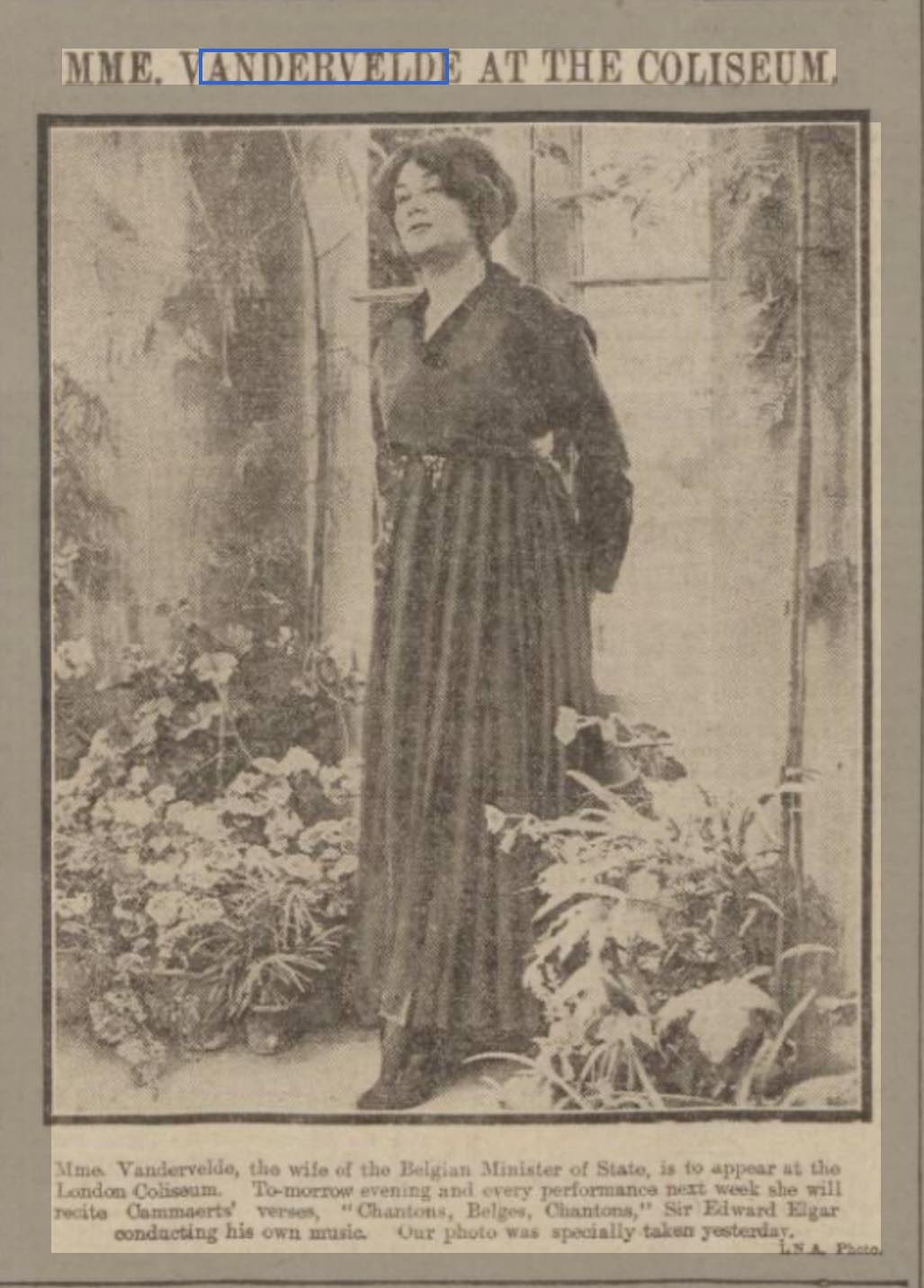
Madame Vandervelde zal optreden in het Coliseum, Londen. The Manchester Courier, 2 oktober 1915

Na terugkeer in Groot-Brittannië in april 1915 zette Lalla Vandervelde zich tomeloos in voor haar Belgische medeburgers, zowel voor de vluchtelingen in de UK als voor het Belgische leger. Haar echtgenoot verbleef ook in Engeland, zij aan zij vroegen zij aandacht voor de goede zaak van België.

Verder onderzoek
In de afgelopen drie blogs heb ik een poging gewaagd een deel van het levensverhaal van Lalla Vandervelde-Speyer te vertellen. Ze was een markante, ja, legendarische vrouw. Zeker als ik haar rol voor de versierde meelzakken in WO I in beschouwing neem.
Toch is er weinig over haar geschreven. Waar ze is genoemd zijn soms blatante onjuistheden gedebiteerd. Nadat ze gescheiden was van Emile Vandervelde en weer in Engeland woonde, is ze ogenschijnlijk uit de publiciteit verdwenen.  Op 95-jarige leeftijd is zij overleden in Putney.
Twintig jaar lang waren Lalla Speyer en Emile Vandervelde partners met grote wederzijdse invloed op elkaars werk en leven. Ze speelden een rol op het wereldtoneel in de turbulente tijd van 1900-1920.
Verder onderzoek naar het leven van Lalla Vandervelde-Speyer wil ik van harte aanbevelen.


Aanvulling 1 oktober 2022: Lalla Vandervelde staat op Wikipedia
De kennis over Lalla Vandervelde en haar levensverhaal waaiert online uit. Vanaf 23 september 2022 heeft zij haar eigen (Engelse) bladzijde op Wikipedia.
Zoals bij haar hoort staan er onjuistheden in de tekst. Verder werken aan haar geschiedenis en méér publicaties zijn dus geboden! Ik zie uit naar het vervolg.

Portret van Lalla Vandervelde door Roger Fry, 1917; foto: wikipedia

Aanvulling 8 maart 2023:

Martine Vermandere: ‘Madame Lalla Vandervelde. A very exceptional woman.’

Martine Vermandere, Madame Vandervelde. A very exceptional woman. Gent, Amsab-ISG, 2023

Ter gelegenheid van Internationale vrouwendag heeft Amsab-Instituut voor Sociale Geschiedenis in Gent, het boek Madame Lalla Vandervelde. A very exceptional woman’ uitgebracht, geschreven door Martine Vermandere, historicus en coördinator publiekswerking bij Amsab-ISG. Het boek is verschenen in Nederlands en Frans.

Dit is het eerste boek, verschenen in België, dat Lalla Vandervelde uit de vergetelheid rukt! Vermandere beschrijft het interessante leven van Lalla en haar grote invloed op de politieke en persoonlijke ontwikkeling van haar tweede echtgenoot, de socialistische politicus Emile Vandervelde.

Film ‘Lalla Vandervelde’ naar het boek van Martine Vermandere, Amsab-ISG, 2023

Martine Vermandere schreef op basis van haar boek ook het scenario van een korte film over het leven van Lalla Vandervelde. Te zien online op de website van Amsab-ISG: ‘Lalla Vandervelde’


Dank aan Evelyn McMillan, Stanford University. Zij stuurde mij foto’s van versierde meelzakken in de collecties van de Herbert Hoover Presidential Library Museum en de Hoover Institution Archives.

‘Zakken zijn vol herinneringen. Iedere zak koestert een kostbaar en kwetsbaar verhaal.’


[1] Vandervelde, Lalla, Monarchs and Millionaires. London: Thornton Butterworth Limited, 1925

[2] New York Evening World, 3 april 1915

[3] De Legerbode, 24 april 1915; zie ook De Gentenaar. De landwacht. De kleine patriot, 28 april 1915

[4] De Legerbode, 2 september 1915

Madame Vandervelde Fund 2: 300,000 dollar donations (ENG)

To me, the WWI decorated flour sacks of the Madame Vandervelde Fund stand out. It makes me happy to know that there was a woman who came to the rescue of the Belgian people with conviction. That woman was Lalla Vandervelde-Speyer (Camberwell, England, April 4, 1870 – Putney, England, November 8, 1965). She is one of the many women who worked determinedly towards her goal: care for destitute Belgian compatriots. Her decorated flour sacks also tell the story of charity, gratitude and food aid.
This is part 2 of a series of three blogs.
(See my blogs: Madame Vandervelde Fund 1 and Madame Vandervelde Fund 3)

In her biography “Monarchs and Millionaires”, published in 1925, Lalla Vandervelde gave her personal impressions of her six-month stay in America in four chapters, totaling 60 pages. I provide an anthology of stories from the book.[1]

The “Madame Vandervelde Fund” stamp on the unprocessed flour sack “Gold Dust”, Thornton & Chester, Buffalo, NY. (see also photos below) Collection RAHM Tx 2630

In Antwerp
In Antwerp, fleeing from the advancing German army, Lalla stayed with her husband at Hotel St. Antoine and experienced an air raid of German Zeppelins for the first time in her life. She was terrified by the sound of falling and detonating bombs.

The following evening she stood in the hotel hallway and met with Mr. E. Alexander Powell, correspondent of the American newspaper “New York World”, who said to her “Why don’t you go over to the States and enlist the sympathy of American women and children for the poor Belgians? ” The suggestion opened her eyes to what she could do, and she immediately took action to realize it. She did not want to embark on the adventure without the consent of the Belgian government, or at least that of Prime Minister Baron de Broqueville, so she visited him and presented her plan. His response was negative: “he liked the idea, but did not approve of a woman going alone on such a hazardous expedition, and so on and so forth”. Disillusioned, she left him, but met King Albert’s private secretary and told him about her plan.

The letter from the lady-in-waiting to Madame Vandervelde on behalf of Queen Elizabeth. From: “Monarchs and Millionaires”. Coll. International Institute of Social History

He promised to discuss it with the King and a few hours later he said that King Albert fully agreed with the plan: “He knew what influence women have in America, and sent 4,000 francs towards my traveling expenses.”

Queen Elizabeth in turn instructed a lady-in-waiting to send Madame Vandervelde a letter approving the project, wishing her the best of luck and indicating that she could take the letter with her to read it out in America.

The first Belgian missions to North-America [1a]

The Belgian Mission (the “Atrocity Commission”): Messrs De Sadeleer, Vandervelde, Henri Carton de Wiart and Hymans. The Sun, September 12, 1914

The Belgian Mission (the “Atrocity Commission”) appointed by King Albert, including her husband Emile Vandervelde, left on September 3 with the White Star Liner “Celtic” and arrived in New York on September 12. I have read this in American newspapers. In her biography, Lalla has not written a single word about the mission, not even about her husband.

Liverpool harbour in 1914. Image: online

Because Lalla was not allowed to travel on the same ship – “no women ever, or could, in any circumstances, accompany a diplomatic mission” – it was not easy to book a cabin on the next ship. With the help of British former ambassador to Japan, Sir Claude MacDonald, she managed to leave Liverpool for New York on September 8, 1914 on the White Liner “Cretic”.

Port of Liverpool Building, around 1914. Image: online

The war had raged for over four weeks now and 75 percent of the Belgian territory was in the hands of the Germans. During the ten days at sea, there would be no news reports for the passengers. For Lalla, that felt unbearable, and she got a radio operator to promise to inform her in secret should there be any news to report. On September 14th she received a signal and heard that the Germans had been stopped in their advance in France.

On board she prepared her mission: to evoke sympathy from the Americans by telling them as an eyewitness about the horrors that had taken place in Belgium. She hoped to influence the public opinion and appeal to the well-known generosity of Americans to ease the fate of Belgian refugees. At that time, she did not know that within three months the catastrophe would be much greater and the question was how to feed all the Belgians who lived in occupied territory, this number would grow to 7.5 million people…

Lalla Vandervelde, “Monarchs and Millionaires”. title page of her biography. Coll. International Institute of Social History

She spoke to two fellow travelers, Mr. Augustus Gardner, a member of the United States Congress, and Mr. McEnerney, a highly skilled lawyer from San Francisco, and took their valuable advice on how to frame her propaganda. She realized that she should tell her story in simple terms and without emotion. Only then could she count on support from the people of the US, where many pro-German sentiments were present. The evening before arriving in New York, the captain gave her the opportunity to tell her story on board the ship. She raised an initial amount of $ 360.

In New York City
September 18, 1914, upon arriving from the “Cretic” in New York on a sunny, warm day, she dressed in a colorful summer outfit without thinking about her role. The reaction of a fellow traveler made her realize that her choice of clothing should support her message, so she had her wardrobe dyed black in New York.

Once disembarked, reporters and photographers swarmed around her, but she did not give interviews or comments. She first wanted to speak to the Belgian Relief Committee*) to find out what she could and could not say. The Belgian Consul General, Mr. Mali, picked her up at the port and brought her to her place to stay. The next day, she received a secretary, Miss Conklin, who assisted her for six months.

The Evening World, New York, September 18, 1914

On September 18th, in the Evening World, the evening edition of the New York World, correspondent Alexander Powell’s newspaper, an article with photo appeared under the headline “Mme. Vandervelde brings note from Queen Elizabeth. Wife of Belgian Minister of State Here to Appeal to Americans. Woman envoy here to appeal for aid for destitute Belgians.

Manhattan, New York, 1910. Image: online

Travelling in America
Lalla Vandervelde began her adventure, she humorously reports on her visits to millionaires and dignitaries in her book. Her hostesses and hosts have mostly remained anonymous, so she could poke fun at their boredom, their lack of knowledge about culture, their lack of knowledge of international politics, their dependence on staff. In general, she was “full of pity for this poor millionaire”. She also met a young super millionaire who couldn’t give her money. “the money he devoted to charities was managed and distributed by a committee of specialists in economics, in social hygiene or in some other form of benevolence. This struck me as being a logical, if unpleasant, way of distributing riches.”

Another anecdote: “I spoke on that day to a room full of very expensive looking people. The women …, wore the most outrageous clothes. But they were interested, in their own way in the War, and had made it the fashion to knit very brightly-coloured silk scarves to send to the British and French boys at the front. It was maddening to have to speak about the horrors of the War to the clicking of knitting needles…” Then a pug entered the room as it could no longer live without its owner, but it squeaked, barked and ran around, so she had to stop talking until the dog was removed, along with his mistress. Conclusion: “I did not get anything like the money I expected from that rich audience.”

People with small incomes, drivers and servants in restaurants, clothing workers, went out of their way and collected money, which they handed over with a few kind, encouraging words.

Decorated flour sack “Madame Vandervelde Fund”, embroidered. Courtesy Herbert Hoover Presidential Library Museum. Photo: E. McMillan

Lalla was very pleased with the American female and male journalists and had a good working relationship with them. She recalled a New York dinner party with six female journalists as one of the most interesting experiences during her American stay. “They were eager, tired looking women. Most of them had been married young and badly treated by their husbands, whom they had divorced. This meant poverty, and not infrequently one or two children to bring up. They were very naturally proud at having made a success of life and told me details of the terrible struggles they had gone through. Most of them hated men with an extraordinary active and vital hatred. Only one of them said she was still in love with her husband, but as he was exploiting her, she felt she ought to leave him. She spoke as if she were ashamed of her love and reluctance to be free.

I had never met so many women in the same circumstances. They were not soured or embittered, but proud and happy, especially when they spoke about their children, who were mostly grown up and prepared, through their mothers’ struggles for the battle of life”.

With Lalla’s interest in the role of women, she portrayed American society in late 1914, early 1915: “There is no stigma attached to certain kinds of work, as there was in Europe before the War, and a woman’s scope is infinitely wider than at home.”

Le XXsiecle: journal d’union et d’action catholique, January 16, 1915

Messages in Belgian newspapers
After three months, some Belgian newspapers reported on Madame Vandervelde’s mission. [2]

“In America – The charitable movement in favor of suffering Belgium is growing daily. This is how Mrs. Lalla Vandervelde, returning to New York from a three-month trip through the United States, brought in donations in kind and in cash for the sum of $ 213,000. She continues her fruitful journey.”

The Mill Thornton & Chester in Buffalo, NY. Image: online

Another article featured the news of a large donation of Buffalo sacks of flour, saying that the sacks were intended for reuse: “Madame Vandervelde, the wife of the Secretary of State, has been in the United States for more than three months. There she gave and gives a series of lectures about Belgium and the horrors of which the country has fallen victim, that have been overwhelmingly successful and in which Belgium and the Belgians have been praised. … After these meetings, donations for families of Belgian victims pour in. Madame Vandervelde has already collected almost 1,400,000 francs!

Unprocessed flour sack “Gold Dust” from Thornton & Chester, Buffalo, NY. The back of the flour sack is stamped with “Madame Vandervelde Fund”. (see photo above) Coll. RAHM Tx 2630

In Buffalo, industrialists have loaded her with a ship with 10,000 sacks of flour – sacks made of fine cloth and fine fabric, so that they can then be used and transformed into clothes and towels for the Belgians.
Madame Vandervelde was in Boston last week where her lectures were attended by 5,000 people.[3]]


Madame Vandervelde Fund
I became aware of the fund thanks to the WWI decorated flour sacks in museum collections in Belgium and the US, decorated with her name. I therefore asked myself: how large was the organization, who formed the board?

Decorated flour sack “Gold Dust”, Thornton & Chester, Buffalo, NY, embroidered. The back of this flour sack may have been stamped “Madame Vandervelde Fund”. The flour sack is exhibited in the permanent display of the Royal Military Museum, Brussels. Coll. War Heritage Institute

According to Lalla Vandervelde’s biography, she founded the Madame Vandervelde Fund to house the large amounts of collected dollars. However, the structure of the fund was very simple: it consisted of the two-woman organization of Madame herself and her secretary Miss Conklin! Lalla Vandervelde: “I have always been proud to think that we two women, without any committee to back us, organized my campaign, which produced in material things alone 300,000 dollars or, what was at that time, a million and a half francs.”

To be continued.
Read here my blog Madame Vandervelde Fund 3

*) The Belgian Relief Committee: Jeffrey B. Miller mentioned Madame Vandervelde in relation to the Belgian Relief Committee in his first book “Behind the Lines“, Millbrown Press, 2014, at p. 226 en 227:

“The Belgian Relief Committee had been founded in the late summer by a “few modest Belgians and their sympathizers,” according to one magazine article. At its head was Rev. J. F. Stillemans, a Catholic priest of Belgian birth …
Stillemans got involved in trying to
help the Belgian refugees and became the president of the Belgian Relief Committee. The chairman of the executive committee, and the real power behind the group, was Robert W. de Forest, the vice president of the American Red Cross. During a vacation in Europe that was interrupted by the start of the war, he had seen the Belgian devastation. When he returned home he started the group outside the confines of the Red Cross.  The Belgian members of de Forest’s organization included the Belgian consul in New York, the Belgian minister to the United States, and a well-to-do patron, Madame Vandervelde. …
She had become a darling of New York City, and the country, when she announced she would not go home until she had collected $1 million to aid her country.”


“Sacks are full of memories. Every sack cherishes a precious and vulnerable story.”

My sincere thanks to Dr. Ingrid De Meûter and Ria Cooreman of the Royal Art & History Museum in Brussels. They gave me the opportunity to study the museum’s WWI collection of flour sacks, the so-called “Errera Collection”, which includes two unprocessed flour sacks from the Madame Vandervelde Fund, on February 21, 2020.

[1] Vandervelde, Lalla, Monarchs and Millionaires. London: Thornton Butterworth Limited, 1925

[1a] Amara, M., La propaganda belge et l’image de la Belgique aux États-Unis pendant la Première Guerre mondiale. Revue belge d’histoire contemporaine, XXX 2000, 1-2, p. 173-226. (p. 184)

[2] L’écho belge- journal quotidien du matin paraissant à Amsterdam, December 16, 1914

[3] Le XXsiecle: journal d’union et d’action catholique, January 16, 1915; translated from French

Madame Vandervelde Fund 2: Opbrengst 1,5 miljoen francs

De versierde meelzakken in WO I van het Madame Vandervelde Fund springen er voor mij uit. Het maakt me blij te weten dat er een vrouw is geweest die met overtuiging de bevolking van België te hulp is gekomen. Die vrouw is Lalla Vandervelde-Speyer (Camberwell, Engeland, 4 april 1870 – Putney, Engeland, 8 november 1965). Zij is een van de zeer vele vrouwen die vastberaden werkten aan haar doel: zorg voor hulpbehoevende Belgische landgenoten. Ook haar versierde meelzakken vertellen het verhaal van liefdadigheid, dankbaarheid en voedselhulp.
Dit is deel 2 van een serie van drie blogs.
(Lees hier mijn blogs Madame Vandervelde Fund 1 en Madame Vandervelde Fund 3)

In haar biografie ‘Monarchs and Millionaires’, verschenen in 1925, gaf Lalla Vandervelde in vier hoofdstukken, totaal 60 bladzijden, haar persoonlijke indrukken over haar verblijf van zes maanden in Amerika. Ik geef een bloemlezing van verhalen uit het boek.[1]

Het stempel van het ‘Madame Vandervelde Fund’ op de onbewerkte meelzak ‘Gold Dust’, Thornton & Chester, Buffalo, NY. (zie ook foto’s hieronder) Collectie KMKG/MRAH Tx 2630

In Antwerpen
In Antwerpen, op de vlucht voor het oprukkende Duitse leger, verbleef Lalla met haar man in Hotel St. Antoine en maakte voor het eerst in haar leven een luchtaanval van Duitse Zeppelins mee. Het geluid van vallende en ontploffende bommen vond ze angstaanjagend.

De volgende avond stond ze in de hal van het hotel en kwam in gesprek met meneer E. Alexander Powell, correspondent van de Amerikaanse krant de ‘New York World’, die tegen haar zei: “Why don’t you go over to the States and enlist the sympathy of American women and children for the poor Belgians?” De suggestie opende haar ogen voor wat zíj kon doen en ze ging onmiddellijk tot actie over om het te realiseren. Zonder instemming van de Belgische regering, of op z’n minst die van de premier Baron de Broqueville wilde ze het avontuur niet aangaan, zodat ze hem opzocht en haar plan voorlegde. Zijn reactie was negatief: “he liked the idea, but did not approve of a woman going alone on such a hazardous expedition, and so on and so forth”. Ontgoocheld verliet ze hem, maar ontmoette de privé-secretaris van Koning Albert en vertelde hem over haar plan.

De brief van de hofdame aan Madame Vandervelde namens Koningin Elizabeth. Uit: ‘Monarchs and Millionaires’. Coll. IISG

Deze beloofde het met de Koning te bespreken en enkele uren later berichtte hij dat Koning Albert volledig instemde met het plan: “He knew what influence women have in America, and sent 4.000 francs towards my travelling expenses.”
Koningin Elizabeth gaf op haar beurt een hofdame opdracht Madame Vandervelde een brief te sturen, waarin ze het project goedkeurde, haar veel succes wenste en aangaf dat ze de brief kon meenemen om voor te lezen in Amerika.

De eerste Belgische missies naar Noord-Amerika [1a]

Het Belgisch gezantschap: de heren De Sadeleer, Vandervelde, Henri Carton de Wiart en Hymans. The Sun, 12 september 1914

Het Belgisch gezantschap (de ‘Atrocity Commission’) benoemd door Koning Albert, waaronder echtgenoot Emile Vandervelde, vertrok op 3 september met de White Star Liner ‘Celtic’ en arriveerde op 12 september in New York. Dit heb ik gelezen in Amerikaanse kranten. Lalla heeft in haar biografie met geen woord meer geschreven over het gezantschap, zelfs niet over haar man.

Liverpool haven in 1914

Omdat Lalla niet mocht meereizen op hetzelfde schip –‘no women ever had, or could, in any circumstances, accompany a diplomatic mission’- was het niet eenvoudig direct plaats te krijgen op een volgend schip. Met hulp van de Britse oud-ambassadeur in Japan, Sir Claude MacDonald, slaagde ze erin op 8 september 1914 vanuit Liverpool naar New York te vertrekken op de White Liner ‘Cretic’.

Port of Liverpool Building, omstreeks 1914

De oorlog woedde inmiddels ruim 4 weken en België was voor driekwart in handen van de Duitsers. De tien dagen op zee zou er voor de passagiers geen ontvangst van nieuwsberichten zijn. Voor Lalla voelde dat onverdragelijk en ze kreeg een radiotelegrafist zo ver om haar toe te zeggen dat hij haar in het geheim zou informeren, mocht er nieuws te melden zijn. Op 14 september kreeg ze een seintje en hoorde dat de Duitsers een halt was toegeroepen in hun opmars in Frankrijk.

Ze bereidde aan boord haar missie voor: de sympathie oproepen van de Amerikanen door hen als ooggetuige te vertellen over de verschrikkingen, die hadden plaatsgevonden in België. Ze hoopte er de publieke opinie mee te beïnvloeden en beroep te doen op de bekende gulheid van Amerikanen om het lot van de Belgische vluchtelingen te verlichten. Op dat moment wist ze niet dat binnen drie maanden de catastrofe veel groter zou zijn en dat de vraag was hoe alle Belgen te voeden, die in bezet gebied verbleven, dit aantal groeide tot 7,5 miljoen mensen…

Lalla Vandervelde, titelblad van haar biografie ‘Monarchs and Millionaires’. Coll. IISG

Ze sprak met twee medereizigers, de heer Augustus Gardner, lid van het Amerikaanse Congres en de heer McEnerney, een hooggeleerde jurist uit San Francisco en nam hun waardevolle adviezen aan hoe ze haar propaganda zou moeten inkleden. Ze besefte dat ze haar verhaal in eenvoudige bewoordingen en zonder emotie zou moeten vertellen. Alleen dan kon ze rekenen op steun van de mensen in de VS, waar ook veel pro-Duitse sentimenten leefden. De avond voor aankomst in New York gaf de kapitein haar gelegenheid haar verhaal te doen aan boord van het schip. Ze haalde een eerste bedrag van 360 dollar op.

In New York
Bij aankomst van de ‘Cretic’ in New York op een zonnige, warme dag kleedde ze zich zonder verder na te denken over haar rol, in een kleurrijke zomerse outfit. Door de reactie van een medereizigster realiseerde ze zich dat haar kledingkeuze haar boodschap zou moeten ondersteunen, dus liet ze in New York haar garderobe zwart verven.
Eenmaal van boord zwermden verslaggevers en fotografen om haar heen, maar ze gaf geen interviews of kommentaar. Eerst wilde ze spreken met het Belgian Relief Committee*) om te weten wat ze wel en niet kon zeggen. De Belgische consul-generaal, de heer Mali, haalde haar op in de haven en bracht haar naar haar logeeradres. De volgende dag kreeg ze beschikking over een secretaresse, Miss Conklin, die haar zes maanden heeft bijgestaan.

The Evening World, New York, 18 september 1914

Op 18 september verscheen in de Evening World, de avondeditie van de New York World, de krant van correspondent Alexander Powell, een artikel met foto, onder de kop ‘Mme. Vandervelde brings note from Queen Elizabeth. Wife of Belgian Minister of State Here to Appeal to Americans. Woman envoy here to appeal for aid for destitute Belgians.

Manhattan, New York, 1910

Op reis in Amerika
Lalla Vandervelde ging het avontuur aan en in haar boek heeft ze op humoristische wijze verslag gedaan van haar bezoeken aan miljonairs en hoogwaardigheidsbekleders. Haar gastvrouwen en gastheren zijn meestal anoniem gebleven, ze stak de draak met hun verveling, hun gemis aan kennis over cultuur, hun gemis aan kennis over internationale politiek, hun afhankelijkheid van personeel. In het algemeen was ze “full of pity for this poor millionaire”. Ook ontmoette ze een jonge supermiljonair die haar geen geld kon geven. “the money he devoted to charities was managed and distributed by a committee of specialists in economics, in social hygiene or in some other form of benevolence. This struck me as being a logical, if unpleasant, way of distributing riches.”

Nog een anecdote: “I spoke on that day to a room full of very expensive looking people. The women …, wore the most outrageous clothes. But they were interested, in their own way in the War, and had made it the fashion to knit very brightly-coloured silk scarves to send to the British and French boys at the front. It was maddening to have to speak about the horrors of the War to the clicking of knitting needles…” Vervolgens kwam er een mopshond de kamer binnen, omdat die niet langer zonder zijn baasje kon, maar die piepte, blafte en rende rond, zodat ze haar verhaal moest staken tot de hond verwijderd was, samen met zijn bazin. Conclusie: “I did not get anything like the money I expected from that rich audience.”

Mensen met kleine inkomens, chauffeurs en bedienden in restaurants, kledingverzorgsters, deden hun uiterste best en brachten bedragen bij elkaar, die ze met enkele vriendelijke, bemoedigende woorden overhandigden.

Versierde meelzak Madame Vandervelde Fund, geborduurd. Courtesy Herbert Hoover Presidential Library Museum. Foto: E. McMillan

Lalla was goed te spreken over de Amerikaanse vrouwelijke en mannelijke journalisten en had een prima werkrelatie met hen. Een New Yorkse dinner party met 6 vrouwelijke journalisten noemde ze een van de meeste interessante ervaringen tijdens haar Amerikaanse verblijf. “They were eager, tired looking women. Most of them had been married young and badly treated by their husbands, whom they had divorced. This meant poverty, and not infrequently one or two children to bring up. They were very naturally proud at having made a success of life and told me details of the terrible struggles they had gone through. Most of them hated men with an extraordinary active and vital hatred. Only one of them said she was still in love with her husband, but as he was exploiting her, she felt she ought to leave him. She spoke as if she were ashamed of her love and reluctance to be free.

I had never met so many women in the same circumstances. They were not soured or embittered, but proud and happy, especially when they spoke about their children, who were mostly grown up and prepared, through their mothers’ struggles for the battle of life”.

Met Lalla’s interesse in de rol van de vrouw gaf ze haar beeld op de Amerikaanse samenleving eind 1914, begin 1915: “There is no stigma attached to certain kinds of work, as there was in Europe before the War, and a woman’s scope is infinitely wider than at home.”

Le XXsiecle: journal d’union et d’action catholique, 16 januari 1915

Berichten in Belgische kranten
Na drie maanden berichtten enkele Belgische kranten over Madame Vandervelde’s missie. ‘En Amérique – Le mouvement charitable en faveur de la Belgique qui souffre prend journellement de l’ampleur. C’est ainsi que Mme. Lalla Vandervelde, retour à New York d’un voyage de trois mois aux Etats Unis en a rapporté des dons en nature et en espèces pour une somme de 213.000 dollars. Elle continue son voyage fructueux’.[2]

Maalderij Thornton & Chester, Buffalo, NY

Een ander artikel bevatte het nieuws van een grote donatie van zakken meel uit Buffalo, met de opmerking dat de zakken bedoeld zijn voor hergebruik: ‘Madame Vandervelde, de vrouw van de Minister van Staat, is al meer dan drie maanden in de Verenigde Staten. Ze gaf en geeft daar over België en de gruwelen, waarvan het land slachtoffer is geworden, een reeks lezingen die overweldigend succes hebben en waarin België en de Belgen alle lof krijgen toegezwaaid. … Na deze bijeenkomsten stromen de donaties voor families van Belgische slachtoffers binnen. Madame Vandervelde heeft op dit moment al bijna 1.400.000 francs ingezameld!

Onbewerkte meelzak ‘Gold Dust van Thornton & Chester, Buffalo, NY. De achterzijde van de meelzak is bedrukt met ‘Madame Vandervelde Fund’. (zie foto hierboven) Coll. KMKG/MRAH Tx 2630

In Buffalo hebben industriëlen haar een schip geladen met 10.000 zakken meel geschonken – zakken gemaakt van fijn doek en van fijne stof, zodat deze vervolgens gebruikt kunnen worden en getransformeerd tot kleding en handdoeken voor de Belgen.
Afgelopen week was Madame Vandervelde in Boston waar haar lezingen door 5000 mensen zijn bijgewoond.’[3]

Madame Vandervelde Fund
Het fonds is mij bekend dankzij de versierde meelzakken van WO I in museumcollecties in België en de VS. Ik vroeg me daarom af: hoe groot was de organisatie, wie vormde het bestuur?

Versierde meelzak ‘Gold Dust’, Thornton & Chester, Buffalo, NY, geborduurd. De achterzijde van deze meelzak is misschien voorzien van het stempel van het Madame Vandervelde Fund. De meelzak is tentoongesteld in de vaste opstelling van het Koninklijk Legermuseum, Brussel. Coll. War Heritage Institute

Blijkens de biografie van Lalla Vandervelde stichtte zij het Madame Vandervelde Fund om de grote bedragen aan ingezamelde dollars in onder te brengen. De structuur van het fonds was echter zeer eenvoudig van opzet: het bestond uit de twee vrouws-organisatie van Madame zelf en haar secretaresse Miss Conklin! Lalla Vandervelde: “I have always been proud to think that we two women, without any committee to back us, organized my campaign, which produced in material things alone 300,000 dollars or, what was at that time, a million and a half francs.”

Versierde meelzak Madame Vandervelde Fund, borduurwerk, kant. Gold Dust, Thornton&Chester, Buffalo, NY. Part. coll. in België; Uit: Ucclensia, Uccle ’14-’18, foto: L. Schrobiltgen

Wordt vervolgd.
Lees hier mijn blog Madame Vandervelde Fund 3


*) The Belgian Relief Committee: Jeffrey B. Miller noemde Madame Vandervelde in relatie tot het Belgian Relief Committee in zijn eerste boek ‘Behind the Lines‘, Millbrown Press, 2014, op p. 226 en 227:

‘The Belgian Relief Committee had been founded in the late summer by a “few modest Belgians and their sympathizers,” according to one magazine article. At its head was Rev. J. F. Stillemans, a Catholic priest of Belgian birth …
Stillemans got involved in trying to
help the Belgian refugees and became the president of the Belgian Relief Committee. The chairman of the executive committee, and the real power behind the group, was Robert W. de Forest, the vice president of the American Red Cross. During a vacation in Europe that was interrupted by the start of the war, he had seen the Belgian devastation. When he returned home he started the group outside the confines of the Red Cross.  The Belgian members of de Forest’s organization included the Belgian consul in New York, the Belgian minister to the United States, and a well-to-do patron, Madame Vandervelde. …
She had become a darling of New York City, and the country, when she announced she would not go home until she had collected $1 million to aid her country.’


‘Zakken zijn vol herinneringen. Iedere zak koestert een kostbaar en kwetsbaar verhaal.’

Mijn dank gaat uit naar Dr. Ingrid De Meûter en Ria Cooreman van het Museum Kunst & Geschiedenis in Brussel. Ze hebben me de gelegenheid geboden de collectie meelzakken van WO I  van het museum, de zgn. ‘Collectie Errera’ , waarin opgenomen twee onbewerkte meelzakken van het Madame Vandervelde Fund, te bestuderen op 21 februari 2020.

[1] Vandervelde, Lalla, Monarchs and Millionaires. London: Thornton Butterworth Limited, 1925

[1a] Amara, M., La propaganda belge et l’image de la Belgique aux États-Unis pendant la Première Guerre mondiale. Revue belge d’histoire contemporaine, XXX 2000, 1-2, p. 173-226. (p. 184)

[2] L’écho belge- journal quotidien du matin paraissant à Amsterdam, 16 december 1914

[3] Le XXsiecle: journal d’union et d’action catholique, 16 januari 1915; eigen vertaling uit het Frans

Madame Vandervelde Fund 1: Appeal to American Women (ENG)

To me, the WWI decorated flour sacks of the Madame Vandervelde Fund stand out. It makes me happy to know that there was a woman who came to the rescue of the Belgian people with conviction. That woman was Lalla Vandervelde-Speyer (Camberwell, England, April 4, 1870 – Putney, England, November 8, 1965). She is one of the many women who worked determinedly towards her goal: care for destitute Belgian compatriots. Her decorated flour sacks also tell the story of charity, gratitude and food aid.
This is part 1 of a series of three blogs.
(See my blogs: Madame Vandervelde Fund 2 and Madame Vandervelde Fund 3)

Lalla Vandervelde-Speyer, portrait in ‘The Spell of Belgium’ by Isabel Anderson. Photo: Mathilde Weil, Philadelphia

Charlotte Helen Frederica Maria Speyer was British-born, from an affluent Jewish family. Her parents were German by birth and settled in England after their marriage in 1869, where father Edward Antoine Speyer had previously joined his older brother Carl in 1859 in a very successful haberdashery importing business. Lalla came to Brussels as a 16-year-old teenager to continue her education.
She married Belgian mining engineer Hubert François Edouard Ferdinand (Ferdinand) Kufferath (ºSaint-Josse-ten-Noode 1855.07.28 – †Schaerbeek, 1920.07.14) in Reigate, Surrey, UK, on 19 January 1892 and would continue to live in Belgium. The couple divorced officially on January 3, 1901.

Lalla Speyer’Kufferath’ remarried on 15 February 1901 in Fulham, London, to the Belgian socialist politician Emile Vandervelde (ºElsene 1866.01.25 – †Brussels 1938.12.27).

Lalla and Emile Vandervelde in Brussels, April 18, 1902, more than a year after their marriage. Photo: photo agency Zander & Labisch, coll. Deutsche Fotothek. *)


Lalla and Emile Vandervelde in England, around 1905-1910. Photographer: William Coles. Coll. Institut Emile Vandervelde

In Brussels 1914
When war broke out in August 1914 and Germany occupied Belgium, Lalla Vandervelde was forced to leave her new homeland, together with her husband who was appointed Minister of State.

Lalla was 44 years old and in the prime of her life. Her name, Madame Emile Vandervelde, -this was the Minister of State, who was her husband- appeared in ‘L’Œuvre des femmes bruxelloises’ as one of the presidents, next to ladies Henry Carton de Wiart and Paul Hymans, to whom Queen Elizabeth requested that they take care of children of military personnel who went to battle with the army. The vice-presidents were Messrs. Brassine, Leroy, Prosper, Poullet, Paul Vandervelde and Philippson-Wiener. The Queen was the patroness of the organization.[1]

Photo-collage unprocessed flour sacks, Phototypie Belge. Collection In Flanders Fields Museum

Lalla’s work experience for the socialist movement, her women’s suffrage activities and her completely autonomous nature led to immediate decisive action in the crisis situation of the first weeks of the war.

She published this advice in the newspaper Le Soir to women who wanted to make themselves useful.[2]

“For those who want to help
An excellent letter from Ms. Vandervelde:
Many women and girls have been writing to me for the past few days asking for advice on how to be helpful in these scary days. The ambulances are full of women of goodwill, but there are many who are just waiting to be of service to their country. I would like, as it is impossible for me to answer each of them individually, advise them to sew a lot of men’s shirts, children’s dresses, knit socks, etc.
The blue smocks of civic guards, too, which are urgently needed, are cut out, all ready to be sewn, 3 Rue de Louvain, at one of the ministry’s offices. By going there on my part, they will gladly give it to all those who request it.
Let friends’ groups form: let one of them take a book and read it to their friends. Not light reading. We are in a phase of heroism and women, mothers and expectant mothers must not let their emotions take over. By their calm and cold blood, they can do precious services right now. What to read? The History of France by Michelet; The History of Belgium, of Pirenne; The Legend of the Centuries, The Turbulent Forces, by Emile Verhaeren, etc. I note these few titles in a hurry, but in each one you will find beautiful pages which have already allowed them to endure the consequences of existence.

Lalla VANDERVELDE

P.S. – I beg the merchants of cigars and cigarettes and the individuals of good will to send me something to smoke for our soldiers, soldiers and wounded. If they could get an idea of the joy of our brave people when they are given something to smoke, I am sure that my house would be too small to contain everything that would be sent to me.”

To America
Lalla Vandervelde was still in Brussels when she wrote the quoted advice. Two weeks later she had to leave to stay out of the hands of the advancing German troops and she moved to Antwerp. On the spot, the plan arose to travel to America to ask for help from the women there. On September 1, 1914, she sent a telegram to New York calling on American women to come to the aid of the Belgian people.

The New York Times posted the “Appeal” in the Sept. 2 edition on p. 3 under the heading:
SENDS AN APPEAL TO AMERICAN WOMEN

Mme. Vandervelde Coming Here to Tell of Belgian War Victims’ Sufferings.
HAS LETTER FROM QUEEN
Wife of Socialist Leader Will Sail for New York in a Few Days- Says the Need is Terrible.”

The article read:
“LONDON, Sept. 1.-Mme Vandervelde, the brilliant wife of the famous Socialist leader who is now Minister of State in the Belgian Government of National Defense, sends the following appeal to the women of America through the columns of The New York Times:
Women and Friends in America: I am coming to ask your sympathy on behalf of my fellow-countrymen in Belgium. It is not a political mission. It is an appeal for help for devastated homes, the fatherless families of those whom this terrible war has left houseless, who, when the war is over, will be left without rooftrees, without money to rebuild them, and-and all too often-without sons or husbands to work for them.

I am the bearer of a letter from our well-loved Queen. I only ask you to give me an opportunity of reading it to you and telling you in person of our tragic conditions and of asking your help. I am leaving Antwerp only for this purpose, and as soon as I have accomplished it am returning to share the fate of my countrymen in our besieged city.
…….

The Belgian Women’s Dollar Fund, page 38 from the book “The Voluntary Aid of America”

That is why, women of America, I am coming to you, leaving for a few weeks the country for which my heart is bleeding. I want you, I count on you, to make life worth living again for these poor people, make them by degrees forget the sorrows they have passed through.
Belgium is ruined. You are enjoying all the blessings of peace. I implore you to help my country, to make it by your generosity once more a happy home for its sons and daughters.
LALLA VANDERVELDE
Mme Vandervelde purposes to sail for New York in a few days, by which time she hopes to hear that the American women to whom she appeals have taken steps to obtain for her a hearing when she arrives.”

In Londen
Lalla Vandervelde travelled to America via London, together with “La Mission Belge aux Etats-Unis”, the Belgian mission of four ministers, who had been ordered by King Albert to explain the Belgian position on the condemnable and brutal invasion of the Germans to US President Wilson. One of the ministers was her husband Emile Vandervelde.

L’Indépendance Belge, September 5, 1914

“The Belgian Mission in the United States.
The Belgian mission to the President of the United States arrived in London Monday evening, and before his departure from this city, set for the following day, was received by the King of England at Buckingham Palace.
….
Mr. Vandervelde is accompanied by Mrs. Vandervelde, who will give lectures to women, in the cities of the United States.”[3]

Lalla and her husband assumed she could make the trip to the US on the same ship as the official Belgian delegation, but this was a miscalculation. They were formally told that: “no women ever had, or could, in any circumstances, accompany a diplomatic mission”.[4]

Rectification”, La Métropole-journal quotidien, September 5, 1914

That they were not the only ones who had expected otherwise is evident from the rectification, “because of transmission and translation” in La Métropole of September 5, 1914:
“Correcting our comments, we add that it is also incorrect that Madame Vandervelde will accompany her husband during his mission to the United States.”
The words “also incorrect” referred to an earlier newspaper report that Lalla Vandervelde was going to make the journey with a letter from Queen Elizabeth.
No, the letter was not from the “head of the court of H.M. the Queen”, but “This is a letter written by a lady from the Queen’s service to the wife of our new Minister of State, in response to her offer to make known in England, during a series of conferences, the situation in Belgium.”

It made me curious about the contents of the letter from Queen Elizabeth’s court, which Madame Vandervelde had read at the Eighty Club at the Cecil Hotel in London. Curiously, that letter left nothing to be desired for positivity and clarity:
“Sa Majesté la Reine me prie de vous dire qu’elle approuve pleinement votre intention de porter à la connaissance de l’opinion publique en Angleterre et en Amérique, les misères infligées à notre paisible population, par l’invasion allemande. Cinq de nos provinces sont dévastés, des milliers de famille chassées de leur demeure et actuellement sans domicile, et c’est une œuvre qui mérite la reconnaissance du pays et de l’humanité, que de chercher à les secourir. Les meilleurs souhaits de la Reine vous accompagnent dans ces deux pays, qui auront à coeur de donner assistance à ceux en détresse”.

(“Her Majesty the Queen has asked me to tell you that she fully approves of your intention to bring to the attention of public opinion in England and America the miseries inflicted on our peaceful people by the German invasion. Five of our provinces are devastated, thousands of families driven from their homes and currently homeless, and it is a work that deserves the recognition of the country and of humanity, to seek to rescue them. The Queen’s best wishes are with you in these two countries, which would be keen to give assistance to those in distress”.)

Was this a way for some gentlemen on the side of the Belgian government to show a woman, in particular a representative of the socialist movement, her place at the start of the mission to America? Was it protecting women against their desire for autonomy? In any case, it took patience and resilience to walk the line, even under war conditions…

Travelling

Decorated flour sack “Madame Vandervelde Fund”, embroidered. Courtesy Herbert Hoover Presidential Library Museum. Photo: E. McMillan

Lalla Vandervelde was in no way restrained. She traveled to New York, where “The Belgian Women’s Dollar Fund” was founded the day her “Appeal” was published in the New York Times. ‘It received its first subscriptions before noon of the same day’.[5]

This roadmap and data proof the determination of a wartime woman: Madame Lalla Vandervelde traveled around the US and Canada for six months to raise money and arouse sympathy for her Belgian compatriots. Copyright © 2021 Annelien van Kempen
Decorated flour sack “Madame Vandervelde Fund”, embroidered, phototypie. Collection In Flanders Fields Museum, inv.nr. IFF 003008

Her own “Madame Vandervelde Fund” would emerge during her impressive six-month tour in the US and Canada. She was welcomed with open arms and enthusiasm. She traveled from Syracuse to Chicago, then to St. Paul and Minneapolis. She gave speeches in the major cities of Canada. [6] She was particularly successful in collecting money in Chicago, Philadelphia and Boston. Friends in Buffalo helped her to send food aid to Belgium: flour packed in cotton sacks, which could be used to make clothes after washing and bleaching. These friends also made sure that the name “Madame Vandervelde Fund” was printed on the flour sacks.

Flour sacks that testify today to the determination of a wartime woman.

To be continued.
(See my blogs: Madame Vandervelde Fund 2 and Madame Vandervelde Fund 3)

“Sacks are full of memories. Every sack houses a fragile and precious story.”

– My sincere thanks to Evelyn McMillan, Stanford University, for the information and photos she provided to me. She mentioned Isabel Anderson’s book The Spell of Belgium and sent the New York Times article of September 2, 1914. She also sent pictures of decorated flour sacks in the collections of the Herbert Hoover Presidential Library Museum and the Hoover Institution Archives.

“75 years” medal of l’Université Libre de Bruxelles for Ferdinand Kufferath, 1909. Photo: Bram Desmet on website about Frans Kufferath

– Thanks to Hubert Bovens for his research on the biographical data of Lalla’s first husband Ferdinand Kufferath. Ferdinand was director of Société anonyme des Carrières de Porphyre de Quenast (les Almanachs de Bruxelles).


Birth and death certificates of Kufferath, Hubert François Edouard Ferdinand (Ferdinand), (ºSint-Joost-ten-Noode 1855.07.28 – †Schaarbeek, 1920.07.14) married to Charlotte Hélène Frédérique Speyer in Reigate, Surrey, UK, on ​​January 19, 1892, divorced on January 3, 1901. Kufferath remarried to Rachel Hermine Marie Vens.
Lalla and Emile Vandervelde (right), with two German socialist friends. Maison du Peuple, Brussels, Friday April 18, 1902. Photo: photoagency Zander & Labisch, coll. Deutsche Fotothek. *)

*) Sources for this photo:
– Vermandere, Martine, Madame Lalla Vandervelde. A very exceptional woman. Ghent, AMSAB IHS, 2023, p. 22,23: the photo has been published on the front page of the French magazine ‘La Vie Illustrée’, April 25, 1902, no. 184 under the heading “Le Grand Agitateur Belge – M. Vandervelde”. The caption lists the Maison de Peuple in Brussels and the names of the German Socialist deputies: Albert Sudekom (standing left) and Sigmund Haller von Hallerstein (seated left). M. Pierre was the photographer.

– Belgian written newspaper articles from April 1902 show that the photo will have been taken in the evening of April 18, 1902. Emile Vandervelde gave a speech and greeted the two German socialist friends in the room. He did not mention their names, to protect them from possible reprisals by the Belgian government.
La soiree de vendredi. Le meeting de la Maison du Peuple. ….
Vandervelde, au nom de la solidarité internationale, salue deux députés socialistes allemands présents. (longue acclamation). Je ne les nommerais pas, car je connais trop l’hospitalité du gouvernement belge pour n’être pas prudent. Mais je vous dis qu’ils souffrent de vos souffrances et je les prie d’aller dire notre merci fraternel à nos vaillants compagnons allemands. (Ovation). Avec de tels appuis et de telles forces, la grêve continuera.
(Le Peuple, April 19, 1902, p.2)
(Translation: “Friday Evening. The meeting in the House of the People. ….
Vandervelde, in the name of international solidarity, greets two German socialist deputies present. (long cheer). I won’t name them, because I know the Belgian government’s hospitality too well not to be careful. But I tell you that they suffer from your sufferings and I beg them to go and say our fraternal thanks to our valiant German companions. (Ovation). With such support and such forces, the strike will continue.”)


Notes:
[1] L’étoile belge, August 6, 1914

[2] Le Soir, August 16, 1914; Le Peuple, August 15, 1914

[3] L’Indépendance, September 5, 1914

[4] Vandervelde, Lalla, Monarchs and Millionaires. London: Thornton Butterworth Limited, 1925

[5] Williams, Jefferson and ‘Mayfair’, The Voluntary Aid of America. New York, London: 1918

[6] Anderson-Weld Perkins, Isabel, The Spell of Belgium. Boston: The Page Company, The Colonial Press, C.H. Simonds Co., 1915


Madame Vandervelde Fund 1: ‘Appeal to American Women’

De versierde meelzakken in WO I van het Madame Vandervelde Fund springen er voor mij uit. Het maakt me blij te weten dat er een vrouw is geweest die met overtuiging de bevolking van België te hulp is gekomen. Die vrouw is Lalla Vandervelde-Speyer (ºCamberwell, Engeland, 4 april 1870 – †Putney, Engeland, 8 november 1965). Zij is een van de zeer vele vrouwen die vastberaden werkten aan haar doel: zorg voor hulpbehoevende Belgische landgenoten. Ook haar versierde meelzakken vertellen het verhaal van liefdadigheid, dankbaarheid en voedselhulp.
Dit is deel 1 van een serie van drie blogs.
(Lees hier mijn blogs: Madame Vandervelde Fund 2 en Madame Vandervelde Fund 3)

Lalla Vandervelde-Speyer, portret in ‘The Spell of Belgium’ van Isabel Anderson. Foto: Mathilde Weil, Philadelphia

Charlotte Helen Frederica Maria Speyer was geboren Britse, stammend uit een welvarende, joodse familie. Haar ouders waren Duits van geboorte en vestigden zich na hun huwelijk in 1869 in Engeland, waar vader Edward Antoine Speyer zich al eerder in 1859 bij zijn oudere broer Carl had gevoegd in een zeer succesvol bedrijf dat fournituren importeerde.
Lalla kwam als 16-jarige tiener naar Brussel om haar opleiding te vervolgen.
Zij trouwde met de Belgische mijningenieur Hubert François Edouard Ferdinand (Ferdinand) Kufferath (ºSint-Joost-ten-Noode 28.07.1855 – †Schaarbeek, 14.07.1920) in Reigate, Surrey, UK, op 19 januari 1892 en zou in België blijven wonen. Op 3 januari 1901 werd de scheidingsakte van haar eerste huwelijk opgemaakt.
Ze hertrouwde op 15 februari 1901 in Fulham, Londen, met de Belgische, socialistische politicus Emile Vandervelde (ºElsene 25.01.1866 – †Brussel 27.12.1938).

Lalla en Emile Vandervelde in Brussel, 18 april 1902, ruim een jaar na hun huwelijk. Foto: fotoagentschap Zander & Labisch, coll. Deutsche Fotothek. *)


Lalla en Emile Vandervelde in Engeland, rond 1905-1910. Fotograaf: William Coles. Coll. Institut Emile Vandervelde

In Brussel 1914
Toen in augustus 1914 de oorlog uitbrak en Duitsland België bezette was Lalla Vandervelde genoopt, samen met haar echtgenoot die tot Minister van Staat werd benoemd, haar nieuwe vaderland te verlaten.

Lalla was 44 jaar en in de kracht van haar leven. Haar naam als ‘Madame Emile Vandervelde’ dook op in ‘L’Œuvre des femmes bruxelloises’ als een van de presidentes, naast de dames Henry Carton de Wiart en Paul Hymans, aan wie Koningin Elizabeth verzocht de zorg op zich te nemen van kinderen van militairen die met het leger ten strijde waren getrokken. De vice-presidentes waren de dames Brassine, Leroy, Prosper, Poullet, Paul Vandervelde en Philippson-Wiener. De Koningin was beschermvrouwe van de organisatie.[1]

Foto-collage onbewerkte meelzakken, Phototypie Belge. Collectie In Flanders Fields Museum

De werkervaring van Lalla voor de socialistische beweging, haar activiteiten voor de suffragette beweging en haar volstrekt autonome aard, leidden tot onmiddellijk slagvaardig handelen in de crisissituatie van de eerste oorlogsweken.
Ze publiceerde in de krant Le Soir dit advies aan vrouwen die zich nuttig wilden maken.[2]

‘Pour celles qui veulent aider
Une excellente letter de Mme Vandervelde:

De nombreuses femmes et jeunes filles m’écrivent depuis quelques jours pour me demander conseil sur la manière de se rendre utiles en ces jours angoissants.
Les ambulances sont pleines de femmes de bonne volonté, mais il en reste beaucoup qui ne demandent qu’a être utiles à leur pays. Je voudrais, comme il m’est impossible de répondre à chacune d’elles individuellement, leur donner le conseil de coudre des chemises d’hommes en quantité, des robes d’enfants, de tricoter des chausettes, etc.
Les blouses bleues de gardes civiques aussi, dont la confection est urgente, se trouvent découpées, toutes prêtes à être cousues, 3 Rue de Louvain, à l’un des bureaux du ministère. En y allant de ma part, on en donnera bien volontiers à toutes celles qui en feront la demande.
Que des groups d’amies se forment: que l’une d’elles prenne un livre et en fasse la lecture à ses amies. Pas de lecture émollientes. Nous sommes dans une phase de l’héroisme et les femmes, les mères et les futures mères ne doivent pas se laisser aller à leur émotion.Par le calme et le sang froid, elles peuvent rendre en ce moment de précieux services. Que lire? L’Histoire de France de Michelet; L’Histoire de Belgique, de Pirenne; La Légende des Siècles, Les Forces tumultueuses, d’Emile Verhaeren, etc. Je notes ces quelques titres en hâte, mais chacune trouvera dans ses souvenirs, de belles pages qui l’ont déja aidée à supporter les contre-coups de l’existence.

Lalla VANDERVELDE

P.S. – Je supplie les marchands de cigares et de cigarettes et les particuliers de bonne volonté de m’envoyer de quoi fumer pour nos soldats, troupiers et blessés. S’ils pouvaient se faire une idée de la joie de nos braves quand on leur apporte de quoi fumer, je suis sure que ma maison serait trop petite pour contenir tout ce qu’on m’enverrait.

Naar Amerika
Lalla Vandervelde was nog in Brussel toen ze dit advies voor de vrouwen schreef. Twee weken later moest ze vertrekken om uit handen te blijven van de oprukkende Duitse troepen en nam ze de wijk naar Antwerpen. Ter plekke ontstond het plan naar Amerika te reizen om hulp te gaan vragen aan de vrouwen daar.  De Amerikaanse reporter Edward Alexander Powell speelde een belangrijke rol in het besluit om naar Amerika te gaan, blijkt uit zijn naoorlogse boeken.

Powell, Edward Alexander, ‘Ooggetuigen uit de Grote Oorlog. Een Amerikaans reporter beleeft en beschrijft de strijd in Vlaanderen in 1914’. Bewerkt door Nicky & Anthony Langley. Davidsfonds Uitgeverij, 2013, p. 28

Oproep aan Amerikaanse vrouwen
Lalla stuurde op 1 september 1914 een telegram naar New York met oproep aan Amerikaanse vrouwen om het Belgische volk te hulp te komen. De New York Times plaatste de ‘Appeal’ in de editie van 2 september op p. 3 onder de kop:
SENDS AN APPEAL TO AMERICAN WOMEN
Mme. Vandervelde Coming Here to Tell of Belgian War Victims’ Sufferings.
HAS LETTER FROM QUEEN
Wife of Socialist Leader Will Sail for New York in a Few Days- Says the Need is Terrible.”

Het artikel luidde:
“LONDON, Sept. 1.-Mme Vandervelde, the brilliant wife of the famous Socialist leader who is now Minister of State in the Belgian Government of National Defense, sends the following appeal to the women of America through the columns of The New York Times:
Women and Friends in America: I am coming to ask your sympathy on behalf of my fellow-countrymen in Belgium. It is not a political mission. It is an appeal for help for devastated homes, the fatherless families of those whom this terrible war has left houseless, who, when the war is over, will be left without rooftrees, without money to rebuild them, and-and all too often-without sons or husbands to work for them.
I am the bearer of a letter from our well-loved Queen. I only ask you to give me an opportunity of reading it to you and telling you in person of our tragic conditions and of asking your help. I am leaving Antwerp only for this purpose, and as soon as I have accomplished it am returning to share the fate of my countrymen in our besieged city.
…….

The Belgian Women’s Dollar Fund, bladzijde 38 uit het boek ‘The Voluntary Aid of America’

That is why, women of America, I am coming to you, leaving for a few weeks the country for which my heart is bleeding. I want you, I count on you, to make life worth living again for these poor people, make them by degrees forget the sorrows they have passed through.
Belgium is ruined. You are enjoying all the blessings of peace. I implore you to help my country, to make it by your generosity once more a happy home for its sons and daughters.
LALLA VANDERVELDE
Mme Vandervelde purposes to sail for New York in a few days, by which time she hopes to hear that the American women to whom she appeals have taken steps to obtain for her a hearing when she arrives.”

In Londen
Lalla Vandervelde reisde op weg naar Amerika via Londen, tesamen met ‘La Mission Belge aux Etats-Unis’, het gezantschap van vier Ministers, die door Koning Albert was opgedragen het Belgische standpunt over de verwerpelijke en brute inval van de Duitsers te gaan toelichten bij de Amerikaanse president Wilson. Onder hen was haar man Emile Vandervelde.

L’Indépendance Belge, 5 september 1914

La Mission Belge aux Etats-Unis
La mission Belge auprès du président de la République des Etats-Unis est arrivée à Londres lundi soir, et avant son départ de cette ville, fixé au lendemain, a été reçue par le Roi d’Angleterre au palais de Buckingham.
….
Vandervelde est accompagné de Madame Vandervelde, qui donnera des conférences aux femmes, dans les villes des Etats-Unis.’[3]

Lalla en haar man gingen er van uit dat zij op hetzelfde schip als de officiële Belgische delegatie de reis naar de VS zou kunnen maken, maar dat was een misrekening. Ze kregen formeel te verstaan dat: ‘no women ever had, or could, in any circumstances, accompany a diplomatic mission’.[4]

La Métropole-journal quotidien, 5 september 1914

Dat ze niet de enige waren die anders hadden verwacht, blijkt uit de rectificatie, “vanwege transmissie en vertaling” in La Métropole van 5 september 1914:
‘Rectifiant nos commentaires, nous ajoutons qu’il est aussi inexact que Madame Vandervelde accompagne son mari au cours de sa mission aux Etats-Unis’.
De woorden ‘aussi inexact’ sloegen terug op een eerder krantenbericht dat Lalla Vandervelde met een brief van Koningin Elizabeth de reis zou gaan maken. Neen, het was geen brief van de ‘chef de la maison de S.M. la Reine’, maar ‘Il s’agit d’une lettre écrite par une dame du service de la Reine à la femme de notre nouveau ministre d’Etat, en réponse à l’offre de celle-ci de faire connaître en Angleterre, au cours d’une série de conférences, la situation de la Belgique.’

Het maakte me nieuwsgierig naar de inhoud van de brief van de hofhouding van Koningin Elizabeth, die Madame Vandervelde in de Eighty Club van het Cecil Hotel in Londen had voorgelezen. Merkwaardig genoeg liet die brief aan positiviteit en duidelijkheid niets te wensen over:
“Sa Majesté la Reine me prie de vous dire qu’elle approuve pleinement votre intention de porter à la connaissance de l’opinion publique en Angleterre et en Amérique, les misères infligées à notre paisible population, par l’invasion allemande. Cinq de nos provinces sont dévastés, des milliers de famille chassées de leur demeure et actuellement sans domicile, et c’est une œuvre qui mérite la reconnaissance du pays et de l’humanité, que de chercher à les secourir. Les meilleurs souhaits de la Reine vous accompagnent dans ces deux pays, qui auront à coeur de donner assistance à ceux en détresse”.

Was dit een manier waarop enkele heren aan de kant van de Belgische regering hun plaats wilden wijzen aan de vertegenwoordigers van de socialistische beweging bij de start van de missie naar Amerika? Was het het in bescherming nemen van vrouwen tegen hun wens tot autonomie? Hoe dan ook vergde het geduld en incasseringsvermogen om, zelfs onder oorlogsomstandigheden, in deze formele pas te moeten lopen…

Op reis

Versierde meelzak Madame Vandervelde Fund, geborduurd. Courtesy Herbert Hoover Presidential Library Museum. Foto: E. McMillan

Lalla Vandervelde liet zich op geen enkele wijze weerhouden. Ze reisde naar New York, waar ‘The Belgian Women’s Dollar Fund’ was opgericht op de dag dat haar ‘Appeal’ in de New York Times was verschenen. ‘It received its first subscriptions before noon of the same day’.[5]

Deze routekaart met data bewijst de vastberadenheid van een vrouw in oorlogstijd: Madame Lalla Vandervelde reisde zes maanden rond in de VS en Canada om geld in te zamelen en sympathie te wekken voor haar Belgische landgenoten. © 2021 Annelien van Kempen
Versierde meelzak ‘Madame Vandervelde Fund’, geborduurd, lichtdruk procédé. Collectie In Flanders Fields Museum, inv.nr. IFF 003008.

Het eigen ‘Madame Vandervelde Fund’ zou tijdens haar indrukwekkende rondreis van zes maanden door de VS en Canada ontstaan. Ze werd met open armen en enthousiasme ontvangen. Zij reisde van Syracuse naar Chicago, daarna naar St.Paul en Minneapolis. Ze hield redevoeringen in de grote steden van Canada.[6] Vooral in Chicago, Philadelphia en Boston was ze zeer succesvol met de inzameling van geld. In Buffalo hielp een vriend om voedselhulp naar België te versturen: meel verpakt in katoenen zakken, die na wassen en bleken gebruikt zouden kunnen worden om kleding van te maken. De vriend zorgde er ook voor dat de naam ‘Madame Vandervelde Fund’ op de meelzakken werd gedrukt.

Meelzakken die heden ten dage getuigen van de vastberadenheid van een vrouw in oorlogstijd.

Wordt vervolgd.
Lees hier mijn blogs: Madame Vandervelde Fund 2 en Madame Vandervelde Fund 3

“Zakken zijn vol herinneringen. Iedere zak koestert een kostbaar en kwetsbaar verhaal.”

– Mijn grote dank aan Evelyn McMillan, Stanford University, voor de vele informatie en foto’s die ze mij ter beschikking heeft gesteld. Ze wees me op het boek The Spell of Belgium van Isabel Anderson en stuurde me het artikel uit de New York Times van 2 september 1914. Ook stuurde ze mij foto’s van versierde meelzakken in de collecties van de Herbert Hoover Presidential Library Museum en de Hoover Institution Archives.

Penning 75 jaar Vrije Universiteit Brussel voor Ferdinand Kufferath, 1909. Foto: Bram Desmet op website over Frans Kufferath

– Dank aan Hubert Bovens voor de opzoekingen van biografische gegevens van Lalla’s eerste echtgenoot Ferdinand Kufferath. Hij was directeur van Société anonyme des Carrières de Porphyre de Quenast (les Almanachs de Bruxelles).

Geboorte- en overlijdensakten van Kufferath, Hubert François Edouard Ferdinand (Ferdinand), (ºSint-Joost-ten-Noode 28.07.1855 – †Schaarbeek, 14.07.1920) gehuwd met Charlotte Hélène Frédérique Speyer in Reigate, Surrey, UK, op 19 januari 1892, gescheiden op 3 januari 1901. Kufferath hertrouwde met Rachel Hermine Marie Vens.
Lalla en Emile Vandervelde (rechts) met twee Duitse socialistische vrienden. Maison du Peuple, Brussel, vrijdag 18 april 1902. Fotoagentschap Zander & Labisch, coll. Deutsche Fotothek *)

*) Bronnen bij deze foto:
– Vermandere, Martine, Madame Lalla Vandervelde. A very exceptional woman. Gent, AMSAB IHS, 2023, p. 22,23: de foto blijkt gepubliceerd te zijn op de voorpagina van het Franse tijdschrift ‘La Vie Illustrée’, 25 april 1902, nr. 184 onder de kop ‘Le Grand Agitateur Belge – M. Vandervelde’. Het bijschrift vermeldt de locatie Maison du Peuple in Brussel en de namen van de Duitse socialistische afgevaardigden: Albert Sudekom (staand links) en Sigmund Haller von Hallerstein (zittend links). M. Pierre was de fotograaf.

– Belgische geschreven krantenartikelen van april 1902 tonen aan dat de foto zal zijn genomen in de avond van 18 april 1902. Emile Vandervelde hield een toespraak en groette daarin de twee Duitse socialistische vrienden in de zaal. Hij noemde hun namen niet, om hen te beschermen tegen mogelijke represailles van de Belgische overheid.
La soirée de vendredi. Le meeting de la Maison du Peuple.   ….
Vandervelde, au nom de la solidarité internationale, salue deux députés socialistes allemands présents. (longue acclamation). Je ne les nommerais pas, car je connais trop l’hospitalité du gouvernement belge pour n’être pas prudent. Mais je vous dis qu’ils souffrent de vos souffrances et je les prie d’aller dire notre merci fraternel à nos vaillants compagnons allemands. (Ovation). Avec de tels appuis et de telles forces, la grêve continuera.’
(Le Peuple, 19 april 1902, p.2.)

Noten:
[1] L’étoile belge, 6 augustus 1914

[2] Le Soir 16 augustus 1914; Le Peuple 15 augustus 1914

[3] L’Indépendance, 5 september 1914

[4] Vandervelde, Lalla, Monarchs and Millionaires. London: Thornton Butterworth Limited, 1925

[5] Williams, Jefferson and ‘Mayfair’, The Voluntary Aid of America. New York, London: 1918

[6] Anderson-Weld Perkins, Isabel, The Spell of Belgium. Boston: The Page Company, The Colonial Press, C.H. Simonds Co., 1915

Trotting on a flour sack

Ball games have always been around in history. How nice would it be if balls were to appear on decorated flour sacks from WWI: printed on the original flour sack in North America or embroidered/painted in Belgium?
I would like to write a blog about it.
The thought came to my mind because of Matthew Schaefer’s blog, “Opening Day, Baseball and Tough Times,” about Herbert Hoover’s involvement in baseball. It recently appeared on the blog of the Herbert Hoover Presidential Library in West Branch, Iowa, USA. Archivist Matthew Schaefer regularly publishes on “Hoover Heads”, blogs covering a wide variety of topics related to the life and work of the man who was director of the Commission for Relief in Belgium and later became the 31st President of the United States of America, Herbert Hoover, and his wife Lou Henry Hoover.
But since I have not yet found a ball on any flour sack, I would like to present another sport on a flour sack, namely the equestrian sport.

“Roller Mills IXL”, one of eight panels with decorated flour sacks in the folding screen. Coll. IFFM inv.no. IFF 002733


Trotter and driver on a sulky, detail folding screen. Coll. IFFM
‘Roller Mills’ in backstitch. Coll. IFFM

Trotting on a flour sack
The first “equestrian sack” I got to know was in the collection of the In Flanders Fields Museum (IFFM) in Ypres. It is part of a folding screen which consists of 8 panels with decorated flour sacks. One of the panels is the flour sack “Roller Mills IXL” with the image of harness racing: a fast trotting horse in front of a sulky with large wheels and a concentrated driver on it.
During my flour sack research at IFFM in June 2019, I was able to study the horse and driver on the folding screen in the Depotyze depot at Zonnebeekseweg.

The driver on the sulky in green tunic with double row of golden buttons. Coll. IFFM

The flour sack was first painted and colored. Then the embroidery was done: the contours of the horse along the neckline and some accents on the green uniform of the driver. The jacket has a double row of golden buttons, the crease of the pants and the headgear are accentuated. The details of his face are entertaining: black stitches form the eyes and a proud mustache!

Kepi of the Belgian ‘chasseurs à pied 1837, 1845, 1850

The headgear most resembles the kepi of the Belgian ‘chasseur à pied’ or the ‘karabanier’.[1] Even a regimental number has been added with some black stitches.


The X of “IXL” in backstitch with French buttons

The contours of the letters “Roller Mills” are embroidered in backstitch. The letters IXL are filled with stitches and “French buttons”. Underneath that is the word “FANCY”, also embroidered, but the letters have been cut in half because the panel’s nails are punched into the fabric at that location.

A beautiful flour sack, unfortunately without an indication of the origin of the mill, which has donated the sack filled with flour to Belgium.
Which mill sent this sack, where did the flour come from? After hours of unsuccessful online research and days thinking about a way to find out the name of the mill, I got an idea. Equestrian sport.

The unprocessed flour sack IXL, Central Milling Co., Logan, Utah. Coll. RMAH Tx 2650

Horse racing
I remembered the Bulletin of the Art & History Museum (RMAH) in Brussels. In it, Professor Guy Delmarcel of UCLouvain published an interesting article about the museum’s collection of decorated flour sacks in 2013. [2] He described a flour sack depicting “horse racing” with inventory number Tx 2650. Appendix 1 to the article, the “List of American Flour Sacks in the RMAH” listed the state of Utah, brand name IXL, miller Central Milling Co. in the town of Logan.
Even without seeing a picture of the RMAH flour sack, I thought: “IXL in combination with horse racing: YES! that may well be the right combination, also for the flour sack in the IFFM folding screen!”

In February 2020 I was able to study the RMAH collection in Brussels for a day. I have indeed found the second equestrian sack, my assumption was correct.

Trotter and driver on sulky. Unprocessed flour sack IXL, Central Milling Co. Coll. RMAH Tx 2650
Trotter at full speed. Coll. RMAH

Comparison
It is intriguing to compare the two harness racing sacks with my photos from Brussels and Ypres: the American print of the unprocessed flour sack next to the processed flour sack with Belgian painting and embroidery.
The horse races just as intense, the driver is just as concentrated. But there are differences: the large wheels of the sulky have gossamer spokes, the driver wears a jacket with a single row of ordinary buttons, the pants are without fold, on the head there is a cap with visor. The eyes look straight ahead and the mustache is a little less pleasing on the upper lip.
All in all, the Belgian adaptation has made a colorful spectacle of the trotting.

Logan, Utah
I have tried to study the history of Central Milling Co. in Logan, Utah, starting from the question: why is harness racing depicted on the flour sack of this mill?

The old mill of Central Mills in Logan. On the right the Deseret Mills. Left the Logan Utah Temple. Photo: Central Milling Co. website

The city of Logan is the largest city in Utah after the capital Salt Lake City. Utah is known for half the population being Mormons affiliated with the Church of Jesus Christ of Latter-day Saints. The large Logan Utah Temple defines Logan’s cityscape. “A History of Cache County” [3] gives an impression of the arrival of the settlers in this part of the US, life in Logan and the County Cache in the early 20th century.

Photo: ‘A History of Cache County’

Founded in 1867, Central Milling is one of the oldest companies in Utah still operating today. Central Milling will have emerged as a cooperative of farmers who had their grain milled together. The society of Mormon settlers tackled many businesses together, leading to successful businesses. Railways were also constructed, accelerating transportation of goods to other states and accelerating the economic development of the Cache County agricultural area. Central Milling became a leading producer of flour using the industrial roller mill system for grinding grain. The mill was located on the Logan River, which supplied hydropower to power the machines. During WWI, the company was owned by 50 shareholders, the founders of the company. In 1917, Herbert R. Weston of Idaho bought out all 50 shareholders and the Weston family then ran the company for 80 years. The current mill has merged with Gilt Edge Mills and focuses on the production of organic flour products based on the philosophy of cooperation between farmers, millers and bakeries.

Photo: ‘A History of Cache County’

Harness racing
Baseball and horse racing were the primary outdoor sports for the people who settled in Utah.[4] They paid a lot of attention to the breeding and training of racehorses. A good half mile racetrack was laid out in Logan at the “Church Farm” in 1881, the public came from many areas around Logan and had a great time during horseraces and harness races, especially on Sundays and public holidays. The MendonUtah.net website mentions by name the successful stallions, geldings and mares and their owners from that era.
Through this information the link between harness racing and the flour sacks of Central Milling Co. is clearly established. But we will have to stay in the dark with regards to the names of the horse and the owner.

Lou Henry Hoover on horseback, circa 1931. Photo: Herbert Hoover Presidential Library

Lou Henry Hoover
Matthew Schaefer informed me that Herbert Hoover was not a fan of horses, he rode infrequently. On the other hand, his wife Lou Henry Hoover loved horses and was a good rider.

Matthew added that he had recently attended the opening of the exhibit “The Pull of Horses” at the University of Iowa Library in Iowa City.

Trotter in Logan, Utah. Detail flour sack folding screen. Coll. IFFM

To him it was enlightening to be reminded of the ubiquity of horses 100 years ago.
I myself received this feeling of enlightenment through the study of trotting horses on the decorated flour sacks of WWI in the collections of IFFM in Ypres and RMAH in Brussels.


Featured image:
Part of a digital photo collage of the collection of decorated flour sacks from WWI in the In Flanders Fields Museum, Ypres. Photo collage: Tamara Raats, 2020.


Many thanks to:
– Els de Roo of the In Flanders Fields Museum, Ypres. She received me as the first visiting researcher in Depotyze to research the folding screen with eight panels of decorated flour sacks, including panel ‘IXL’;
– Dr. Ingrid De Meûter and Ria Cooreman of the Royal Art & History Museum in Brussels. They gave me the opportunity to study the museum’s collection of flour sacks from WWI, the so-called ‘Errera Collection’, which includes the unprocessed flour sack ‘IXL, Central Milling Co.’.

[1] My sincere thanks to Rob Troubleyn for the information about the kepi of the Belgian “chasseurs à pied” and the “karabaniers”.

Kepi of the Belgian “karabaniers”

He corrected my earlier interpretation, the kepi of the French “chasseur forestier”, 1884 model, see the Dossiers/Files In Flanders Fields Museum 9, From Tradition to Protection. French military headgear in the First World War. Exhibition prepared by Philippe Oosterlinck i.c.w. Dominiek Dendooven

[2] Delmarcel, Guy, Pride of Niagara. Best Winter Wheat. Amerikaanse Meelzakken als textiele getuigen van Wereldoorlog I (American Flour Sacks as textile witnesses of World War I). Brussels, Parc Cinquantenaire: Bulletin of the Art and History Museum, volume 84, 2013, p. 97-126.

[3] F. Ross Peterson, A History of Cache County. Salt Lake City: Utah State Historical Society, Cache County Council, 1997

[4] An Early History of Cache County… compiled by M.R. Hovey, Logan Chamber of Commerce, 1923. At website MendonUtah.Net


In draf op een meelzak

Balspelen zijn er in de geschiedenis altijd geweest. Hoe leuk zou het zijn als er ballen zouden opduiken op versierde meelzakken van WO I: bedrukt op de originele meelzak in Noord-Amerika of geborduurd of beschilderd in België?
Ik zou er graag een blog over schrijven.
De gedachte kwam bij me op door het blog van Matthew Schaefer:  ‘Opening Day, Baseball and Tough Times’ over de betrokkenheid van Herbert Hoover bij de baseball sport. Het verscheen recent op de blogwebsite  van de Herbert Hoover Presidential Library in West-Branch, Iowa, VS. Matthew Schaefer is er archivaris en publiceert met regelmaat op ‘Hoover Heads’,  blogs met een grote variëteit aan onderwerpen rondom het leven en werken van de man die directeur was van de Commission for Relief in Belgium en later de 31ste President van de Verenigde Staten van Amerika werd, Herbert Hoover, en zijn vrouw Lou Henry Hoover.

Maar omdat ik tot heden geen bal op enige meelzak heb aangetroffen presenteer ik graag een andere sport op een meelzak en wel de paardensport.

‘Roller Mills IXL’, een van de acht panelen met versierde meelzakken in het kamerscherm. Coll. IFFM inv.nr. IFF 002733


Draver en pikeur op sulky, detail kamerscherm. Coll. IFFM
‘Roller Mills’ in stiksteken. Coll. IFFM

In draf op een meelzak
De eerste ‘paardensport-zak’ waar ik kennis mee maakte, bevond zich in de collectie van het In Flanders Fields Museum (IFFM) in Ieper. In de collectie is een kamerscherm, bestaande uit 8 panelen met versierde meelzakken. Eén paneel is de meelzak ‘Roller Mills IXL’ met de afbeelding van een fel dravend paard voor een sulky met grote wielen en daarop een geconcentreerd mennende pikeur.
Tijdens mijn meelzakkenonderzoek in IFFM in juni 2019 heb ik de draver en pikeur op het kamerscherm van nabij mogen bestuderen in het depot Depotyze aan de Zonnebeekseweg.

De pikeur op de sulky in groene uniformjas met dubbele rij gouden knopen. Coll. IFFM

De meelzak is eerst beschilderd en van kleuren voorzien. Dan is het borduurwerk aangebracht: de contouren van het paard langs de halslijn en enkele accenten op het groene uniform van de pikeur. Het jasje heeft een dubbele rij gouden knopen, de vouw van de broek en het hoofddeksel zijn geaccentueerd. De details van het gezicht zijn vermakelijk: zwarte steekjes maken de ogen en zetten een trotse snor!

Kepi van de Belgische ‘chasseurs à pied’ 1837, 1845 en 1850

Het hoofddeksel lijkt het meest op de kepi van een Belgische ‘chasseur à pied’ òf een karabanier. Zelfs een regimentsnummer is met enkele zwarte steekjes aangebracht. [1]


De X van ‘IXL’ in stiksteken met Franse knoopjes

De contouren van de letters ‘Roller Mills’ zijn in stiksteken geborduurd. De letters IXL zijn opgevuld met stiksteken en ‘Franse knoopjes’. Daaronder staat het woord ‘FANCY’, ook geborduurd, maar de letters zijn gehalveerd omdat de nagels van het paneel op die plaats in de stof zijn geslagen.

Een fraaie meelzak, jammer genoeg zonder herkomst aanduiding van de maalderij, die de zak met meel gevuld geschonken heeft aan België.
Welke maalderij heeft deze zak verstuurd, waar kwam het meel vandaan? Na uren tevergeefs online speurwerk en dagen nadenken over een manier om achter de naam van de maalderij te komen, kreeg ik een ingeving. De paardensport.

De onbewerkte meelzak IXL van Central Milling Co., Logan, Utah. Coll. KMKG Tx 2650

Paardenrennen
Ik herinnerde me het Bulletin van de Koninklijk Musea Kunst & Geschiedenis (KMKG) in Brussel. Daarin heeft professor Guy Delmarcel van KULeuven in 2013 een interessant artikel gepubliceerd over de collectie versierde meelzakken van het museum.[2] Hij beschreef een meelzak met een beeld van ‘paardenrennen’ met inventarisnummer Tx 2650. Bijlage 1 bij het artikel, de ‘Lijst van de Amerikaanse meelzakken in de KMKG’ vermeldde bij dit nummer de staat Utah, merknaam IXL, maalderij Central Milling Co. in de plaats Logan.
Ook zonder foto van de KMKG-meelzak te hebben gezien, dacht ik: “IXL in combinatie met paardenrennen: YES! dat zal best eens de goede combinatie kunnen zijn, ook voor de meelzak in het IFFM kamerscherm!”

In februari 2020 heb ik de collectie van het KMKG in Brussel een dag mogen bestuderen. En heb inderdaad de tweede paardensport-zak gevonden, mijn vermoeden was juist.

Draver en pikeur op sulky. Onbewerkte meelzak IXL, Central Milling Co. Coll. KMKG Tx 2650
Draver op volle snelheid. Coll. KMKG

Vergelijking
Het is intrigerend om aan de hand van mijn foto’s uit Brussel en Ieper de twee paardensport-zakken met elkaar te vergelijken: de Amerikaanse bedrukking van de onbewerkte meelzak naast de bewerkte meelzak met Belgische beschildering en borduurwerk.
Het paard draaft even fel, de pikeur is net zo geconcentreerd. Verschillen zijn er ook: de grote wielen van de sulky hebben ragfijne spaken, de pikeur draagt een jas met enkele rij knopen, de broek heeft geen vouw, op het hoofd staat een pet met klep. Ogen kijken recht vooruit en de snor staat iets minder genoegzaam op de bovenlip.
Al met al heeft de Belgische bewerking een kleurrijk schouwspel gemaakt van de draverij.

Logan, Utah
De geschiedenis van de maalderij Central Milling Co. in Logan, Utah heb ik geprobeerd te bestuderen vanuit de vraagstelling: waarom staat de drafsport afgebeeld op de meelzak van deze maalderij?

De oude maalderij van Central Mills in Logan. Rechts de Deseret Mills. Links de Logan Utah Temple. Foto: website Central Milling Co.

De stad Logan is na de hoofdstad Salt Lake City de grootste stad van Utah. Utah staat erom bekend dat de helft van de bevolking Mormonen zijn, aangesloten bij de Kerk van Jezus Christus van de Heiligen der laatste Dagen. Een grote tempel bepaalt het stadsbeeld van Logan. In ‘A History of Cache County’[3] is een indruk gegeven van de komst van de ‘settlers’ in dit deel van de VS, het leven in Logan en de ‘County Cache’, begin 20ste eeuw.

Interieur Central Mill, circa 1907. Foto: ‘A History of Cache County’

Central Milling is opgericht in 1867 en een van de oudste ondernemingen in Utah die nog altijd in bedrijf is. Central Milling zal als coöperatie zijn ontstaan van boeren die gezamenlijk hun graan lieten malen. De samenleving van Mormoonse settlers pakten velerlei ondernemingen tesamen aan, wat leidde tot succesvolle bedrijven. Ook spoorlijnen werden aangelegd, waardoor transport van goederen naar andere staten werd versneld en de economische ontwikkeling van het agrarische gebied in Cache County in hoog tempo verliep. Central Milling werd een vooraanstaand producent van meel door gebruik te maken van het industriële ‘roller mill’ systeem om graan te malen. De maalderij was gevestigd aan de Logan River die waterkracht leverde om de machines aan te drijven. Tijdens WO I was het bedrijf eigendom van 50 aandeelhouders, de oprichters van de onderneming. In 1917 kocht Herbert R. Weston uit Idaho alle 50 aandeelhouders uit en de Weston familie runde het bedrijf vervolgens 80 jaar. De huidige maalderij is samengegaan met Gilt Edge Mills en richt zich op het voortbrengen van biologische meelproducten vanuit de filosofie van samenwerking tussen boeren, molenaars en bakkers.

Dorsmachine die werkt op paardenkracht. Foto: ‘A History of Cache County’

De drafsport
Baseball en paardenraces waren de voornaamste buitensporten voor de mensen die zich kwamen settelen in Utah.[4] Ze besteedden veel aandacht aan het fokken en trainen van racepaarden. Een goede renbaan van een halve mijl was in Logan aangelegd op de ‘Church Farm’ in 1881, het publiek kwam uit vele streken rondom Logan en vermaakte zich uitstekend tijdens de races en draverijen, vooral op zon- en feestdagen. De website MendonUtah.net noemt succesvolle hengsten, ruinen en merries en hun eigenaars uit die tijd bij naam. De link met de draver op de meelzakken van Central Milling Co. is hiermee duidelijk gelegd. De naam van het paard en de eigenaar zullen we echter moeten blijven gissen.

Lou Henry Hoover te paard, circa 1931. Foto: Herbert Hoover Presidential Library

Lou Henry Hoover
Desgevraagd berichtte Matthew Schaefer me dat Herbert Hoover geen paarden-fan was, hij reed af en toe, maar zijn vrouw Lou Henry Hoover reed des te meer paard. Zij was een uitstekende amazone.

Matthew voegde eraan toe dat hij recent aanwezig was geweest bij de opening van een tentoonstelling ‘The Pull of Horses’ in de bibliotheek van de Universiteit van Iowa in Iowa City.

Draver in Logan, Utah. Detail meelzak kamerscherm. Coll. IFFM

Hij noemde het verhelderend om herinnerd te worden aan de alomtegenwoordigheid van paarden 100 jaar geleden.
Die verheldering kwam tot mij door het paard in draf op de versierde meelzakken van WO I in de collecties van IFFM in Ieper en KMKG in Brussel.


Uitgelichte afbeelding:
Gedeelte van een digitale fotocollage van de collectie versierde meelzakken van WO I in het In Flanders Fields Museum Ieper. Foto-collage: Tamara Raats, 2020.

Mijn dank gaat uit naar:
– Els de Roo van het In Flanders Fields Museum, Ieper. Ze ontving me als eerste bezoekende onderzoeker in Depotyze voor research van het kamerscherm met acht panelen van versierde meelzakken, waaronder paneel ‘IXL’ ;
– Dr. Ingrid De Meûter en Ria Cooreman van het Museum Kunst & Geschiedenis in Brussel. Ze hebben me de gelegenheid geboden de collectie meelzakken van WO I  van het museum, de zgn. ‘Collectie Errera’ , waarin opgenomen de onbewerkte meelzak ‘IXL, Central Milling Co.’, te bestuderen.

[1] Met dank aan Rob Troubleyn voor de informatie over de kepi van de

Kepi van de Belgische karabaniers

Belgische ‘chasseurs à pied’ en de karabaniers.
Hij corrigeerde mijn eerdere interpretatie, de kepi van een Franse ‘chasseur forestier’ (jager-boswachter), model 1884, zie Dossiers/Files In Flanders Fields Museum, Van Traditie naar Bescherming. Franse militaire hoofddeksels uit de Eerste Wereldoorlog. Samenstelling Philippe Oosterlinck mmv Dominiek Dendooven

[2] Delmarcel, Guy, Pride of Niagara. Best Winter Wheat. Amerikaanse Meelzakken als textiele getuigen van Wereldoorlog I. Brussel, Jubelpark: Bulletin van de Koninklijke Musea voor Kunst en Geschiedenis, deel 84, 2013, p. 97-126

[3] F. Ross Peterson, A History of Cache County. Salt Lake City: Utah State Historical Society, Cache County Council, 1997

[4] An Early History of Cache County… compiled by M.R. Hovey, Logan Chamber of Commerce, 1923. Op website MendonUtah.Net

De Bevoorrading van België

Mijn blog ‘Humanitaire hulp voor België’ van 11 maart 2020 eindigde met de conclusie dat de Amerikaanse inzameling van voedingsmiddelen voor de Belgische bevolking, zo enthousiast begonnen in najaar 1914, eind april 1915 voorbij was.
De Commission for Relief in Belgium (CRB) groeide in de eerste helft van 1915 uit tot een naar omstandigheden geoliede inkoop- en logistieke organisatie die wereldwijd tarwe, bloem en andere voedingsmiddelen inkocht. Zie ook het blog: Vierenhalf miljoen ‘Amerikaanse Bloemzakken’ naar België

De CRB importeerde de produkten in België via Rotterdam. Het Nationaal Komiteit voor Hulp en Voeding (NKHV) was er in geslaagd de distributie van voedingsmiddelen zodanig op te pakken dat in het algemeen gesproken de Belgische bevolking in de minimale, primaire behoefte aan eten en kleding was voorzien. De nieuwe CRB-publiekscampagne in de VS richtte zich op geldinzameling en kleding. Het geld was nodig om de nood te ledigen van de ‘destitute’, de hulpbehoevenden.

Lossen van zakken meel in de haven van Brussel. L’Evénement Illustré, 1 april 1915

De Belgische bevolking met voldoende geld om eten te kopen, betaalden voor hun voeding, armlastigen zonder geld ontvingen onderstand, ze konden met een voedselkaart terecht bij de soep- en broodbedeling.
NKHV en CRB verkregen gelden voor zorg aan de armlastigen, doordat ze een kleine opslag rekenden op de prijs van de voedingsmiddelen die ze verkochten. Alle goederen gingen in België in de verkoop, ook die door liefdadigheidsorganisaties wereldwijd waren ingezameld. De opbrengst van deze goederen kwam ten goede aan de armlastigen via het fonds ‘Hulp’ van de NKHV.
Het Vlaamsche Nieuws van 7 februari 1915 gaf toelichting op de organisatie van de Komiteit in de provincie Antwerpen in het artikel ‘De Bevoorrading van België’.

Welke relatie is te leggen met de versierde meelzakken?

In het boek ‘Figthing Starvation in Belgium’ van Vernon Kellogg staan drie foto’s die mij zeer aan het denken hebben gezet.

Foto 1 is een ‘relief ship’, een oceaanstomer uit Canada of de VS met levensmiddelen voor België.

Foto 2 geeft inkijk in het vrachtruim van een schip, gevuld met zakken bloem, ze zijn bedrukt met logo’s van meelfabrieken, het zijn handzame zakken met inhoud van 49 lbs, gelijk aan 22,5 kg. De zakken staren me aan als kleine hoeveelheden, stukwerk dat tijd kost, lading die om intensieve handling vraagt. Maar wel kleurrijke, exotische zakken bloem die geschonken zijn vanuit het hart door verre weldoeners en gulle gevers.

Foto 3 is het beeld van de Maashaven in Rotterdam, waar een oceaanstomer zijn lading graan lost. Dit is bulkvervoer, twee graanelevatoren zuigen het ruim van het schip leeg, met motoren op maximaal vermogen. In recordtempo vullen ze de binnenvaartschepen voor hun reis naar België.

The New York Times, 29 december 1914

Lijst van ‘State Ships’. Ze vervoerden de levensmiddelen, zowel aangekocht als  donaties [5]
Van lieverlee drong het tot me door dat de meelzakken waarnaar ik onderzoek doe, naar België zullen zijn vervoerd als onderdeel van Amerikaanse en Canadese liefdadigheid: ze waren donaties in natura, in najaar 1914 en begin 1915 ingezameld door de duizenden Belgian Relief comité’s met acties door vrouwen op scholen, in kerken, winkels, met verslaglegging in de kranten, getransporteerd door de ‘State ships’, de Miller’s Belgian Relief Movement, enkele schepen van de Rockefeller Foundation, de Canadese schepen die als eerste hulpgoederen brachten.
In de loop van 1915 was dit over, de CRB was goed op dreef, ze vroegen niet meer om voedsel, maar om kleding en geld, bovendien was de urgentie verdwenen en de Amerikaanse comité’s verlegden hun interesse.


De conclusies die ik trek zijn:


  1. De stroom meelzakken met kleurrijke bedrukkingen is medio 1915 opgedroogd;
  2. De meelzakken die ik bestudeer zijn deels verpakkingen van donaties geweest, dus maakten deel uit van de 10% CRB-budget, dat door internationale liefdadigheid bijeen is gebracht;
  3. Het enthousiasme van de Belgische bevolking voor de meelzakken had als extra facet, dat zij bekend waren met de donaties en aankopen. Toch betaalde iedere Belg -behalve de armlastigen- voor de hulp, waardoor de buitenlandse liefdadigheid een interessant binnenlands accent kreeg;
  4. De meelzakken aangevoerd in die begintijd zijn door Belgische vrouwen, meisjes en kunstenaars uitgekozen voor hun eigen liefdadigheidswerk middels transformatie tot kleding en door versieringen met borduur- en naaldwerk en beschilderingen.
Jeanne Castadot houdt haar toespraak tot  CRB-gedelegeerde Robert Arrowsmith; Herstal, 13 januari 1916; foto eigen collectie

Ik kan nu ook beter de uitspraak plaatsen van Jeanne Castadot, voorzitster van l’Œuvre des Prisonniers in Herstal, provincie Luik, ter gelegenheid van de verkooptentoonstelling van versierde meelzakken in januari 1916.

Zij hield een toespraak in aanwezigheid van Robert Arrowsmith, Amerikaans CRB-gedelegeerde in de provincie Luik. Ze richtte zich tot Arrowsmith en zijn collega’s toen ze zei: “We thank you, you who have been so kind and so generous to send us, so many bushels of flour.
We have had the pleasure to embroider and beautify the empty bags and to employ them a second time as a matter of charity.
Be welcome, American benefactors, who have prevented our unhappy little country from starving. We shall be eternally grateful to you.”[1]

‘Bénis soit l’Amerique!’ Versierde Meelzak ‘Belgian Relief Flour’ from Russell-Miller Milling Co., Minneapolis, Minn.; door Marthe Boël verkocht aan een Amerikaanse militair na WOII; collectie HHPLM

Mme Pol Boël, Marthe de Kerchove de Denterghem, leidde als erevoorzitster het liefdadigheidswerk in La Louvière.[2]
Zij maakte een toelichting bij de meelzak ‘Bénis soit l’Amerique!’ over het decoreren van de meelzakken “a game of ingenuity. Those that bore inscriptions naturally were the most prized”. Ze vervolgde “American flour sacks have twice nourished our people, once thanks to the American flour and a second time in allowing artists and work girls to be kept alive by the salaries the work brought them.”[3]


Symbool van kleinschalige humanitaire hulp en liefdadigheid
Versierde Meelzakken staan bekend als symbool voor de internationale voedselsteun aan België tijdens WOI. Die voedselsteun was een toonbeeld van humanitaire hulp, door de Amerikanen efficiënt uitgevoerd als ‘economic machine’; in België onder aanvoering van Emile Francqui streng geleid door ondernemers, bestuurders en de heersende klasse, gestuurd door maatschappelijke normen en waarden.[4]

Versierde Meelzak ‘Zephyr’ van Bowersock Mills & Power Co., Lawrence, Kansas; eigen collectie

De uitstraling van de versierde meelzakken levert een scherp contrast op.
Versierde Meelzakken zijn zowel voor Noord-Amerika als voor België het bewijs van lokale, kleinschalige, menselijke hulp en liefdadigheid, spontaan ontstaan in de crisissituatie van de Groote Oorlog. Daardoor werden ze een rage.
De meelzakken kwamen uit de harten van de Noord-Amerikanen, die klopten voor België.
De versieringen kwamen uit de harten van Belgische vrouwen, meisjes en kunstenaars, ze hielden moed, opgewarmd door de liefdadigheid van de internationale gemeenschap. Gedreven door de eigen cultuur verleenden ze via de versierde meelzakken kleinschalige, humanitaire hulp aan gezinnen van werklozen, aan krijgsgevangenen in Duitsland, aan weduwen en wezen van omgekomen soldaten.
Daarom zijn versierde meelzakken zakken vol herinneringen.


[1] Castadot, Jeanne, Discours prononcé par Madame Castadot, Présidente de l’œuvre des prisonniers de guerre, le 13 janvier 1916, à l’Hotel de ville de Herstal. Eigen collectie

[2] Le Quotidien, ‘L’Exposition des Arts et Travaux de la Femme, à la Louvière’, 4 september 1915

[3] Boël, Marthe, Story of the American Flour Sacks. Brief, ongedateerd, (circa 1945); behoord bij versierde meelzak ‘Bénis soit l’Amérique’ in collectie HHPLM, West-Branch, Iowa; informatie uit de Hoover Heads blog van HHPLM: ‘Subversive Flour Sacks of Thanks’ van Thomas Schwartz, 6 januari 2016

[4] Nath, Giselle, Brood willen we hebben! Honger, sociale politiek en protest tijdens de Eerste Wereldoorlog in België. Antwerpen: Manteau, 2013

[5] Gay, George I., Fisher, H.H. Public Relations of The Commission for Relief in Belgium. Documents. Volume II. Stanford University Press, Stanford University, California, 1929. Doc. No. 548

Humanitaire hulp voor België

Humanitaire hulp voor België kwam onmiddelijk op gang, na de Duitse inval in het land in augustus 1914. Omringende landen vingen Belgische vluchtelingen op.

Belgian Relief Bulletin, New York, 25 november 1914

Duizenden gemeenschappen in Canada, gevolgd door de VS, richtten een Belgian Relief Fund op, waarbij de Belgische consuls initiatieven tot het bijeenbrengen van geld en goederen mede coördineerden, teneinde de ‘war relief donations’ naar bezet België te versturen. Nationale en lokale kranten in de donorlanden vormden de motor achter de communicatie. De donaties werden accuraat bijgehouden, de kranten publiceerden lange lijsten met namen van de donors, bedragen en goederen, en riepen op tot méér donaties.

Op aandringen van Belgische vooraanstaande burgers ontstond de Commission for Relief in Belgium (CRB) in Londen ontstond eind oktober 1914 temidden van deze spontane en gedreven acties en werkte zich op tot de centrale -particuliere- organisatie voor humanitaire hulp aan bezet België. Orde scheppen en acties coördineren vanuit het hoofdkantoor in Londen zag de CRB als eerste taak. Ze had de medewerking van Groot-Brittannië ontvangen tot doorlaten van de goederen en Duitsland had verklaard geen door de CRB geïmporteerde producten in België te zullen opeisen. In België bereidde het Nationaal Komiteit voor Hulp en Voeding (NKHV/CNSA) zich voor op de ontvangst van de goederen en de provinciale en lokale distributietaken. De tekorten waren inmiddels door het hele land voelbaar.

Collectie Keym, Stadsarchief Brussel, 1915

“Stuur ons tarwemeel in handzame zakken volgens instructie bedrukt of gestempeld, wij nemen het transport naar België voor onze rekening”, propageerde de CRB vanuit Londen. En het verzocht leiders van Amerikaanse staten  goederen en geld in te zamelen, zodat de levensmiddelen per schip -door de CRB betaald- de oversteek van de Atlantische Oceaan konden maken. Met alle publiciteit van dien.

In vier maanden tijd, november 1914-februari 1915, slaagden de diverse organisaties in en buiten België erin hun taken zodanig op te pakken dat in het algemeen gesproken de Belgische bevolking in de minimale, primaire behoefte aan eten en kleding was voorzien.

Waar het geld vandaan kwam
Welke ontwikkeling kende de financiering van de humanitaire hulp?
Het NKHV en de CRB startten de inkoop van goederen met leningen van particulieren, zoals Ernest Solvay, van banken via Emile Francqui, buitenlandse tegoeden van de Belgische overheid; ook de Britse regering verstrekte een lening.
Vandaar groeide de financiering door tot een complex systeem van leningen, schuldvereffeningen, garanties en subsidies tussen de geallieerde landen België, Frankrijk en Engeland.
Het was ondenkbaar dat de overheid van een neutraal land, zoals de VS, mee financierde aan de voedselhulp voor bezet België, een land in oorlog. Zelfs was er kritiek op de oproepen van de CRB aan de Amerikaanse Staten om mee te werken en het publiek in de VS om geld in te zamelen voor Belgian Relief.
Toen de VS in april 1917 de oorlog verklaarde aan Duitsland veranderde de situatie. Vanaf toen financierde de Amerikaanse overheid met leningen de bevoorrading van bezet België en Noord-Frankrijk.

De importen van de CRB waren totaal:

Totaal bedrag importen 1914-1919, zoals gepubliceerd door Gay, Fisher in Public Relations of the Commission for Relief in Belgium, 1929

De overheidsleningen van de VS, Groot-Brittannië en Frankrijk waren:

Totaal bedrag overheidsleningen 1914-1919, zoals gepubliceerd door Gay, Fisher in Public Relations of the Commission for Relief in Belgium, 1929

Internationale liefdadigheid
Door de inleiding van dit blog zou je de indruk kunnen hebben dat de bevoorrading van bezet België gefinancierd is door liefdadigheid. Dat is een misverstand. Meer dan 90% van de goederen is gefinancierd door overheden. Er zijn wel altijd liefdadige accenten gelegd: de medewerkers van de CRB ontvingen geen salaris, de Amerikaanse spoorwegen vervoerden de zakken meel naar de zeehavens enige tijd gratis, de Rotterdamse haven stelde de CRB-schepen vrij van havengelden, het CRB-kantoor in Rotterdam mocht vrij gebruik maken van telefoon en telegraaf verbindingen, enz., enz. *)

Ik citeer Vernon Kellogg, CRB-medewerker en hoogleraar aan Stanford University, Palo Alto, Ca.:
A glimpse of the great commercial activities involved in de buying and sending of the food: Although much of it, especially in the beginning months of the work, was bought directly by the givers in their various States and regions, some of it in large quantities by committees, as in the case of the special relief ships, and some of it in small quantities by the individual givers, the greater part of the food sent to Belgium has been bought by the New York and London offices by the Commission, which have an elaborate purchasing and shipping machinery.”[1]

Het liefdadige accent van de donaties van het publiek -wereldwijd- aan de CRB is maximaal 10% geweest van de inkomsten die de CRB nodig heeft gehad om haar taken van 1914-1919 uit te voeren.
“The Commission has not, as too widely believed in America, obtained all of the $300,000,000 worth (amounting in quantity to 3 million tons) of food and clothing it has sent into Belgium and North France, by charitable donation from the United States, nor even from the United States plus the rest of the world. Nor has it delivered all this food directly to the 9 1-2 million unfortunate inhabitants of Belgium and Northern France by the immediate hands of its American volunteer members. The total private charity of the world for the relief of Belgium and North France, put into the hands of the Commission as money or direct donations of food and clothing, has amounted to but $30,000,000, of which ten millions have come from the United States, and there have never been more than forty American Commission workers at one time in Belgium and Northern France.”[2]

Versierde Meelzak ‘The Rockefeller Foundation’, geborduurd en naaldkant; collectie War Heritage Institute, Brussel

Dus: $10 miljoen aan publiekdonaties uit de VS met substantiële bijdragen van filantropische instellingen en particulieren als The Rockefeller Foundation (enkele miljoenen dollars), the ‘Miller’s Belgian Relief Movement’ (een half miljoen dollar).

Versierde Meelzak ‘Belgian Relief Flour from Red Wing Milling Co., Red Wing, Minn.’; onderdeel van de Miller’s Belgian Relief Movement, geborduurd en teruggestuurd naar Red Wing Milling Co.; Collectie Herbert Hoover Presidential Library-Museum, West-Branch, Iowa (foto HHPLM)
Begeleidende brief bij de geborduurde meelzak van Northwestern Miller editor W. Edgar aan Red Wing Milling Co., 24 november 1916. Collectie HHPLM

De overige $20 miljoen aan donaties kwam voornamelijk uit de Gemenebest landen: Groot-Brittannië, Canada, Australië, Nieuw-Zeeland: “The great sum received by private gifts from British sources has been chiefly raised by the admirably organized and energetically directed campaign of the British National Committee for Belgian Relief” schrijft Vernon Kellogg.
De motor achter het Britse comité was de secretaries Sir William Goode: “This committee has conducted an impressive campaign of propaganda and solicitations of funds, collecting $12,500,000 with which to purchase foodstuffs and clothing for the Belgian destitute.”

De donaties voor Belgian Relief volgens Gay & Fisher, Public Relations of the CRB Documents deel II no. 597-599, 1929

“Propaganda” en “nuisance value”
Ik breng in herinnering de CRB-oproep aan het Amerikaanse publiek in najaar 1914, die ik vanwege mijn focus op de meelzakken beperkt heb geformuleerd tot “Stuur ons tarwemeel in handzame zakken volgens instructie bedrukt of gestempeld, wij nemen het transport naar België voor onze rekening”. De oproep was echter veel breder: “zamel in en stuur ons voedingsmiddelen, kleding en geld voor België”, waarbij het ingezamelde geld lokaal diende te worden omgezet in hulpgoederen, om plaatselijke ondernemers en werkgelegenheid te ondersteunen.

“Cash Contributions Only”: Belgian Relief Bulletin, New York, 5 januari 1915

De CRB was een Amerikaans geleide inkoop- en logistieke organisatie en erop gebrand zo efficiënt mogelijk te werken.
Binnen enkele weken hinderden de kleine zendingen met hulpgoederen van het publiek de efficiëntie. Publieke donaties in natura kregen ‘nuisance value’. Vernon Kellogg: “As a matter of fact, the purchase and sending to us of food in small quantities gave us much trouble, and was necessarily a very uneconomical way of handling the matter.”

Branden Little: “The CRB understandably desired to systematize donations and eventually preferred cash gifts rather than randomly donated items, so that it could procure bulk cargoes of grains and other foods, thereby optimizing its shipping capacity and achieving economies of scales with its expenditures.”[3]

Waarom had de CRB dan toch in die beginmaanden ingezet op publieke hulp in natura?
Het antwoord heb ik gevonden in een telegram gedateerd 31 augustus 1915 van Herbert Hoover vanuit Londen, aan Lindon W. Bates, CRB-directeur in New York. Voor mij een relevatie, daarom druk ik het in vette letters af: De oproep aan het publiek, overgenomen door journalisten en breed uitgemeten in de kranten, was propaganda. De CRB had een drukmiddel nodig om de politiek en de strijdende partijen bereid te vinden hulpgoederen voor bezet België toe te laten.

Herbert Hoover op de foto met zakken ‘relief flour’ ten gunste van een van de vele door hem geleide humanitaire initiatieven; foto van inmiddels inactieve website ‘Hoover Legacy’

Hoover in zijn telegram: “It appears to me, from the considerable experience which we have now had in all phases of this work, that certain features have developed. We initially appealed foodstuffs for a starving nation, but we have since built up an economic machine by which this is no longer a legitimate undercurrent of appeal and we long since abandoned it everywhere…. The only legitimate, honest appeal which we have the right to make to the public now is for food, money, or clothing for the destitute in Belgium….

Collectie Keym, Stadsarchief Brussel

In the initial stages in order to bring vividly before the world the right of the Belgians to import foodstuffs, we engaged in a wide propaganda of newspaper publicity. This material had great news value and was freely used and in the main served to create a public opinion in support of the Commission’s objects. This phase is now firmly established, and the material no longer has news value and is no longer received by the press.”[4]

Branden Little zag het tegenstrijdige in het handelen van de CRB als het zoeken naar de balans om de Amerikaanse burgers achter zich te hebben staan: “Fully aware of the insufficiency of private donations to purchase food for millions dwelling in occupied lands, Hoover nevertheless thrived on the volume of small contributions, which he understood were an indication of America’s heart for Belgium.”

Najaar 1915 reorganiseerde de CRB zijn Amerikaanse organisatie en beperkte zich in de oproepen aan het publiek: kleding en geld was nodig ten behoeve van de ‘destitute’ in België. De inzameling van voedingsmiddelen in natura was voorbij.

In het volgend blog De Bevoorrading van België zal ik de relatie leggen met de versierde meelzakken.

*) Deze ‘liefdadige accenten‘ zijn echter wel ’te gelde’ gemaakt. Reeds in mei 1916 liet de CRB aan de Belgische minister van Financiën Van de Vyvere weten dat ze de ‘winsten’ van hun werk niet toerekenden aan de ‘Belgian government subsidies’, de Belgische overheidssubsidies, maar aan de ‘public subscriptions’, de Belgische bijdragen van de burgers. De winsten waren ontstaan door de inzet van vrijwilligers, honderden mensen via CRB en 35.000 tot 40.000 mensen door CNSA, etc. Ook was de winst ontstaan door de ‘belasting’ opgelegd aan de rijke burgers in bezet België waarmee de hulpbehoevenden werden geholpen.
De CRB stelde in een brief van 18 juli 1916 daarom voor dat bij liquidatie van de CRB in de toekomst deze ‘winsten’ ten goede zouden komen aan het hoger en universitair onderwijs in België. (Bron: Gay & Fisher, Public Relations of the CRB Documents deel II no. 527, 1929)
Bij de liquidatie in 1919-1920 is de hoogte van de ‘winsten’ vastgesteld, zijnde een bedrag van $33 miljoen.

[1] Kellogg, Vernon, Fighting Starvation in Belgium. New York: Doubleday, Page & Company, Garden City, 1918 p. 111

[2] Williams, Jefferson and ‘Mayfair’, The Voluntary Aid of America. New York, London: 1918. Het citaat geef ik vanwege het relatieve beeld tussen subsidies en donaties; men baseerde zich op andere totaalcijfers van de CRB-hulp dan Gay en Fisher.

[3] Little, Branden, De humanitaire mobilisatie in de Amerikaanse steden voor de steun aan België, 1914-18. Brussel: Musée et Archives de la Ville de Bruxelles, Cahiers Bruxellois – Brussels Cahiers 2014/1N (XLVI), (p. 127-145)

[4] Gay, George I., Fisher, H.H. Public Relations of The Commission for Relief in Belgium. Documents. Volume II. Stanford University Press, Stanford University, California, 1929. Doc. No. 577, p. 268

Translate »