
The Woman’s Section van de American Commission for Relief in Belgium in New York was een netwerk dat via de aansluiting van Amerikaanse vrouwenorganisaties -op papier- vijf tot zes miljoen vrouwen door de Verenigde Staten heen vertegenwoordigde. Het netwerk deed een oproep aan de betrokken vrouwenorganisaties levensmiddelen voor België in te zamelen. In ‘The Woman’s Section’, het netwerk van Josephine White Bates heb ik het ontstaan van het Amerikaanse vrouwencomité beschreven.
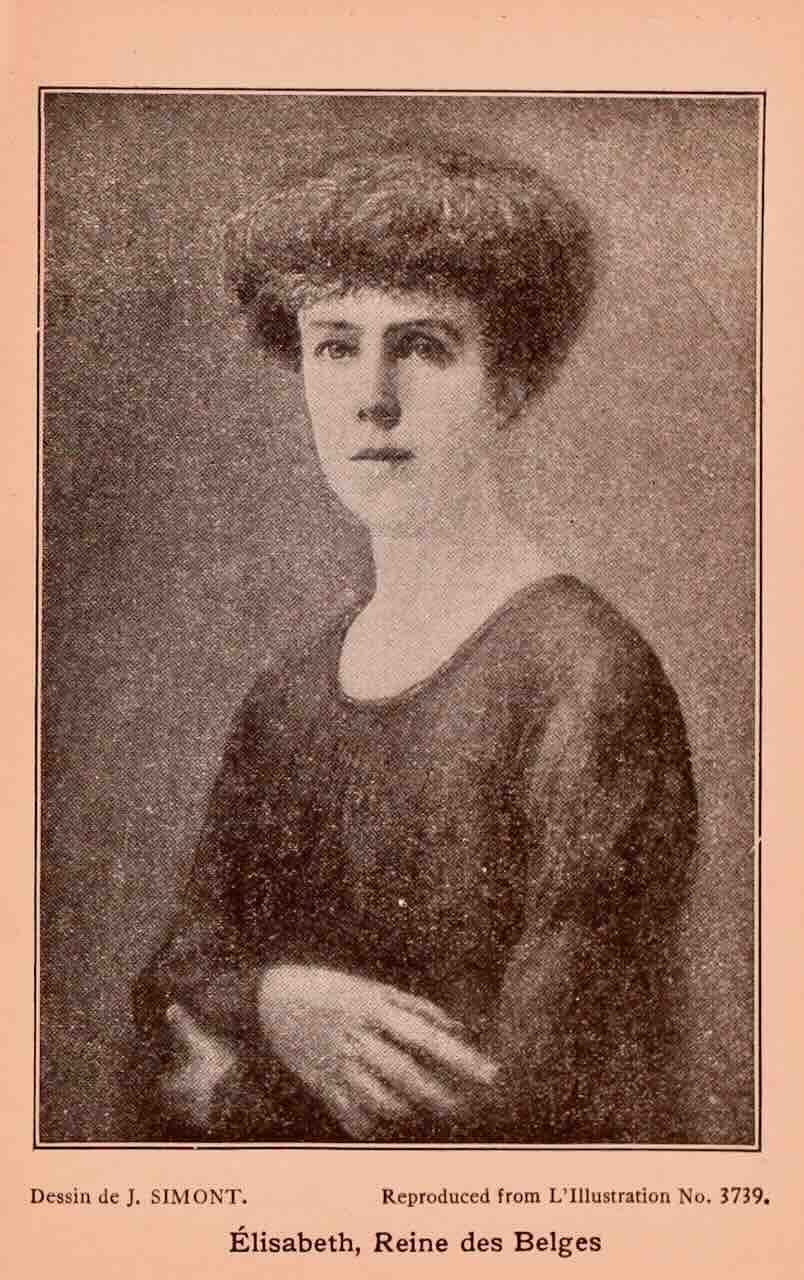
Koningin Elisabeth en Henriëtte, prinses van België, waren de beschermvrouwen van The Woman’s Section. Op welke manier zijn de Belgische koninklijke hoogheden bij het Amerikaanse vrouwennetwerk betrokken geraakt?
‘American Woman’s Section’ wil officiële Belgische erkenning
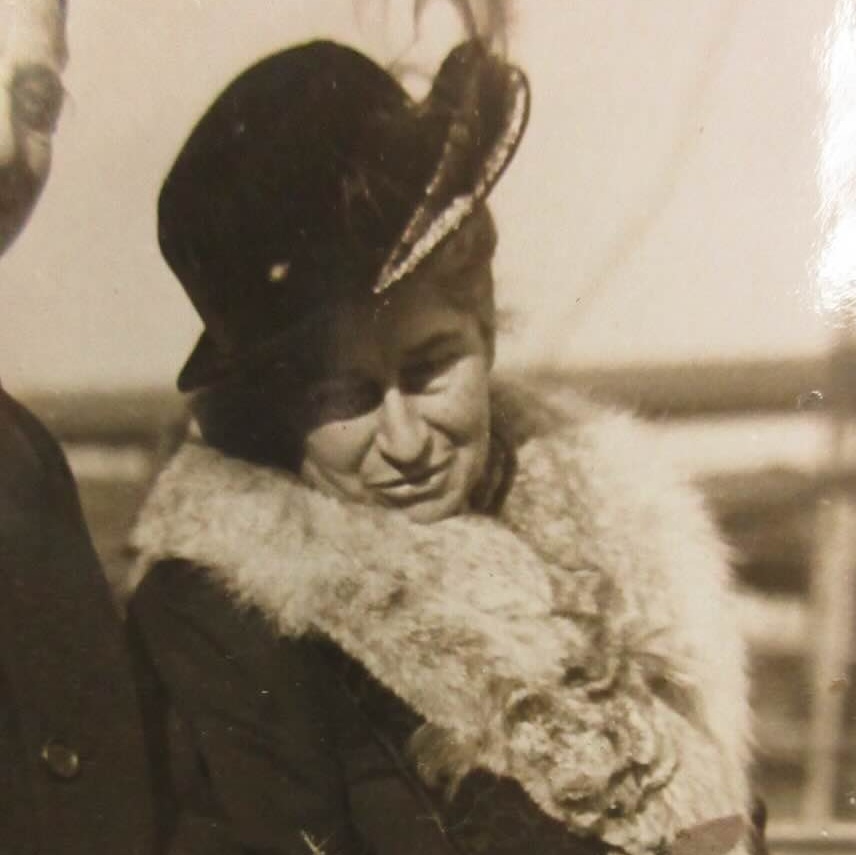
Toen Josephine Bates haar groep van vrouwen in de upper-class van New York ging formeren vond zij de dames bereid toe te treden, op voorwaarde dat er expliciete Belgische erkenning werd verkregen alvorens hun namen bekend te maken. Lindon W. Bates bracht het verzoek over aan Herbert Hoover op 5 november 1914.
‘AMERICAN WOMAN’S SECTION. Mrs.Bates is decidedly busy re the personnel of the group and ran against a snag again in the shape of a ‘sine qua non’ that there be official Belgian recognition here, before certain valuable names could be telegraphed to you. I attended a meeting of theirs, their last meeting.’ [1]
Op 8 november herhaalde Bates tweemaal zijn verzoek: ‘Publication high Belgian appreciation of women’s movement, now launched by very strong committee, would be useful.’
Vervolgens, met verwijzing naar Miss Anne Morgan die vroeg om bevestiging van de hoogst mogelijke Belgische autoriteit: ‘Confidential. Anne Morgan and other important women decide Mrs Bates should have appointment supplemented by cable confirmation highest attainable Belgian authority, direct or by positive instructions to Belgian Minister Washington.’ [2]
Het antwoord uit Londen was dat een bevredigende oplossing in het verschiet lag. ‘Expect have satisfactory solution all organization matters in few days mainly on lines your suggestion.’ [3]
Koninklijke ‘appeals’
Koningin Elisabeth en koning Albert riepen in najaar 1914 op tot voedselhulp voor de Belgische bevolking via Amerikaanse kranten en tijdschriften. Meerdere ‘appeals’ kwamen tot stand via het hoofdkantoor van de CRB in Londen, ze werden opgesteld in overleg met Amerikaanse diplomaten in Londen en Brussel en via de Ambassadeur van de VS in Groot-Brittannië aan de CRB in Londen ter hand gesteld.
Een opmerkelijke gang van zaken, omdat de Ambassadeur van België in de VS geacht zou mogen worden hier een rol in te hebben. Maar de oorlog in Europa doorbrak diplomatieke gebruiken: België was door de Duitsers bezet; de Belgische regering was zich aan het installeren in Le Havre, Frankrijk; koning Albert en koningin Elisabeth verbleven achter het front in De Panne, België; vanuit Londen werd rechtstreeks met het Belgische hof gecommuniceerd ten behoeve van berichten voor de VS.
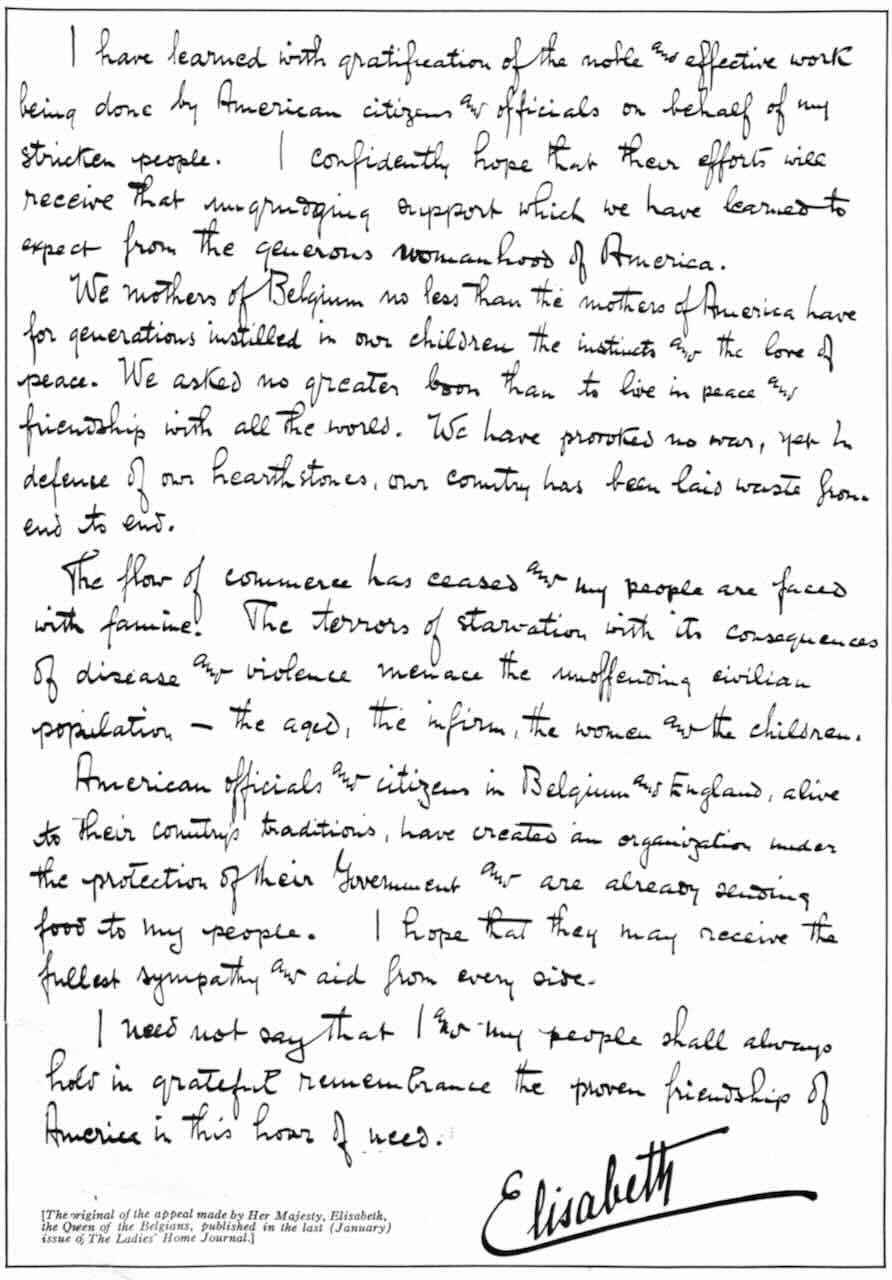
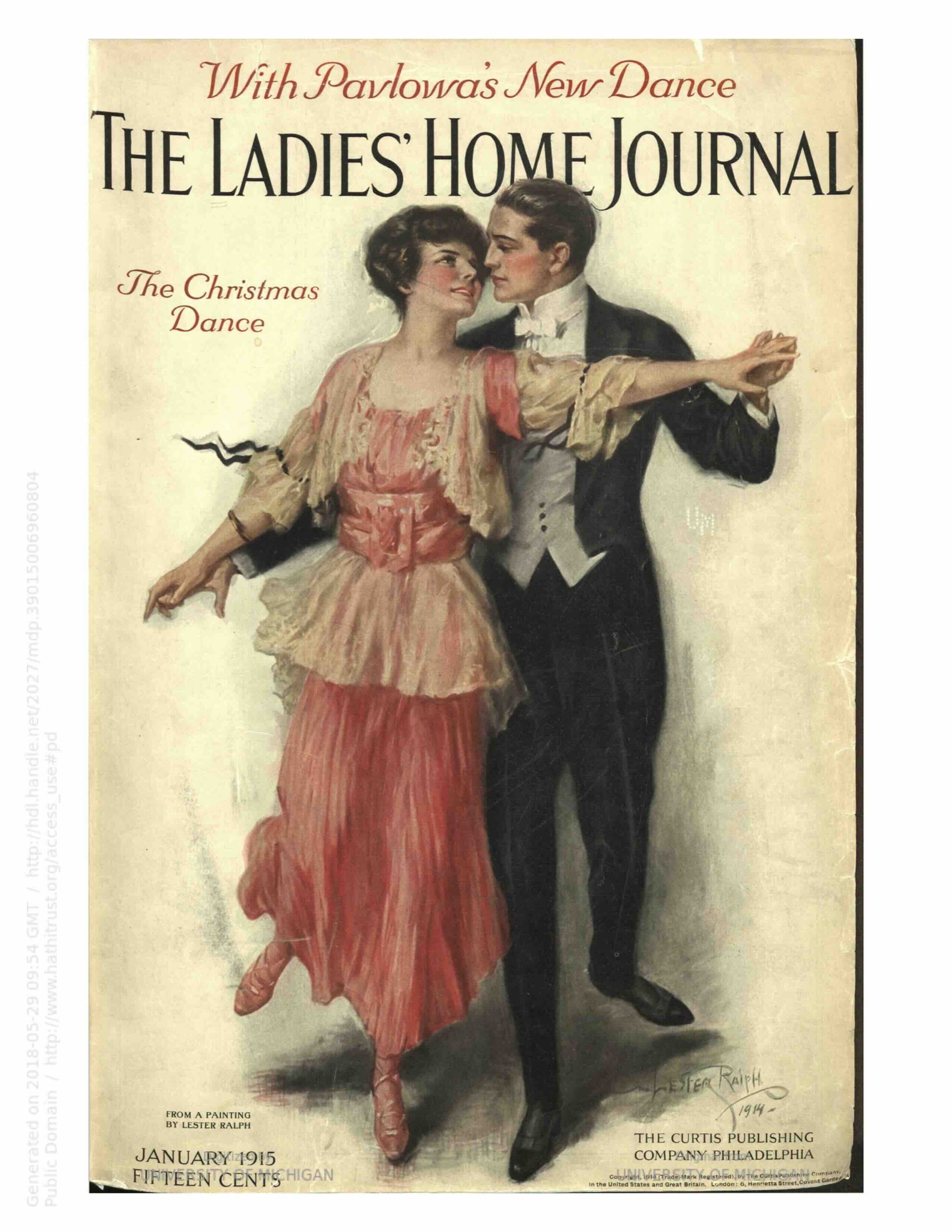
Ladies Home Journal en de oproep van koningin Elisabeth
Op 10 november ontving Lindon Bates bericht van Hoover, dat hij zèlf enkele weken eerder voor de Belgische koningin een oproep tot hulp had opgesteld die inmiddels door haar was ondertekend. De oproep van de koningin was bestemd voor het Amerikaanse tijdschrift Ladies Home Journal, van wie de hoofdredacteur had toegezegd de CRB in Londen te willen ondersteunen. Hoover vond het bezwaarlijk opnieuw de koningin te benaderen, dus stelde voor dat er vanuit New York contact zou zijn met Bek om de oproep van de koningin ter beschikking te stellen van de Woman’s Section.
‘About three weeks ago Bek, Ladies Home Journal, asked Page secure for him an appeal signed by Queen Belgium. I wrote the document and Queen signed, Bek agreeing raise funds for our Commission. The wording this letter exactly fits the Women’s division. Bek proposed produce in December number. Do not know how to get it out of his hands now, but seems to me Bok should be willing adapt his fund and appeal to Womens division, this document then constituting their Charter. I find it embarrassing get the same substance again from this quarter….’ [4] Josephine Bates reageerde met: ‘Shall try adjust Bok situation’. [5]
Het dagboek van Hugh Gibson
Een reconstructie, gemaakt op basis van het dagboek van Hugh Gibson, secretaris van de Amerikaanse ambassade in Brussel, laat zien hoe de oproep van koningin Elisabeth voor The Ladies Home Journal tot stand kwam. [6]
24 oktober 1914 in Londen
Another strenuous day on the food question and other things. My plans were to leave for Brussels on Monday morning, but in the evening the Ambassador (Page) sent for me and it was decided that I should go to Havre and from there to see the King and Queen.
26 oktober 1914 Le Havre – 28-29 oktober Duinkerken – De Panne
I had just got inside when the door opened and the King came in. He had heard that I was coming to see the Queen. And had motored down from Furness. (…)
I suggested to him that it would probably help our committee in raising funds if he would write an appeal for help from America. He fell in with the idea at once, and together we got out an appeal that is to be sent across the water. Just as we were finishing, the Queen came and bade us in to tea. …. I suggested to the Queen that she, too, make an appeal to the women of America, to which she agreed. Another appeal was prepared for her, and it, too, will be sent to America by the first post.
2 november 1914 Londen the Embassy
I got off some telegrams about my trip, and was told the Ambassador (Page) wanted to see me. Hoover was with him, and I turned over to them the appeals from the King and Queen.
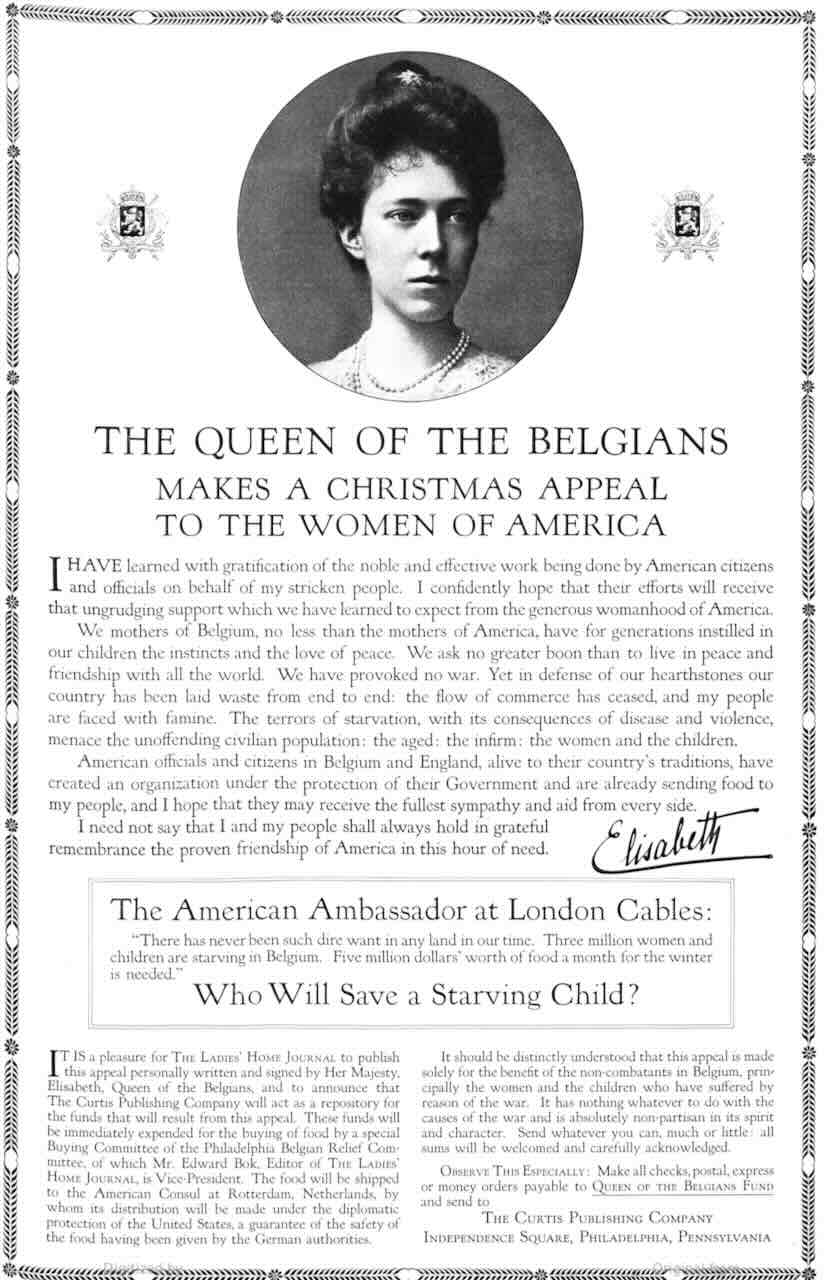
Niet in december 1914, maar in het nummer van januari 1915 van Ladies Home Journal verscheen de oproep van koningin Elisabeth.
Madame H.- en Madame Vandervelde – an awkward, stupid situation
De eerste officiële oproep tot hulp voor België van de Woman’s Section op 16 november 1914 benoemde geen Belgische erkenning of Belgische autoriteit. [7] Josephine Bates was er kennelijk niet in geslaagd met de heer Bok tot overeenstemming te komen. Maar ze had dus ook geen alternatief gevonden.
Josephine Bates zou later uitleg geven waarom. Ze had in een vroeg stadium mevrouw Havenith, de vrouw van de Belgische ambassadeur gevraagd als beschermvrouwe, vervolgens ook Madame Vandervelde, maar het gaf onoverkomelijke problemen.
‘At the request of my Committee, I very early asked the wife of the Belgian minister to be one of our two Honorary Patronesses. The Minister declined to recognize any appointment of the American Commission (…) having still much pressure from my own Committee, I sat down and in the name of the Woman’s Section, myself wrote to Madame H.-in Washington, asking her to accept a place as Honorary Patroness of the Movement.
(…)

Mr. De Forest (vice-president of the Belgian Relief Fund) requested, however as a personal favor to them, that we extend to Madame Vandervelde the privilege of acting as one of our two patronesses. In deference to the De Forest Committee, we agreed to do this, and in the name of the Woman’s Section, I sent a letter at once – Mr. De Forest himself directing and sending it on. (…)
The days have passed and we are now at the 28th (November). Neither letter acknowledged by either party. Finally, two days ago, I received from Madame Vandervelde a letter saying that so very many Belgian committees had wished the use of her name, she had been obliged to allow the use of it to none. This eliminated her.
(…) last night after all the waiting, I had from Madame H— an acceptance as patroness to the Woman’s Section.
Since our literature is all out, our letter-heads and our appeals, it makes an awkward, stupid situation. I am the more reluctant to incorporate her name since we have had our exchange of cables in relation to a royal patroness. I am awaiting a reply from your side and then I will have to submit to my Committee the whole subject. If it were of my own deciding, it would be settled very rapidly!!![8]
Bloemrijke tekst van Josephine Bates – ‘American sisters’
In de laatste alinea van haar brief noemt Josephine Bates een telegramuitwisseling tussen haar en Herbert Hoover over een koninklijke beschermvrouwe. Een dag eerder heeft ze hem suggesties gestuurd hoe CRB Londen de koningin en prinses kon laten antwoorden op de uitnodiging beschermvrouwe van The Woman’s Section te worden.
In bloemrijke woorden waarin haar schrijverschap te herkennen is, benadrukte Josephine Bates het zusterschap tussen de Belgische en Amerikaanse vrouwen. ‘Reply anything worthy of the National need, suggest somewhat as follows, begins “From the trenches of the Yser from its flooded verge, this narrow strip of Belgium still held free for the womanhood of all our country, however mute, we send tender greetings, with the woman’s section and the leaders of the great organisations supporting it we stand gladly for our people. As woman, mother and their Queen, we who were about to die, salute our American sisters, praying as we go into deepening valleys of travail to match with enduring bravery the sympathy and loving kindness from over-seas.” ‘ [9]
CRB-Londen retoriek: van ‘diepe dankbaarheid’ tot ‘extreme ellende’

Josephine Bates’ woorden over het zusterschap zijn ver te zoeken in de uiteindelijke acceptatie van de koningin en de prinses.
De mannen van het CRB-hoofdkantoor in Londen stelden de teksten op die ze nodig hadden voor hun onderneming. Optreden namens ‘het Belgische volk’ vroeg om een stevige retoriek: de nadruk moest liggen op diepe blijken van dankbaarheid gevolgd door kreten om hulp.
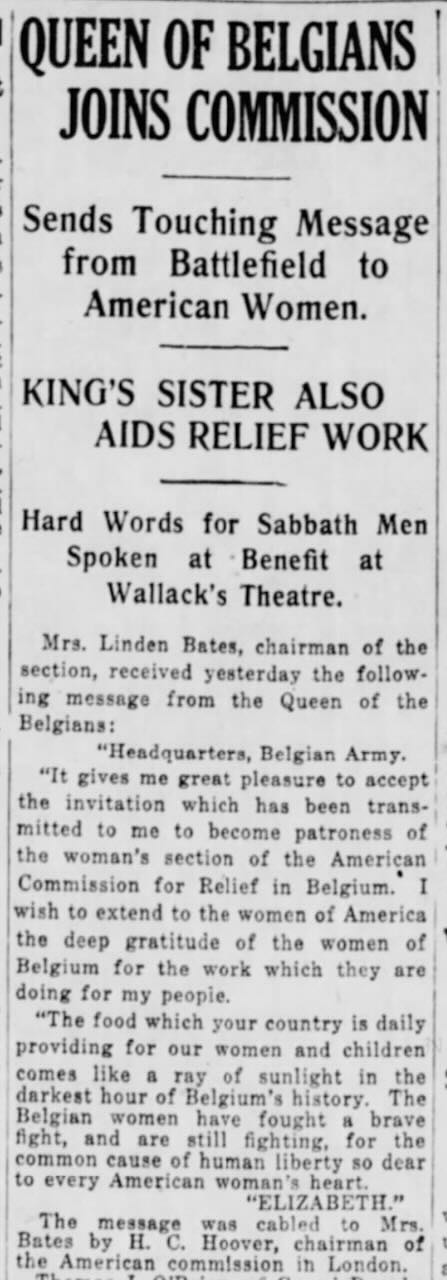
Koningin Elisabeth vanuit ‘het Belgische Militaire Hoofdkwartier’ volgde de opzet van het CRB-hoofdkantoor en ondertekende. Henriette, de prinses van België, evenzo. Josephine Bates ontving het telegram van Herbert Hoover op 7 december. Het leidde tot een intrigerend opportunistische krantenkop in New York: ‘Koningin van België treedt toe tot de Commissie‘ en ‘Stuurt Ontroerende Boodschap vanaf Oorlogsslagveld naar Amerikaanse vrouwen’.
The Woman’s Section in New York publiceerde de koninklijke berichten in folders die ze uitstuurde in december 1914. ‘These messages, welling out of agonized hearts were so profoundly pitiful and appealing that they told as nothing else could, the extremity of sorrow and suffering in Belgium’. [10]
Conclusie
Josephine White Bates is er in geslaagd de Woman’s Section of the American Commission for Relief in Belgium in New York te vestigen.
Het vinden van erkenning voor haar comité onder Belgische gezagdragers in de VS slaagde niet.
In plaats daarvan werden koningin Elisabeth en Henriette, de prinses van België, vanuit CRB-Londen in Europa aangezocht tot beschermvrouwen van The Woman’s Section. Het stelde het CRB-hoofdkantoor in Londen in de gelegenheid de Belgische koninklijke hoogheden de retoriek van de CRB-leiding in Europa te uiten tot het Amerikaanse volk: de boodschap van diepe dankbaarheid en extreme ellende.
Voetnoten:
[1] 5 november 1914 CRB Records Box 5 HILA-album Lindon Bates correspondence)
[2] 8 november 1914 CRB Records Box 5, HILA
[3] Telegram H. Hoover aan L. Bates, 9 november 1914 CRB Records Box 5, HILA
[4] 10 november 1914, CRB Records 22003 box 114 HILA
[5] received 12 november 1914, CRB Records 22003 box 114 HILA
[6] Gibson, Hugh, A Journal from our Legation in Belgium. Toronto: William Briggs. Garden City, N.Y.: The Country Life Press, 1917., p. 284-297.
[7] 16 november 1914
[8] Brief Josephine Bates aan Herbert Hoover, 28 november 1914, LHH Papers Box 82 HHPLM
[9] 27 november 1914 CRB Records 22003 box 114 HILA
[10] History of The Woman’s Section of the Commission for Relief in Belgium, February 26, 1915, p.15